Showing posts with label processors. Show all posts

12.14.2022

Arm stopped selling licenses to Chinese companies for advanced processor architectures

Arm stopped selling licenses to Chinese companies for advanced processor architectures

Arm stopped selling licenses to Chinese companies for advanced processor architectures

Chinese processor developers are making serious bets on Arm and RISC architectures, since access to them has so far not been restricted by political opponents.
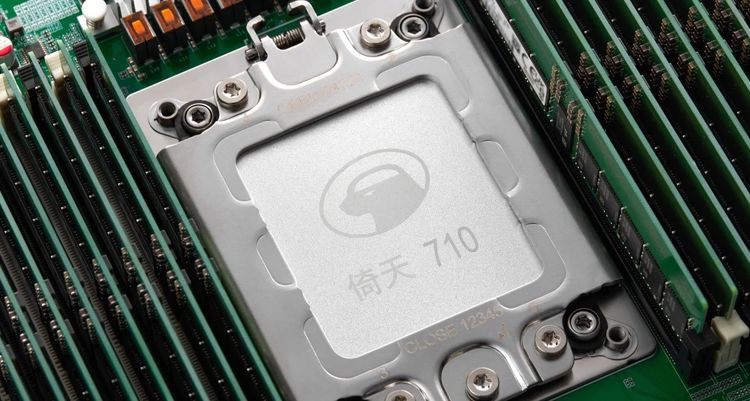
But now Arm has refused to export Neoverse V architecture licenses to China and this could become a nasty precedent, limiting the pace of development of China's national semiconductor industry.Image source: AlibabaBritish Arm holding, as the Financial Times reports, has determined that Chinese customers cannot buy licenses to use Neoverse V processor architectures because they allow processors to be built at performance levels that exceed the values allowed by US export rules.
The Neoverse V architecture includes elements developed in the United States, so British Arm has to negotiate the nuances of exporting the relevant technology with overseas officials.
As expected, the Chinese giant Alibaba as a result of such restrictions may face the inability to use the Neoverse V1 or V2 architecture in its processors.
In this case, the Chinese partners of Arm will be available architecture series Neoverse N2, which has a lower speed.This situation resonates with the restrictions, which have already faced NVIDIA, which lost the right to supply after the fall of next year, gas pedals generation calculations Ampere and Hopper with a certain level of performance.
The supplier was quick to react and started offering Chinese customers special A800 gas pedals, whose performance avoided the sanctions restrictions by a margin.
Arm's Chinese customers found themselves in a similar situation.
The same company, Alibaba, expected to buy a license from Arm to use the Neoverse V1 architecture to develop processors used in cloud systems.
Competitor Amazon Web Services in the U.S.
already uses the architecture of this series to create specialized processors used in its own infrastructure.
Alibaba representatives, on condition of anonymity, expressed dissatisfaction with Arm's behavior, stating its reluctance to sell technology to China even if such deals are adequately funded.

11.29.2022

Intel hasn't enabled DLVR for power efficiency on Raptor Lake, but it could work on future CPUs

Intel hasn't enabled DLVR for power efficiency on Raptor Lake, but it could work on future CPUs

Intel hasn't enabled DLVR for power efficiency on Raptor Lake, but it could work on future CPUs

Rumors that Raptor Lake processors should get new DLVR technology have been circulating since March last year, but nothing was known about it at the time.
Some time later, Intel registered a patent, which described the purpose of DLVR.
As it turned out, we are talking about Digital Linear Voltage Regulator (DLVR), a new mechanism that improves the energy efficiency of processors.Image source: VideoCardzThe document explained that the digital linear voltage regulator in Intel processors works in parallel with the main one, which is installed on the motherboard.
DLVR can reduce the voltage of the processor and thus reduce power consumption by 20-25%.
At the same time, a 21% reduction in power consumption allows for up to a 7% increase in performance.Image source: VideoCardzAs you know, some of the Intel Core 13th generation processors are already on sale.
However, there is no sign of DLVR technology in them.
Intel hasn't said anything publicly about the new feature either.
However, traces of DLVR were found in fresh versions of ASUS mainboards BIOS for new processors.
It is called CPU DLVR Bypass Mode Enable.
In this case the function itself does not work.
Turning it on or off has no effect.Image source: VideoCardzThe ASUS company's in-house overclocker, a.k.a.
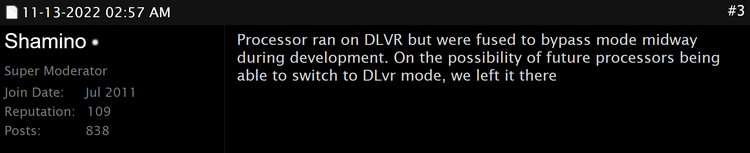
Shamino, has said that the DLVR function is indeed supported on the company's latest motherboards, but Intel has disabled it on Raptor Lake CPUs themselves.
He also added that there is a possibility that future Intel chips will support it.Image source: ASUS ROG ForumsThe wording \"future processors\" draws attention.
The Raptor Lake chips are expected to be the last for Intel's LGA 1700 platform.
Expected after Raptor Lake processors Meteor Lake series will almost certainly require a new processor socket.
On the other hand, rumors that Intel is allegedly working on updated Raptor Lake Refresh chips are starting to appear in the web.
Presumably, they will be able to offer up to 20% lower power consumption compared to the current Raptor Lake models due to the DLVR function.

Leaked - Prices for select 6GHz Core i9-13900KS have been revealed

Leaked - Prices for select 6GHz Core i9-13900KS have been revealed

Leaked - Prices for select 6GHz Core i9-13900KS have been revealed

Canadian retailer PC-Canada has declassified ten planned Intel processors that will expand the Raptor Lake series.
Most of them are Core i9, Core i7 and Core i5 models without a \"K\" in the name, which have a reduced to 65W TDP rating.
However, the list also includes the flagship Core i9-13900KS model.Image source: IntelThe seller has indicated the price of the expected new products.
If converted to U.S.
dollars, prices are as follows:Core i9-13900KS: 24 cores, 32 threads, n/a-6.0 GHz - $725;Core i9-13900: 24 cores, 32 threads, 2.0-5.6 GHz - $615;Core i9-13900F: 24 cores, 32 threads, 2.0-5.6 GHz - $585;Core i7-13700: 16 cores, 24 threads, 2.1-5.2 GHz - $415;Core i7-13700F: 16 cores, 24 threads, 2.1-5.2 GHz - $390;Core i5-13500: 14 cores, 20 threads, 2.5-4.8 GHz - $258;Core i5-13400: 10 cores, 16 threads, 2.5-4.6 GHz - $245;Core i5-13400F: 10 cores, 16 threads, 2.5-4.6 GHz - $218;Core i3-13100: 4 cores, 8 threads, 3.4-4.5 GHz - $155;Core i3-13100F: 4 cores, 8 threads, 3.4-4.5 GHz - $125.
All new products should debut in January next year.
They will compete with processors Ryzen 7000.
And, apparently, Intel will have a significant advantage over the competitor for some time in the number of models and, accordingly, more flexible pricing.
Image source: PC-CanadaAs for the Core i9-13900KS: this 24-core, 32-core processor will be able to automatically overclock multiple cores to 6.0 GHz.
Based on the prices published by the Canadian retailer, the novelty will be about a third more expensive than the Core i9-13900K model offered in the same store.The official premiere of the remaining Intel Raptor Lake series processors is expected at the international electronics show CES 2023 in early January.
They will debut at the same time as motherboards on the Intel B760 chipset.
Like the older models, they will also be compatible with Intel's 600-series motherboards for Alder Lake processors.

11.22.2022

AMD has reduced prices on Ryzen 7000 processors in Europe, they also became cheaper in Russia

AMD has reduced prices on Ryzen 7000 processors in Europe, they also became cheaper in Russia

AMD has reduced prices on Ryzen 7000 processors in Europe, they also became cheaper in Russia

AMD has reduced prices on the latest Ryzen 7000 desktop processors in Europe.
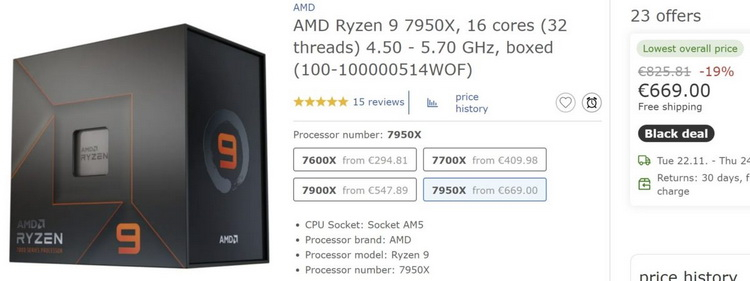
According to VideoCardz, several European stores have discounted some chips with Zen 4 architecture to more than €180.Image source: AMDThe 16-core Ryzen 9 7950X, released less than two months ago, now sells for €699 instead of €849 euros.
The 12-core Ryzen 9 7900X has dropped to €550 from its starting price of €699, and the eight-core Ryzen 7 7700X is now offered for €410 instead of €479.
The youngest in the series, the six-core Ryzen 5 7600X is available for €300 instead of €359.AMD Ryzen 9 7950X price in Europe.
Image source: Check24 Image source: GeizhalsIt is curious that the Ryzen 7000 chips have also gone down in price on the Russian market.
However, since the processors in Russia are supplied by parallel imports, it is likely to be a difference in exchange rates, rather than the desire of AMD to make their new products more accessible to the Russian buyer.
Source image: \"Citilink \"So, in \"Citilink\" the cost of the boxed version of the 12-core Ryzen 9 7900X fell from 56,990 to 50,990 rubles.
The eight-core Ryzen 77700X is offered for 38,990 instead of 45,590 rubles.
And the junior six-core Ryzen 5 7600X model can be purchased for 29,390 instead of 32,590 rubles.
Only the price of the flagship Ryzen 9 7950X has not changed.
It can be purchased for 68,990 rubles.
These processors in OEM version are also available at DNS.
Only Ryzen 5 7600X model is available at OnlineTrade for now.
Some models are also available in the store \"Regard\".Updated: The German store MindFactory managed to find Ryzen 7000 processors with even more affordable prices.
For example, the flagship Ryzen 9 7950X can be ordered there for 639 euros.

11.14.2022

AMD has dramatically reduced its market share in the PC processor market, but increased it in the server segment

AMD has dramatically reduced its market share in the PC processor market, but increased it in the server segment

AMD has dramatically reduced its market share in the PC processor market, but increased it in the server segment

Continuing to battle with Intel Xeon, AMD Epyc chips have captured the competitor's share for the 14th consecutive quarter, but in the desktop and notebook processor segment, the red camp is not so lucky: Q3 has stripped the company of all the achievements of recent years, writes Computer Base.Image source: amd.com The most serious losses were in the notebook chip market.
At the end of III quarter AMD share was 15.7% - a drop of 9.1 points compared to II quarter, and a year earlier this figure was 22%.
The company's current share was last seen in late 2019, but this is clearly not the time to get excited about a return to pre-pandemic levels.
The decline in the desktop chip market is just as unpleasant - it was 6.6 p.p.
in quarterly terms, and the company's share dropped to 13.9 percent, though it was 17 percent last year.
And this is the worst value for AMD since 2018.AMD continues to show positive dynamics in the server segment: during the quarter, the company's share increased by 3.6 p.p.
to 17.5%, while a year earlier it was only 10.2%.
The performance advantage continues to bear fruit: even if the recently introduced Genoa family processors had not come out by the end of the quarter, the company would have continued to build share with Milan, as Sapphire Rapids will definitely not come out this year.On average selling price (ASP) AMD gained 8 p.p.
for the year, while Intel lost 12.
Finally, the Reds once again have the console chip segment to thank: PlayStation and Xbox are flying in the millions, and sales continue to grow compared to last year.
As a result, AMD sells more console chips than notebook, desktop and server processors combined.

11.11.2022

AMD introduced EPYC 9004 (Genoa) server processors - up to 96 Zen 4 cores, DDR5 and PCIe 5.0 support

AMD introduced EPYC 9004 (Genoa) server processors - up to 96 Zen 4 cores, DDR5 and PCIe 5.0 support

AMD introduced EPYC 9004 (Genoa) server processors - up to 96 Zen 4 cores, DDR5 and PCIe 5.0 support

AMD has officially introduced EPYC 9004 series processors codenamed Genoa for servers and data centers.
They feature up to 96 high-performance cores on the Zen 4 architecture.
According to AMD head Lisa Su (Lisa Su), the number of transistors in chips Genoa is 90 billion, AMD itself describes new products as processors with unsurpassed performance, advanced energy efficiency and next-generation architecture.Image source: AMDThe Genoa processors include twelve 5-nm chipset CCD with compute cores and one 6-nm chip with I / O interfaces.
Each processor core has 1MB of L2 cache memory, twice as much as the previous generation EPYC chips on the Zen 3 architecture.
There is also 32 Mbytes of Layer 3 cache per CCD chip.
The new Genoa EPYCs support up to 6 TB of 12-channel DDR5-4800 RAM, 128 lanes of PCIe 5.0 interface.
Although with the latter AMD is undecided, as during the presentation figure of 160 lines sounded.
In addition, support for CXL 1.1 and partly CXL 2.0 is claimed for the processors, which provides significant memory expansion capabilities for data center applications.
Note here that AMD has changed CPU socket for server chips: SP3 is replaced by SP5.
AMD claims EPYC Genoa has 14% more instructions per clock (IPC) than last generation solutions at the same TDP.
At the same time the performance of new chips per watt of power consumption in some tasks increased by up to 2.7 times compared to predecessors based on Zen 3.
Support for new instructions, such as AVX-512, is also noted.
In cloud computing tasks the performance of new chips is up to three times faster than competitors.
And in a direct comparison of the performance per core, EPYC Genoa are up to 55% faster than Intel Xeon processors.
Although the question is about 3rd generation Xeon Scalable, which is now the actual Intel's - presented yesterday Xeon Max on the new architecture will be available only in January.
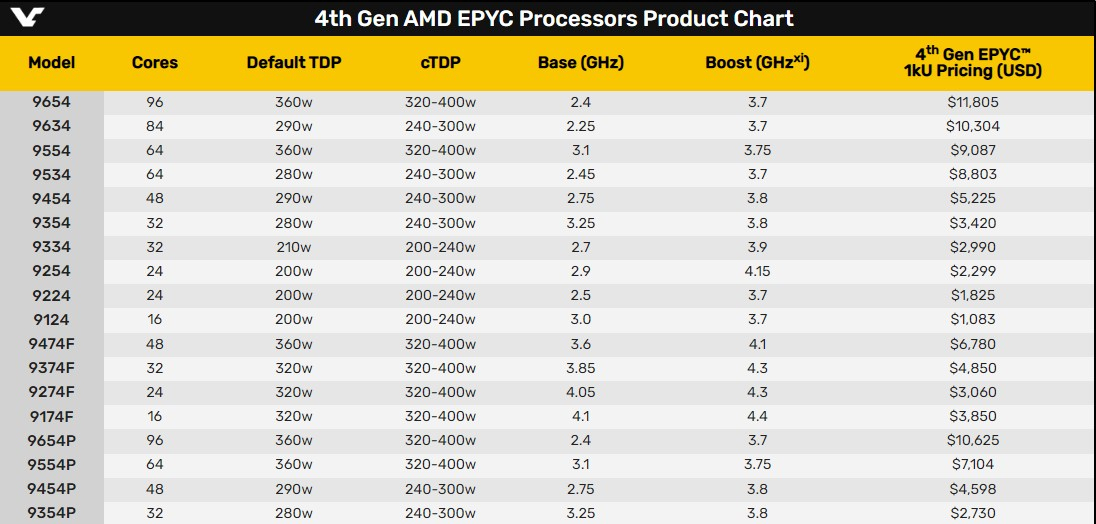
All in all AMD has presented 18 models of EPYC Genoa processors, conditionally divided into different segments for specific tasks.
For HPC and cloud segment manufacturer has provided chips with 48 to 96 cores and TDP from 280 to 360 W.
High-end models with 16 to 48 cores and TDP from 320 to 360W will be offered for corporate sector.
For small business, the company will offer 16 or 32 cores and TDP from 200W to 280W.
Source image: VideoCardzBasic clock speeds range from 2.25 to 4.1 GHz, and Boost speeds from 3.7 to 4.4 GHz.
Note that a number of models support a TDP setting of up to 400W.
As for prices, they range from $2,730 to $11,805 for a processor in a batch of 1,000 units.
As part of the presentation, AMD paid special attention to the energy efficiency of the new Genoa processors, noting the significant increase in server system maintenance costs per kilowatt of power consumed over the past year.
AMD claims EPYC Genoa-based systems will cost significantly less to maintain than systems based on competitive solutions.
AMD's chips are up to 52% more energy efficient than its competitors.
AMD EPYC Genoa processors will be available starting today.
The company also recalled that it plans to release cloud-optimized EPYC Bergamo processors in the first half of 2023.
These processors will get up to 128 cores (and 256 threads), as promised earlier, keeping compatibility with the SP5 socket.
EPYC Genoa-X processors with additional cache will also be available in the first half of next year.
Like Milan-X, they will be oriented to a specific class of workloads, which benefit from the increased available cache size.
These are, for example, computational tasks and DBMS.
And in the second half of next year, AMD will expand its range of Zen 4 server processors with Siena chips.
They will be optimized in terms of energy efficiency and offer up to 64 cores.

11.10.2022

Intel Announces Xeon Max - World's First x86 Processors with HBM Memory

Intel Announces Xeon Max - World's First x86 Processors with HBM Memory

Intel Announces Xeon Max - World's First x86 Processors with HBM Memory

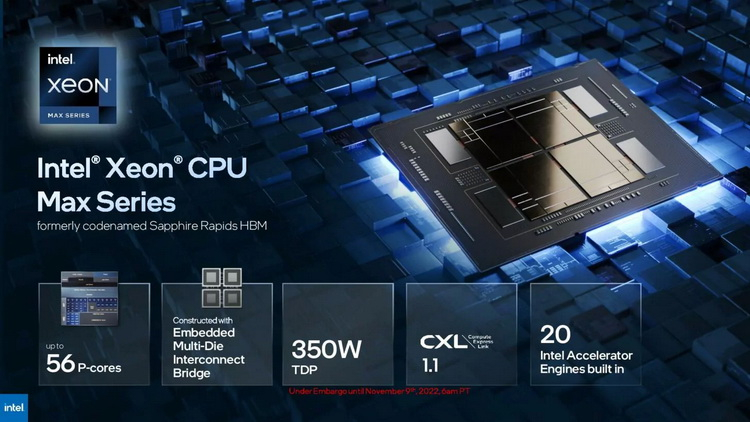
Intel has announced Xeon Max, a series of processors equipped with HBM2e high speed memory, and according to the company it is the world's first CPUs with HBM.
Previously these chips appeared under the codename Sapphire Rapids HBM.
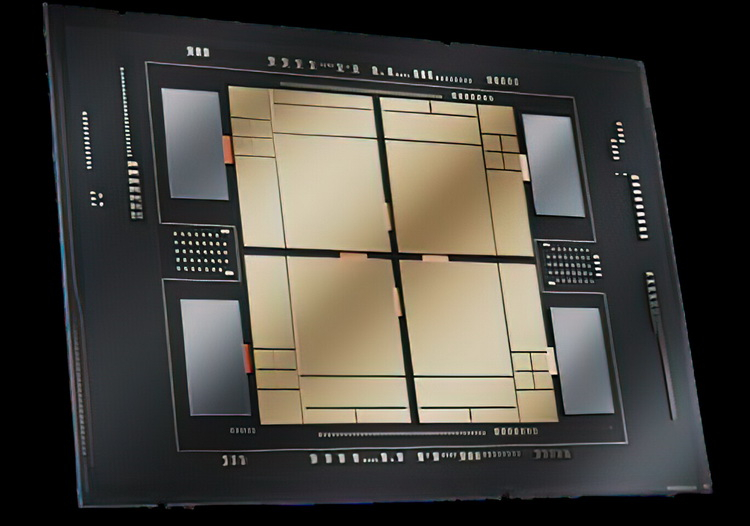
The processors offer up to 56 cores with support for 112 virtual threads and have a TDP of 350W, and they are designed for high-performance server systems.Image source: IntelThe Xeon Max processors use an EMIB interface that integrates four chips with compute cores, as well as located next to the same substrate 64 GB of high-speed HBM2e memory, split into four clusters of 16 GB each.
The total bandwidth is about 1 Tbyte/s.
So there is more than 1GB of HBM2e memory per processor core.
Key features of the Xeon Max are support for PCIe 5.0 and CXL 1.1 interfaces.
HBM2e memory can be used both as additional cache and as additional RAM.
Moreover, a server with Xeon Max can be equipped with no RAM modules at all - the system will rely solely on HBM.
The company claims that Xeon Max power consumption is 68% lower than that of AMD Milan-X processors for the same performance.
The Xeon Max's support for the new AMX instructions speeds up AI-related tasks and provides an eight-fold increase in peak performance over AVX-512 instructions in INT8 and INT32 operations.
Intel says the Xeon Max is up to five times faster in some types of operations compared to the Intel Xeon 8380 or AMD EPYC 7773X (Milan-X with 3D V-Cache technology).
The presentation also compares the Xeon Max to the AMD EPYC 7763, against which the new Intel product shows up to 3.6 times better performance.
Compared to the NVIDIA A100 server computing gas pedal in the MLPerf DeepCAM test, which deals with calculations that accelerate and augment simulations on supercomputers using AI, Xeon Max is up to 1.2 times faster than the competitor.
The Xeon Max series of server processors will hit the market in January 2023.
Key competitors to Xeon Max will be AMD's new EPYC Genoa processors.
Their announcement is expected tomorrow, November 10.
According to rumors, these processors will be available as solutions equipped with HBM memory.

11.03.2022

AMD has cut prices on Ryzen 5000 - "best gaming processor" Ryzen 7 5800X3D now costs $329

AMD has cut prices on Ryzen 5000 - "best gaming processor" Ryzen 7 5800X3D now costs $329

AMD has cut prices on Ryzen 5000

AMD has cut prices on desktop Ryzen 5000 processors on Zen 3 architecture in its official online store.

    Portal VideoCardz notes that the price of individual models has dropped by $250.


    The flagship 16-core Ryzen 9 5950X model was offered for $799 at the start of sales.Now the price of this processor is $549.


    The twelve-core Ryzen 9 5900X has dropped in price by $200, and is now offered for $349 instead of the original $549.


    Ryzen 7 5800X3D with increased cache memory has also dropped in price.AMD is offering it for $329 instead of the original $449.


    The Ryzen 7 5800X is down to $249 from $449, and the junior six-core Ryzen 5 5600X model is selling for $159 instead of the original $299.When you buy Ryzen 5000 series processors from the official online store, AMD is also giving away a copy of the Uncharted: Legacy of Thieves Collection game collection. 


    The listed price of the Ryzen 7 5800X3D in the U.S.is currently the lowest.It costs $369 at MicroCenter retailer, $349 at Amazon for the processor, and $331 at Newegg.However, the chip is not available in all stores.


    The price of the Ryzen 7 5800X3D has also been reduced in Europe, VideoCardz notes.If at the start of sales it was offered for 499 euros, now the processor can be purchased for 349 euros.

11.02.2022

Intel will finally release Sapphire Rapids server processors in January - their release has been delayed since 2021

Intel will finally release Sapphire Rapids server processors in January - their release has been delayed since 2021

Intel will finally release Sapphire Rapids server processors in January - their release has been delayed since 2021

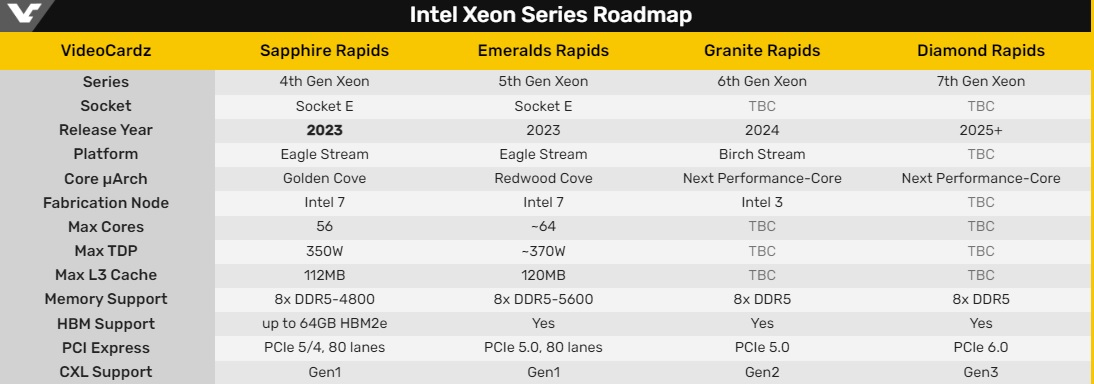
Intel has set a release date for its 4th generation Xeon Scalable server processors, better known by their codename Sapphire Rapids.
The company will release chips based on the new Intel 7 manufacturing process technology, scheduled for January 10 next year.Image source: IntelIntel said it is ready to present solutions that \"meet the requirements for the product being released.\" This wording could mean that not all Sapphire Rapids processor models planned for release will be released at the same time.
This will apply only to those models that have passed all necessary tests and are ready for mass production.
Earlier it was reported that during the development of processors Sapphire Rapids since the announcement the company had to fix about 500 bugs, as well as release 12 different stepping chips - from A0 to E5.As it became known from a recent report of the analyst company TrenForce, the reason for the continued postponed release of Sapphire Rapids is a significant amount of manufacturing defects.
In particular, Intel has faced with a low yield of good chips in the mass production chipsets MCC processors Sapphire Rapids.
These chipsets are produced using the Intel 7 process technology.
The number of quality chips is only 50-60% of the total production volume.
In such circumstances, the transition to mass production of Sapphire Rapids seemed to the company economically impractical, so the manufacturer is trying to eliminate the problem.
Source image: VideoCardzThe Intel Sapphire Rapids processors are designed for Eagle Stream platform, which is announced to support PCIe 5.0 interface and DDR5 RAM.
The platform will also be used by 5th generation Xeon Scalable processors, code-named Emerald Rapids, which are also expected to launch next year.
Sapphire Rapids processors will offer up to 56 processing cores on Golden Cove architecture.

Intel faces high defect rate in production of Sapphire Rapids server chips

Intel faces high defect rate in production of Sapphire Rapids server chips

Intel faces high defect rate in production of Sapphire Rapids server chips

Release of new Intel Sapphire Rapids server processors on the new Intel 7 process technology has been postponed several times already.
According to the last plan, the manufacturer was going to start mass production in the fourth quarter of this year.
However, in a recent report TrendForce analysts said that the company will move the start of mass production of Sapphire Rapids in the first quarter of 2023.Image source: IntelThe reason for the transfer of experts call the significant amount of manufacturing defects.
In particular, Intel has faced with a low yield of good chips in the mass production of chipsets MCC processors Sapphire Rapids.
These chipsets are produced using the Intel 7 process technology.
It is reported that the number of quality MCC chiplets is only 50-60% of the total production volume.
In such circumstances, the transition to mass production of Sapphire Rapids does not look economically viable, so the manufacturer will try to eliminate the problem.
Delayed mass production of server processors Sapphire Rapids will force the OEMs of server equipment and cloud computing providers to delay the launch of new projects based on them, experts say.
AMD could take advantage of the situation.
As pointed out by TrendForce, its share of the server market in 2023 could grow from 15% to 22%.
Given the fact that AMD supplies the server chips, which have a large number of cores, many companies may choose them as a basis for their solutions.
The TrendForce report also points out that due to rising costs of operating the server equipment, amid rising global energy prices, more companies choose to use single-processor server platforms.
At the same time, Intel and its company Altera had problems with the supply of entry-level FPGA, which are used in motherboards with multiple sockets, as a result of the shortage led to a reduction in the supply of dual-processor systems.
As an alternative, manufacturers are looking toward CPLDs from Lattice, but it too is currently in short supply.This is why cloud server holders and server OEMs have increased their interest in AMD's solutions, which have proven to be easier and simultaneously cheaper to use.
According to TrendForce, by the fourth quarter of 2023, AMD will increase the share of its processors in the global market to 25%.

10.31.2022

Intel says it's already winning back its position in the PC market from AMD and isn't going to stop

Intel says it's already winning back its position in the PC market from AMD and isn't going to stop

Intel says it's already winning back its position in the PC market from AMD and isn't going to stop

Intel management at its quarterly reporting event began by saying that revenue in the customer area, while down 17% year over year, has consistently grown by 6%.
The sales structure of Intel components in this sector changed so that the average selling price increased.
The company was able to strengthen its position in the customer segment, and the Intel management is full of confidence that it will be able to do so in the future.Image source: Intel CEO Patrick Gelsinger even let it slip that in the third quarter Intel stepped up work with those of its customers who were willing to accelerate the purchase of the product in light of the upcoming price hikes in the fourth quarter.
According to the company's management, this led to the strengthening of Intel's position in the client segment in the third quarter.
At the same time, revenue in the segment as a whole fell by 17% year-on-year due to the majority of customers having excess products in stock.If we consider revenue from products for the desktop segment, in the third quarter, Intel's revenue increased by 3.3% year-on-year to $3.22 billion, which for the declining market as a whole is not so bad.
In the notebook segment, revenue for the year was down 25.8% to $4.4 billion.
As Patrick Gelsinger pointed out, in the PC segment the company has \"fundamentally increased its market share\", and its existing product lines in terms of competitive positioning are very strong.Intel management is not confused by the possibility of a decline in PC sales in the global market to levels below those seen before the pandemic, although they are convinced that this will not happen at all.
It's just that so many computers were sold during the pandemic that if they have to be replaced sooner or later with new ones, Intel will definitely get its piece of the pie.
According to Gelsinger, Intel's product line is positioned in such a way that it can expect to further increase its market share.
Moreover, the sagging demand is more pronounced in the segment of low-cost PCs, and Intel is now focusing on more expensive offerings.As the head of Intel added, Alder Lake and Raptor Lake processors are showing impressive performance, and preparations for the Meteor Lake release next year are in full swing.
The recently unveiled Raptor Lake processors do show superiority over existing AMD solutions in terms of performance, according to independent tests.
At the same time, Intel products also turn out to be cheaper, so it is easy to explain the confidence of the company's management in the revenge on the consumer market.

Intel 20A process will be used primarily for its own needs

Intel 20A process will be used primarily for its own needs

Intel 20A process will be used primarily for its own needs

Describing the current state of adoption of new process technologies, Intel management avoided making any new ambitious statements at its quarterly report conference, merely mentioning that it continues to believe in its ability to regain technological leadership by 2025.
It was also said that Intel 18A process will be more suitable for the needs of third-party customers, while the previous Intel 20A process will be mainly used by the company itself.Image source: IntelIn the next few years Intel will have to reduce costs by $8-10 billion a year, CFO David Zinsner was forced to clarify that the amount of investment in product development and adoption of new technologies will be affected to a minimum.
In fact, over the next couple of years, the share of capital costs will reach 35% of revenues, before dropping to the more familiar 25%.The Intel 20A technology will use a new RibbonFET transistor structure, and in this regard, the company expects to maintain its status as an innovator in the semiconductor industry, as CEO Patrick Gelsinger made clear.
The Intel 20A process is on track to be adopted, and the company's CEO believes it will be used primarily for its own needs.
After transitioning to Intel 18A by the middle of the decade, the number of third-party customers interested in using this new lithography step will significantly increase.As Gelsinger stressed, a digital project on the Intel 18A process for a large external customer has already been completed, and the first workable prototypes are available.
According to early statements from Intel, it is a product for the needs of the U.S.
Department of Defense, which will be produced at the under-construction facility in Ohio.
In addition, the company already has test samples for its own needs, manufactured using Intel 18A technology.
In the future, several more Intel customers will receive test chips produced using this process.
According to Gelsinger, based on the results of tests of these samples, they will be able to decide on the advisability of mass production by Intel.

AMD will release 10-core Ryzen 7 7800X and 4-core Ryzen 3 7300X - new products have made a mark in Geekbench test

AMD will release 10-core Ryzen 7 7800X and 4-core Ryzen 3 7300X - new products have made a mark in Geekbench test

AMD will release 10-core Ryzen 7 7800X and 4-core Ryzen 3 7300X - new products have made a mark in Geekbench test

The Ryzen 7000 processor family should be updated with several new models in the foreseeable future.
Yesterday it was reported that data about Ryzen 7 7700 model appeared in Geekbench synthetic test database.
Now in the same database marked the Ryzen 7 7800X and Ryzen 3 7300X models, which are also not included in the first wave of AMD desktop processors on the architecture Zen 4.Image source: AMDThe Ryzen 7 7800X model has two more cores compared to its predecessor Ryzen 7 5800X.
Thus, the novelty could become the first AMD Ryzen desktop processor with 10 cores and 20 threads.
According to Geekbench, the chip can automatically overclock to 5.4 GHz and has 64 MB of L3 cache memory on board, which is twice as much as the Ryzen 7 7700X.
But that's not surprising, since the 10 cores are recruited using two chipsets, while the Ryzen 7 7700X has only one octa-core chip.
Image source: GeekbankshThe processor was tested on a Gigabyte Aorus B650 motherboard.
The Ryzen 7 7800X scored 2,097 points in the single-threaded performance test and 16,163 points in the multi-threaded test.
In terms of multi-threaded performance, the novelty in its current state is about 15% ahead of the Ryzen 7 7700X.Ryzen 7 7800X results.
Image source: GeekbenchThe Geekbench database also revealed information about the quad-core and eight-threaded Ryzen 3 7300X model.
According to the benchmark, this processor is able to automatically overclock up to 5.0 GHz and has 32 MB of L3 cache memory.
Image source: GeekbankshThe quad-core and octa-core Ryzen 3 7300X in the single-core test scored 1984 points, and in the multi-threaded performance test - 7682 points.
This chip is capable of delivering a clock speed of 5GHz in auto overclocking.Ryzen 3 7300X results.
Source image: GeekbenchWe should keep in mind that the Geekbench tests most likely involved engineering samples of processors, which may differ in frequency characteristics and power consumption from the final consumer versions.

AMD will unveil EPYC Genoa server processors on the evening of November 10

AMD will unveil EPYC Genoa server processors on the evening of November 10

AMD will unveil EPYC Genoa server processors on the evening of November 10

AMD will unveil next-generation EPYC server processors on the evening of November 10.
The company officially announced this on its website.
The manufacturer did not indicate which series the new chips will belong to, but it is very likely that we are talking about EPYC Genoa processors.Image source: AMDIt is currently known that EPYC Genoa processors will be able to offer up to 96 physical cores on the Zen 4 architecture with support for up to 192 virtual threads.
AMD is going to release a wide range of chips with different numbers of cores.
The minimum is unknown, so let's just note that the current EPYC Milan series includes models with the number of cores from 8 to 64.
We also know from leaks that EPYC Genoa processors will get 1 Mbyte of L2 cache per each core.
L1 cache size is 32 Kbytes for instructions and data, L3 cache size - 4 Mbytes per each core.
New processors will be launched together with new AMD Socket SP5 platform (LGA 6096).
The new processor socket will support 12-channel DDR5 RAM controller and PCIe 5.0 interface.AMD will present new EPYC processors during live broadcast starting at 20:00 PM Moscow time on November 10.
You will be able to watch it on AMD website or on official AMD YouTube channel.

Enthusiast showed how to reduce Ryzen 7000 temperature by 10 degrees without resorting to scalping

Enthusiast showed how to reduce Ryzen 7000 temperature by 10 degrees without resorting to scalping

Enthusiast showed how to reduce Ryzen 7000 temperature by 10 degrees without resorting to scalping

AMD Ryzen 7000 processors are equipped with a very thick (3.6 mm) heat spreading cover.
This is done to make the new chips compatible with older cooling systems designed for Socket AM4.
At the same time, the thicker cover makes the processors hotter because it transfers the heat from the chip to the cooling system worse.
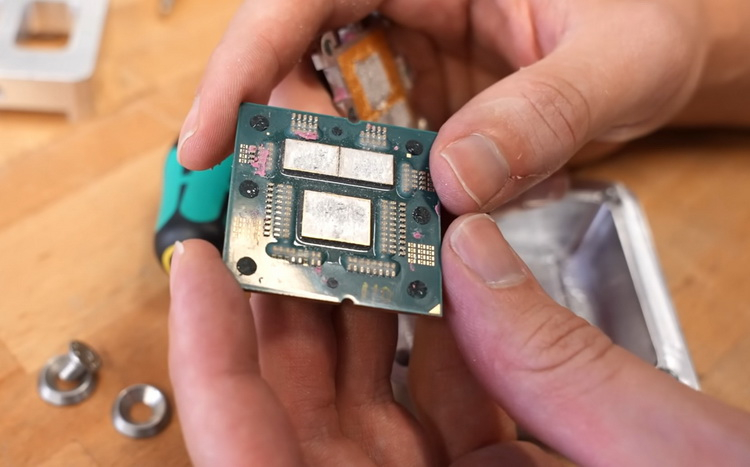
Enthusiasts are looking for different ways to solve this problem and now a relatively safe one has been proposed.Image source: YouTube / JayzTwoCentsOne of the extreme methods to combat the high operating temperature of Ryzen 7000 processors is scalping.
As experiments have shown, the method can reduce the temperature of the same Ryzen 9 7900X from 90 to 70 degrees Celsius, that is as much as 20 degrees.
However, this process is very risky because the CPU is easy to damage both when removing the cover, and when using it later in a \"naked\" form - it is not difficult to chip the crystal.
In addition, any such manipulations with processors will deprive the user of the warranty.
The popular technology blogger JayzTwoCents suggested another solution.
Scalping is not used here, but using this method will also automatically void the warranty of the chip owner.
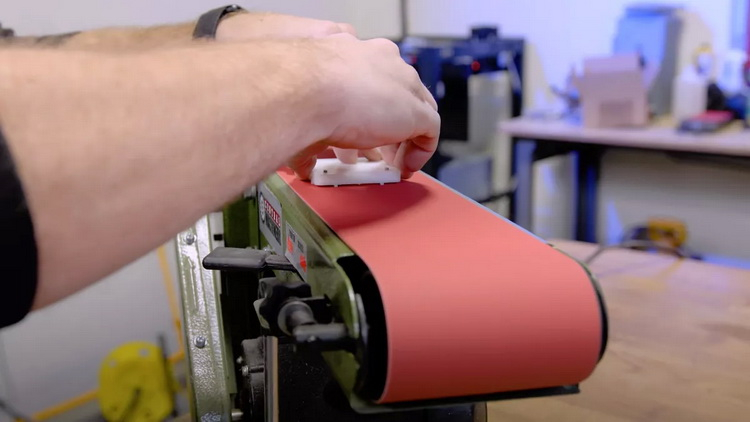
The technoblogger reduced the thickness of his Ryzen 9 7950X processor cover by 0.8 mm with a grinding machine.
As a result, the operating temperature of the chip decreased from 94-95 degrees Celsius to about 85-88 degrees Celsius with all its cores running at 5.10 GHz.
Overclocking all cores to 5.40GHz resulted in a temperature increase to 90.65 degrees Celsius.
All temperature readings were obtained with the use of the VSF.To \"modify\" the cover of the Ryzen 9 7950X processor the technoblogger used a special frame, in which the processor is placed before the procedure.
This way the chance of damaging the CPU was reduced.
The frame was developed by the famous enthusiast Roman \"Der8auer\" Hartung.
It has a certain height at which the chip cover has to be ground down.
In addition to the processor, the enthusiast had to modify the screws of the cooling system so that they allowed to fix it at the right height.
This process requires a lot of patience, a steady hand, a grinder and an understanding of what you're doing.
But as a result, you can expect a 7-10 degree Celsius drop in processor operating temperature.
Again, both of these methods will void the owner's warranty on the processor.
In addition, they are designed only for enthusiasts.For ordinary PC users, the best choice to combat high CPU temperature would be to choose a larger computer case with additional fans and a more efficient CPU cooling system.

The Best Gaming Processors with Excessive Consumption - Intel Raptor Lake Reviews

The Best Gaming Processors with Excessive Consumption - Intel Raptor Lake Reviews

The Best Gaming Processors with Excessive Consumption - Intel Raptor Lake Reviews

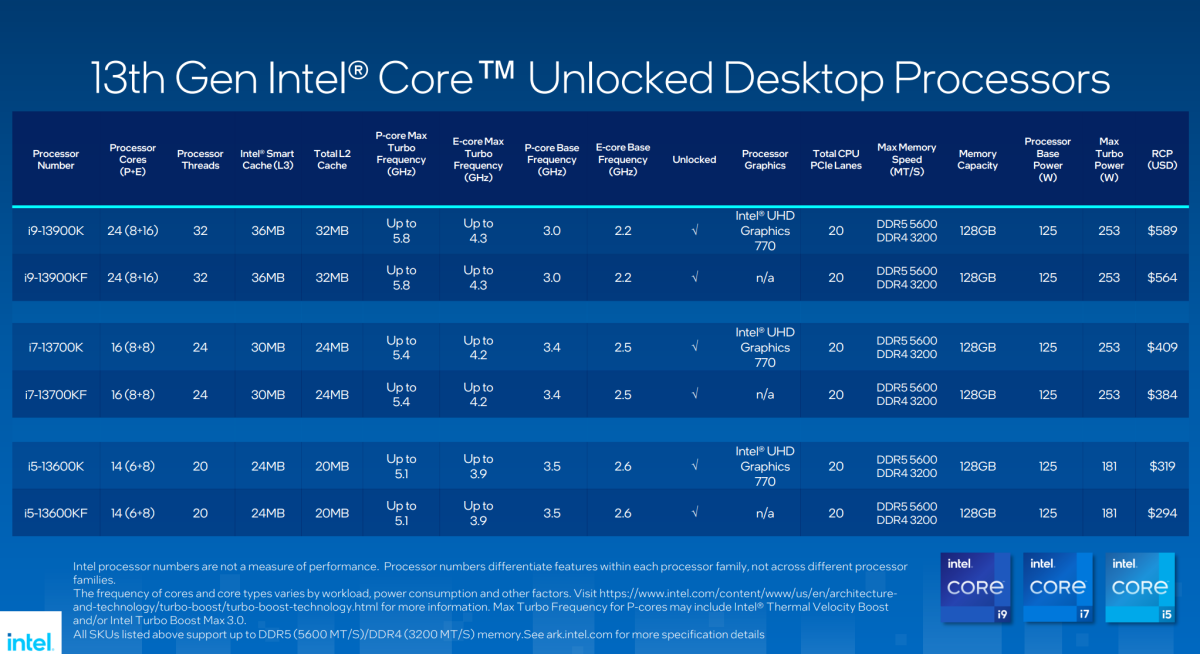
Intel Raptor Lake processors started selling today, and with it, many technology sites and bloggers published reviews of the new products.\tThe Raptor Lake family differs from the Alder Lake family with an increased number of power-efficient E-core, higher clock speeds, and larger Layer 2 and Layer 3 caches.
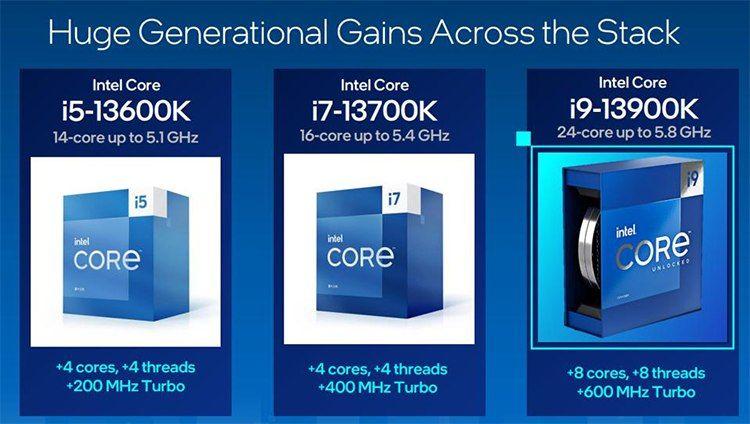
Specifically, the Core i9-13900K offers 8 P- and 16 E-core, 3.0-5.8 GHz, 36 Mbytes of L3 cache, 253W MTP and is priced at $589.
The mid-sized Core i7-13700K has 8 P- and E-core each, 3.4-5.4 GHz, 30 Mbytes of L3 cache, MTP 253W and a price of $409.
And the specs of the younger Core i5-13600K look like this: 6P + 8E, 3.5-5.1 GHz, 24 Mbytes L3, MTP 181W and $319.\t\t\t\tWhen getting acquainted with the Raptor Lake, reviewers unanimously noted the high performance of the new products.
In multi-threaded applications, the Core i9-13900K outperforms the Core i9-12900K by 45%, and in gaming its performance is 20% better.\t\t\t\t\t\t\t\t\tTom's Hardware Tom's Hardware As a result, the Core i9-13900K is about 10-15% faster than the Ryzen 9 7950X and 5-10% faster than the Ryzen 7 5800X3D in games.\t\t\t\t\t\tTechPowerUp That said, the Core i9-13900K and Ryzen 9 7950X perform about the same in multi-threaded content creation applications.\t\t\t\t\t\tTechPowerUp At the same time, almost all reviews note that Raptor Lake has significant consumption and high temperatures even when using very powerful cooling systems.
For example, it can consume up to 275W in multi-threaded loads, and up to 320W in stress tests with AVX2.
However, gamers are unlikely to encounter such consumption - the average consumption of the Core i9-13900K in games is about 140W.\t\t\t\t\t\tComputerbase.de In addition, some reviewers have noticed that the Core i9-13900K can be used quite effectively at reduced power consumption and underwinding.
For example, the processor hardly loses any gaming performance when capped at 125W, although it slows down in content creation applications by about 15%.\t\t\t\t\t\tder8auer Computerbase.de The journalists were more impressed than the Core i9-13900K by the inexpensive Core i5-13600K.
It lags behind the Core i9-13900K in games by a few percent and therefore is faster than any AMD processors, including flagship models.
At the same time, its average gaming consumption is only 85W, and peak consumption in resource-intensive applications does not exceed 155W.
Separately, reviewers pointed out that unlike Ryzen 7000, new Intel releases are compatible with old motherboards under LGA 1700 and can run not only with DDR5, but also with DDR4-memory.Detailed reviews of Core i9-13900K and Core i5-13600K can be found at websites: Igor'sLAB, Tom's Hardware, TechPowerUP, Techspot and others.

Intel says Core i9-13900K is on average 11% faster than AMD Ryzen 9 7950X in games

Intel says Core i9-13900K is on average 11% faster than AMD Ryzen 9 7950X in games

Intel says Core i9-13900K is on average 11% faster than AMD Ryzen 9 7950X in games

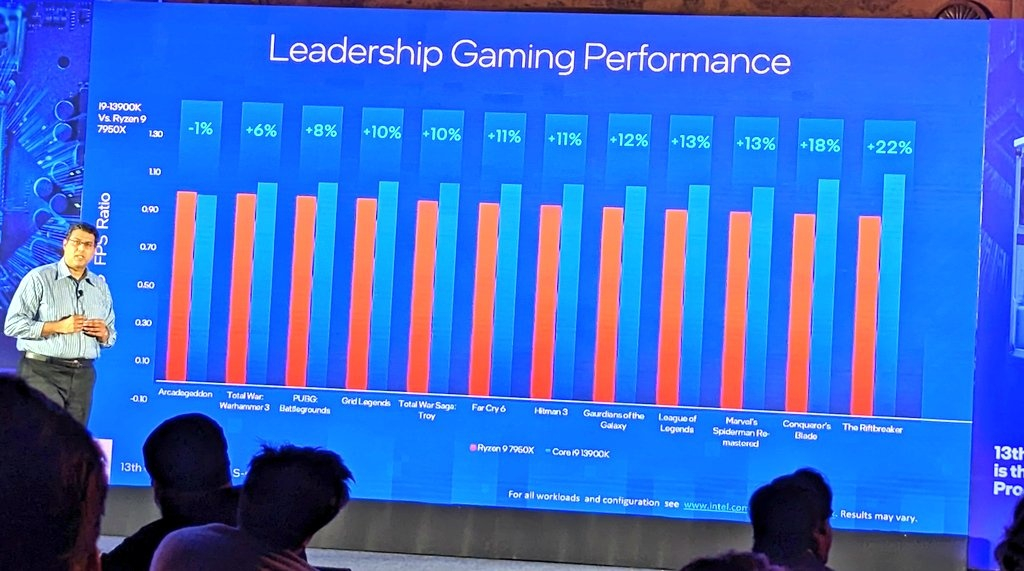
According to Intel itself, the new Raptor Lake series Core i9-13900K processor is on average 11% faster than the flagship AMD Ryzen 9 7950X in games.
One of the VideoCardz reader shared photos from Intel presentation, anticipating the upcoming release of chips, where in particular the performance of new 24-core flagship processor was concerned.Image source: IntelThe slides showed Intel Core i9-13900K performance was compared directly with the direct competitor Ryzen 9 7950X.
So, the new Intel chip was up to 22% faster in games, compared to AMD's solution.
For example, such a difference can be expected in The Riftbreaker game.
In this case, if we talk about the average difference in performance, it is about 11% in favor of the Intel chip.
Intel Core i9-13900K vs AMD Ryzen 9 7950X in games.
Image source: VideoCardz / IntelOn another slide shown, Intel showed the performance of the Core i9-13900K in various applications.
PugetBench, Procyon, AutoCAD/AutoDesk were selected for the tests.
According to Intel, in half of the tests between the two flagships there is parity in performance.
In Photoshop, Intel's new product is slower by 3% than AMD's processor, while in AutoDesk/AutoCAD design programs, on the contrary, it is 4% and 16% faster.
Intel Core i9-13900K vs AMD Ryzen 9 7950X in software.
Source image: VideoCardz / IntelIt should be noted that the information on what conditions and with what PC components the above tests were conducted, is not yet available.
Intel Core 13th generation processors will be available for sale on October 20.
On the same day, the first independent reviews of these chips should appear.

Core i9-13900KF processor overclocked to 6.2GHz single-core using conventional liquid cooling

Core i9-13900KF processor overclocked to 6.2GHz single-core using conventional liquid cooling

Core i9-13900KF processor overclocked to 6.2GHz single-core using conventional liquid cooling

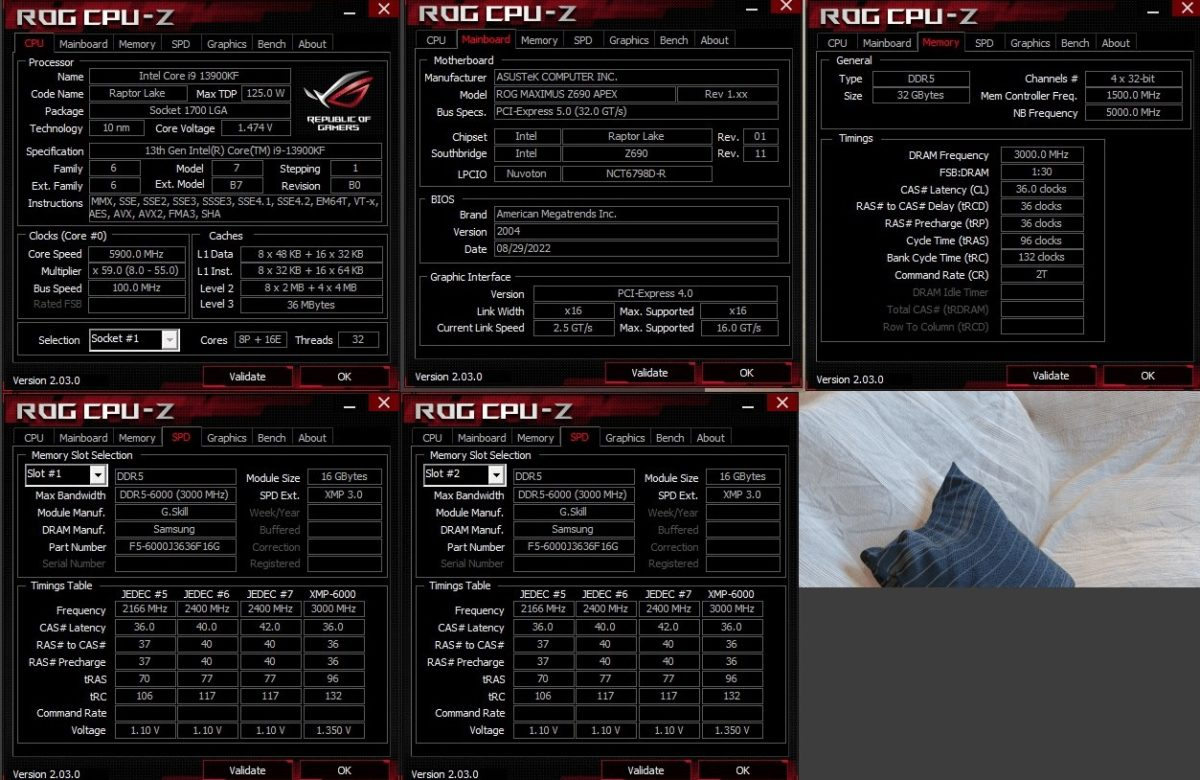
Raptor Lake's flagship 24-core Core i9-13900KF processor was overclocked to 6.2GHz, but only one core, but using only a conventional unattended (AIO) liquid cooling system.
Picture courtesy of Overclock.net.Source image: VideoCardzThe flagship 24-core Core i9-13900KF Raptor Lake processor is officially allowed to automatically overclock one of its cores to 5.8GHz with Thermal Velocity Boost technology.
The suffix \"KF\" in the model name indicates that the chip lacks integrated graphics.When overclocking the CPU to 6.2GHz, a Corsair iCUE H150I RGB Elite liquid cooling system was used as well as a Thermal Grizzly contact frame to protect against socket and poor waterblock contact with the chip cover.
The test system also contained an ASUS ROG Maximus Z690 APEX motherboard, a GeForce RTX 4090 graphics gas pedal and G.Skill DDR5-6000 memory modules with CL36 delays.
Intel Core i9-13900KF overclocking.
Source image: CodyeThe system after overclocking was tested in Cinebench and 3DMark synthetic tests.
In the single-core benchmark Cinebench R23, the processor showed a score of 2352 points after overclocking.
This allowed it to rank 13th in HWBOT's single-core performance ranking.
The user also reported that the processor scored 41,940 points in the multi-core performance test.
Intel Core i9-13900KF overclocking.
Image source: CodyeThe owner of the Core i9-13900KF notes that despite being able to overclock the chip to 6.2GHz on a single core, the processor temperature did not rise above 75°C when using the aforementioned coolant.
The Core i9-13900KF was overclocked at 1.474V.
The enthusiast also added that he was limited in time, so he has not yet conducted thorough tests on the processor.
At the same time, standard overclocking profiles of ASUS ROG Maximus Z690 APEX motherboard were used in the experiment.

10.24.2022

Intel will retire Comet Lake processors next year

Intel will retire Comet Lake processors next year

Intel will retire Comet Lake processors next year

The tenth-generation Intel Core processors introduced in the second quarter of 2020 have already become obsolete, so in anticipation of the arrival of thirteenth-generation (Raptor Lake) processors on the market, the company decided to clean up its desktop solutions range just by the price of tenth-generation models.
They can be ordered until April next year, and the last batch will be shipped in late October.Image source: IntelThe company's notice about the cessation of supplies traditionally mentions the reason - \"demand has shifted towards other Intel products\".
The list of models falling under the program is quite extensive, including Core i9, Core i7 and Core i5 series processors, as well as the Xeon W-12xx platform models for entry-level workstations.
Some Core i9, Core i7, Core i5 and Xeon W models with \"E\" and \"TE\" in the designation are moved to the embedded solutions segment, and therefore will be available for several years.
In general, customers can place an order for the specified categories of desktop Comet Lake processors until April 28, 2023, and the last batch will be shipped on October 27 of the same year.
Boxed versions and tray variants have the same availability dates.
As a rule, processors from discontinued models can be found on sale several years after the discontinuation of shipments.

10.01.2022

Ryzen 7000 gets hot because of the thick cover - scalping reduced the temperature by 20 degrees

Ryzen 7000 gets hot because of the thick cover - scalping reduced the temperature by 20 degrees

Ryzen 7000 gets hot because of the thick cover - scalping reduced the temperature by 20 degrees

Reviews of Ryzen 7000 processors showed that they are very productive, but at the same time very hot chips.
For example, the flagship 16-core Ryzen 9 7950X in tests heated up to 94-95 degrees Celsius, and in games - up to 76 degrees Celsius.
At the same time, at peak load the processor can consume up to 247 watts of power.
Decrease the operating temperature of new AMD processors is possible, but with a very risky procedure of scalping (removing the metal cover).Image source: Der8auerGerman enthusiast Roman Hartung, known under the pseudonym Der8auer, decided to check whether the situation with temperature indicators will improve by removing the heat spreading cover from Ryzen 9 7900X.
The method turned out to be effective, but dangerous.
The processor was successfully scalped and installed into Socket AM5 with a special frame instead of the standard mounting mechanism, which allowed to use a conventional liquid cooling system with the \"bare\" CPU.
A model with 360mm radiator was used.
Enthusiast recorded the frequency of all Ryzen 9 7900X cores at 5.4 GHz.
The CPU temperature under load was only slightly higher than 70 degrees Celsius, while with the cover the temperature reached 90 degrees.
This difference is due to the large thickness of the cover.
An additional advantage of scalping turned out to be the reduced power consumption of the chip by about 15W due to its lower temperatures.
This allowed the enthusiast to overclock all cores by an additional 100 MHz, reaching a frequency of 5.5 GHz.
To remove the lid from the processor Der8auer used a prototype of a special tool for scalping by shear method.
A production model of this tool should be available later on the market.
It should be noted that this method of temperature reduction will not be suitable for most users.
Firstly, it is risky.
There is a chance of damaging the processor, as Hartung demonstrated at the end of the video.
Secondly, it will deprive the processor owners of the manufacturer's warranty.