Showing posts with label amd. Show all posts

11.29.2022

NVIDIA took an even larger share of the discrete graphics market - Intel and AMD have 12%

NVIDIA took an even larger share of the discrete graphics market - Intel and AMD have 12%

NVIDIA took an even larger share of the discrete graphics market - Intel and AMD have 12%

The other day, thanks to a report from Jon Peddie Research (JPR), we learned that shipments of all types of graphics processors collapsed by 25% in the third quarter.
Now, thanks to the same analysts, we know how the discrete graphics card market changed over the same period.
In short - it fell even more, and AMD gave NVIDIA a serious share of this market.Image source: WCCFTechThe discrete graphics market sagged very strongly.
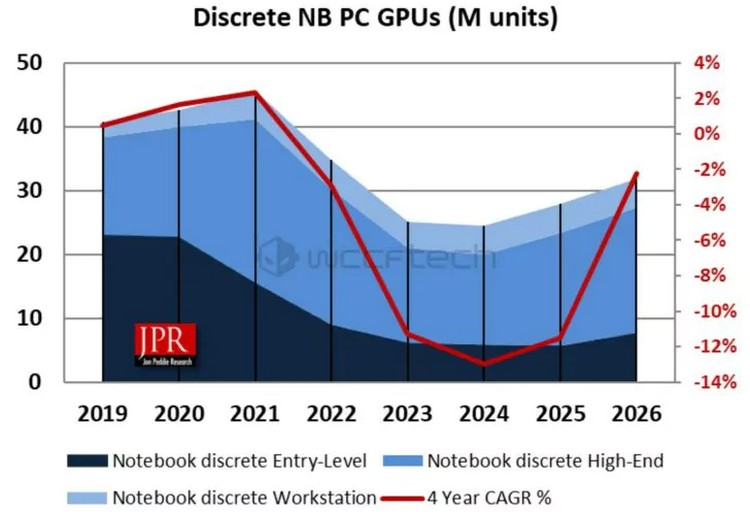
In the third quarter of 2022, the supply of graphics cards was only 14 million units, a drop of 41.6% compared to the same period last year, when the supply was 24 million graphics cards.
Even a quarter earlier the situation on the market was much better - in the second quarter of 2022 was delivered 19 million discrete graphics cards.Shipments of mobile and desktop graphics cards were divided equally - in each segment was delivered 7 million cards.
However, desktop cards previously dominated the market, with 10 million desktop boards shipped in the quarter versus 8.6 million mobile boards, and 13 million desktop boards versus 11.6 million mobile discrete graphics cards shipped in the third quarter of 2021.
NVIDIA saw its share of the discrete graphics market grow to 88% in the third quarter, up 8 percentage points from the quarter before.
As a result, AMD had only 8 percent of the discrete graphics market, down from 15 percent in the second quarter.
And the remaining 4 percent was taken by Intel.
In the desktop segment, AMD is doing slightly better - here it took 10 percent.
The remaining nine tenths of the market were divided between NVIDIA with 86% share and Intel with the same 4%.
As for the mobile segment, NVIDIA's dominance is even stronger - the company owns 90% of the market, while Intel and AMD equally shared the remaining 10%.Overall supply of graphics processors, both discrete and embedded, both mobile and desktop, is rapidly decreasing since the second quarter of 2021.
Then a sharp decline occurred in the third quarter, then in 2022, the market was relatively stable until the first quarter of this year, but after that again began to actively decline.
This is likely due to the economic and geopolitical instability in the world.Analysts expect that next year, sales of graphics processors will fall even more.
In 2024 the market will be steadily low, and the recovery will begin only in 2025.
But the growth will not be too significant.
These are tough times for the PC market: demand for PCs soared during the pandemic, and now the need for them is severely diminished.
The GPU market has been heavily influenced by mining, which has driven high discrete graphics sales.
Now the market is flooded with cheap used video cards from miners, and there are a lot of new gas pedals in stores now, but some are asking too much.

11.18.2022

AMD and Analog Devices have settled a long-standing patent dispute and agreed to cooperate

AMD and Analog Devices have settled a long-standing patent dispute and agreed to cooperate

AMD and Analog Devices have settled a long-standing patent dispute and agreed to cooperate

U.S.
chip maker Advanced Micro Devices Inc (AMD) and Analog Devices Inc (ADI) have decided to wind down litigation related to possible infringement of semiconductor technology patents.
The respective joint press release was issued last night.Image source: AMDThe companies said they have reached agreements on \"mutually agreed terms\" and are \"committed to pursuing technological cooperation to provide next-generation solutions to their customers from the communications and data center markets.\" Details of the agreement were not disclosed, and representatives from both companies have so far refrained from commenting.The issue arose back in 2019, when Massachusetts-based ADI filed a lawsuit against Xilinx Inc, now part of AMD.
ADI claimed that technology used in chips that enable wireless communications and developed by Xilinx violated some patents related to converting analog data to digital data.ADI claimed that Xilinx copied its innovations when the companies collaborated on the development of another Xilinx technology.
According to 2020, Xilinx denied allegations of patent infringement, and in February of this year it was acquired by AMD for about $50 million, the latter at the same time got a lawsuit.The court hearing was previously scheduled for March, but last year the court suspended the procedures related to the lawsuit due to the need for a number of formal actions related to the relevant technologies at the U.S.
Patent Office.
On Monday, the case was dismissed due to an agreement between the parties.

11.14.2022

AMD has dramatically reduced its market share in the PC processor market, but increased it in the server segment

AMD has dramatically reduced its market share in the PC processor market, but increased it in the server segment

AMD has dramatically reduced its market share in the PC processor market, but increased it in the server segment

Continuing to battle with Intel Xeon, AMD Epyc chips have captured the competitor's share for the 14th consecutive quarter, but in the desktop and notebook processor segment, the red camp is not so lucky: Q3 has stripped the company of all the achievements of recent years, writes Computer Base.Image source: amd.com The most serious losses were in the notebook chip market.
At the end of III quarter AMD share was 15.7% - a drop of 9.1 points compared to II quarter, and a year earlier this figure was 22%.
The company's current share was last seen in late 2019, but this is clearly not the time to get excited about a return to pre-pandemic levels.
The decline in the desktop chip market is just as unpleasant - it was 6.6 p.p.
in quarterly terms, and the company's share dropped to 13.9 percent, though it was 17 percent last year.
And this is the worst value for AMD since 2018.AMD continues to show positive dynamics in the server segment: during the quarter, the company's share increased by 3.6 p.p.
to 17.5%, while a year earlier it was only 10.2%.
The performance advantage continues to bear fruit: even if the recently introduced Genoa family processors had not come out by the end of the quarter, the company would have continued to build share with Milan, as Sapphire Rapids will definitely not come out this year.On average selling price (ASP) AMD gained 8 p.p.
for the year, while Intel lost 12.
Finally, the Reds once again have the console chip segment to thank: PlayStation and Xbox are flying in the millions, and sales continue to grow compared to last year.
As a result, AMD sells more console chips than notebook, desktop and server processors combined.

11.11.2022

AMD introduced EPYC 9004 (Genoa) server processors - up to 96 Zen 4 cores, DDR5 and PCIe 5.0 support

AMD introduced EPYC 9004 (Genoa) server processors - up to 96 Zen 4 cores, DDR5 and PCIe 5.0 support

AMD introduced EPYC 9004 (Genoa) server processors - up to 96 Zen 4 cores, DDR5 and PCIe 5.0 support

AMD has officially introduced EPYC 9004 series processors codenamed Genoa for servers and data centers.
They feature up to 96 high-performance cores on the Zen 4 architecture.
According to AMD head Lisa Su (Lisa Su), the number of transistors in chips Genoa is 90 billion, AMD itself describes new products as processors with unsurpassed performance, advanced energy efficiency and next-generation architecture.Image source: AMDThe Genoa processors include twelve 5-nm chipset CCD with compute cores and one 6-nm chip with I / O interfaces.
Each processor core has 1MB of L2 cache memory, twice as much as the previous generation EPYC chips on the Zen 3 architecture.
There is also 32 Mbytes of Layer 3 cache per CCD chip.
The new Genoa EPYCs support up to 6 TB of 12-channel DDR5-4800 RAM, 128 lanes of PCIe 5.0 interface.
Although with the latter AMD is undecided, as during the presentation figure of 160 lines sounded.
In addition, support for CXL 1.1 and partly CXL 2.0 is claimed for the processors, which provides significant memory expansion capabilities for data center applications.
Note here that AMD has changed CPU socket for server chips: SP3 is replaced by SP5.
AMD claims EPYC Genoa has 14% more instructions per clock (IPC) than last generation solutions at the same TDP.
At the same time the performance of new chips per watt of power consumption in some tasks increased by up to 2.7 times compared to predecessors based on Zen 3.
Support for new instructions, such as AVX-512, is also noted.
In cloud computing tasks the performance of new chips is up to three times faster than competitors.
And in a direct comparison of the performance per core, EPYC Genoa are up to 55% faster than Intel Xeon processors.
Although the question is about 3rd generation Xeon Scalable, which is now the actual Intel's - presented yesterday Xeon Max on the new architecture will be available only in January.
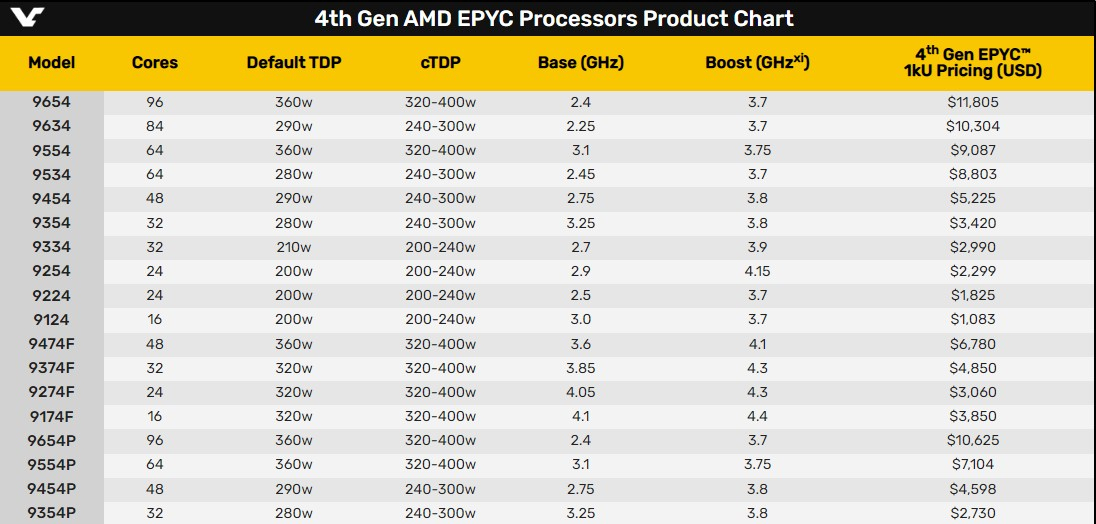
All in all AMD has presented 18 models of EPYC Genoa processors, conditionally divided into different segments for specific tasks.
For HPC and cloud segment manufacturer has provided chips with 48 to 96 cores and TDP from 280 to 360 W.
High-end models with 16 to 48 cores and TDP from 320 to 360W will be offered for corporate sector.
For small business, the company will offer 16 or 32 cores and TDP from 200W to 280W.
Source image: VideoCardzBasic clock speeds range from 2.25 to 4.1 GHz, and Boost speeds from 3.7 to 4.4 GHz.
Note that a number of models support a TDP setting of up to 400W.
As for prices, they range from $2,730 to $11,805 for a processor in a batch of 1,000 units.
As part of the presentation, AMD paid special attention to the energy efficiency of the new Genoa processors, noting the significant increase in server system maintenance costs per kilowatt of power consumed over the past year.
AMD claims EPYC Genoa-based systems will cost significantly less to maintain than systems based on competitive solutions.
AMD's chips are up to 52% more energy efficient than its competitors.
AMD EPYC Genoa processors will be available starting today.
The company also recalled that it plans to release cloud-optimized EPYC Bergamo processors in the first half of 2023.
These processors will get up to 128 cores (and 256 threads), as promised earlier, keeping compatibility with the SP5 socket.
EPYC Genoa-X processors with additional cache will also be available in the first half of next year.
Like Milan-X, they will be oriented to a specific class of workloads, which benefit from the increased available cache size.
These are, for example, computational tasks and DBMS.
And in the second half of next year, AMD will expand its range of Zen 4 server processors with Siena chips.
They will be optimized in terms of energy efficiency and offer up to 64 cores.

11.10.2022

The share of laptops on Arm-processors will grow in the market by 10 times from 2020 to 2023 - Intel loses positions

The share of laptops on Arm-processors will grow in the market by 10 times from 2020 to 2023 - Intel loses positions

The share of laptops on Arm-processors will grow in the market by 10 times from 2020 to 2023 - Intel loses positions

Processors on Arm architecture are trying more and more actively to advance in the market of laptops.
According to experts at DigiTimes, by 2023 their share will be 13.9%.
Although at first glance it seems not very much in relation to the total mass, compared to 2020, the share will increase by 10 times - in that year such models on the market was only 1.4%.
In this case, Intel is actively losing ground in the mobile PC market.Image source: AppleAccording to Tom's Hardware, the DigiTimes report also reflects another trend - it seems that the dominance of Intel solutions in the notebook market is gradually coming to an end.
At the same time the whole segment is suffering from the current difficult macroeconomic situation and the decline in sales after the pandemic weakened.DigiTimes notes that the notebook market as a whole in 2022, there is a decline of 22.8 percent year-on-year - a total of about 190 million devices will be delivered.
However, experts predict a relative stabilization of demand in 2023 - sales should be about 200 million laptops.
Changes in sales will presumably fluctuate by up to 10%.An important role in the promotion of Arm-architecture in the market of laptops was played by Apple, which began in 2020 to promote MacBook on its own Arm-chipset.
For its part, Qualcomm is improving its solutions for Windows.
In addition, sales of Chromebooks on Arm have also recently received a certain impetus, but to a lesser extent than other platforms.Meanwhile, Intel is losing its leadership in the laptop segment due to a number of problems.
In addition to Arm processors that have challenged the hegemony of the x86 architecture, AMD is gaining ground.
Ryzen models have proven to be competitive in the notebook market, so they are increasingly trusted by manufacturers and customers.
According to DigiTimes, while Intel's share of the notebook market in 2016 was 82.2% (AMD accounted for 17.8% in the same year), in Q2 2022 Intel had only 63.5% of the market, while AMD strengthened its position to 36.4%.It is assumed that from 2024 will come other important changes - Qualcomm intends to introduce computer chipsets based on Nuvia developments, which will give new impetus to the Arm-architecture promotion.

11.04.2022

AMD introduced the Radeon RX 7900 XT and RX 7900 XTX graphics cards - the older one is priced at $999

AMD introduced the Radeon RX 7900 XT and RX 7900 XTX graphics cards - the older one is priced at $999

AMD introduced the Radeon RX 7900 XT and RX 7900 XTX graphics cards - the older one is priced at $999

AMD introduced its flagship gaming graphics cards Radeon RX 7900 XT and Radeon RX 7900 XTX.

New products are based on flagship graphics processor with RDNA 3 architecture, which AMD calls the world's first GPU with a chiplet design - it consists of several crystals. 

AMD's new flagship RDNA 3 architecture GPU includes 58 billion transistors, and their density has increased by 165% compared to previous-generation (RDNA 2) GPUs.

The big crystal in the center is made by 5-nm process technology and has an area of 300 mm2.It is called GCD (Graphics Compute Die) and includes all GPU computing blocks, as well as other necessary elements. Next to it are six small crystals with high speed memory Infinity Cache.

They are 6nm processors, have an area of 37mm2 each and are called MCD (Memory Cache Die).The bus bandwidth between GCD and MCD is 5.3 Tbytes/sec.

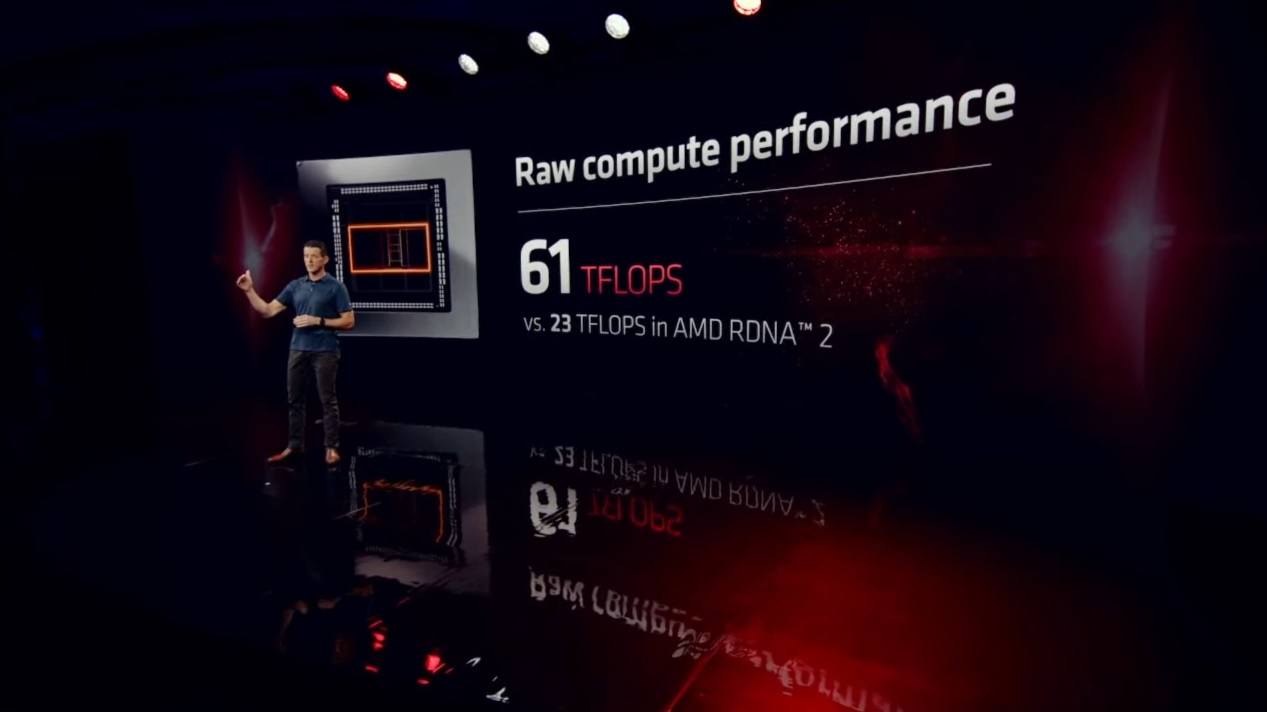
Note that Radeon RX 6000 had Infinity Cache memory on the same chip as GPU, but had 2.7 times less bandwidth. The new chips have a theoretical peak performance of 61 Tflops in single precision floating point operations (FP32), 2.7 times higher than the previous generation GPUs could offer (23 Tflops).

AMD notes that it optimized its computing block architecture for gaming, dramatically increasing performance.It also doubled the number of instructions executed per clock cycle, and increased the processing speed of ray tracing operations (by 50% for each processing unit) and artificial intelligence (by 2.7 times). 


 According to AMD, the new flagship Radeon RX 7900 XTX is 1.5-1.7 times faster in games than the Radeon RX 6950 XT.And when using ray tracing, which was not the strongest point of the last generation graphics cards, the performance increased by 1.5-1.6 times.

In general, AMD positions the new graphics card as a solution for 4K gameplay with high frame rate.And to achieve even higher frequency will help to scale FSR.Unfortunately, AMD did not compare its novelties with its competitors. Senior Radeon RX 7900 XTX has got graphics processor with 96 compute units (Compute Units, CU) with RDNA 3 architecture, which means there are 12,288 stream processors.


The chip runs at a clock speed of 2.3 GHz, which is the average frequency in games.Next to it is 96 MB of high-speed Infinity Cache memory, and the amount of GDDR6 video memory is 24 GB.It is connected via a 384-bit bus.

The graphics card power consumption is 355W. The subflagship Radeon RX 7900 XT has a graphics processor with 84 CU, which carry 10,752 stream processors.The average gaming frequency is claimed to be 2 GHz.The card has 80 MB of Infinity Cache memory, and the amount of GDDR6 video memory is 20 GB, and it is connected via a 320-bit bus.The consumption level of the card is 300 W.

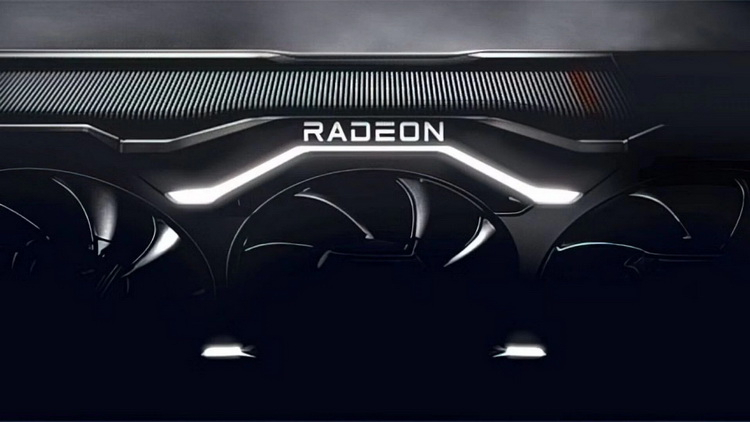
The new AMD reference graphics cards have a cooling system with three fans and take up 2.5 expansion slots in height.

For additional power each has two 8-pin connectors.AMD separately pointed out that \"its new graphics cards won't need new chassis or new power supplies.\" This was obviously a kick in the teeth for NVIDIA, whose flagship GeForce RTX 4090 turned out to be huge, and also uses new 12+4 pin power connector. Also AMD emphasized on the new graphics cards support of the latest DisplayPort 2.1 interface.

It provides the ability to output images in 8K resolution at up to 165 Hz or in 4K resolution at 480 Hz.The problem so far is that there are no monitors with this interface and these characteristics on the market.Here we should also note the support of hardware acceleration when working with AV1 codec.


The recommended price of AMD Radeon RX 7900 XTX video card will be $999, while the junior Radeon RX 7900 XT is priced at $899.Both graphics cards will go on sale on December 13.

Recall that the GeForce RTX 4090 is priced at $1599, while the GeForce RTX 4080 will cost from $1199.

AMD announced FSR 3.0 technology and HYPR-RX feature - both will boost FPS, but will not appear until 2023

AMD announced FSR 3.0 technology and HYPR-RX feature - both will boost FPS, but will not appear until 2023

AMD announced FSR 3.0 technology and HYPR-RX feature - both will boost FPS, but will not appear until 2023

As part of the presentation of the next generation flagship graphics cards Radeon RX 7900 XTX and RX 7900 XT AMD also announced two new software technologies that will be part of the Radeon Software Adrenalin graphics driver in the foreseeable future.


We're talking about a new version of FidelityFX Super Resolution 3.0 image scaling technology, as well as AMD's new HYPR-RX feature.Amd Vice President Scott Herkelman said while speaking at the event that FidelityFX Super Resolution 3.0 (FRS 3.0) will get support for the Unreal Engine 5 game engine.

He also stated that FSR 3.0 will provide twice the gaming performance of FSR 2.0.Unfortunately, he did not share more details about FSR 3.0, but indicated that the technology will become available next year. 


The Radeon Software Adrenalin graphics driver will also include the new AMD HYPR-RX feature.

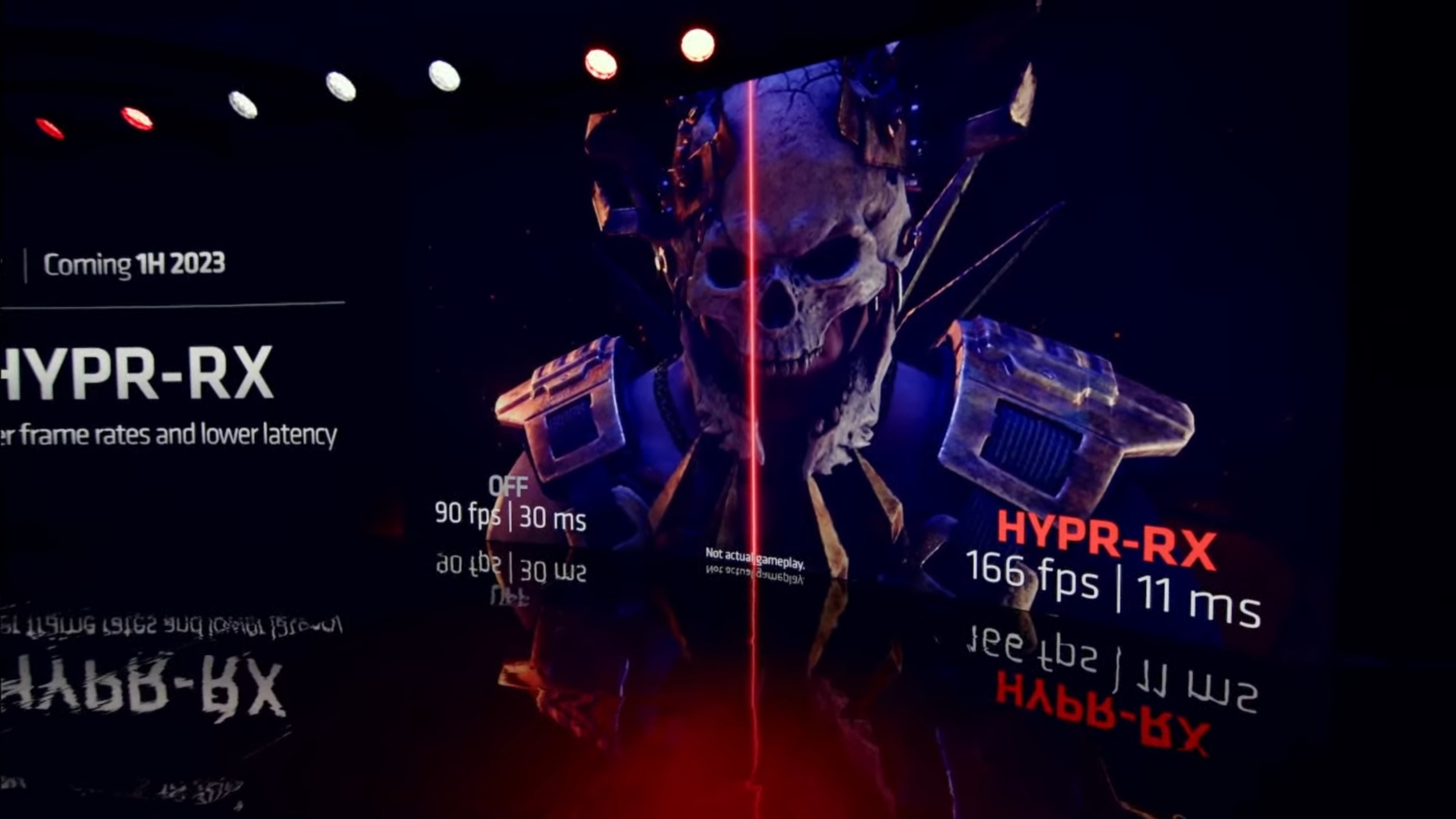
It will allow with the click of a button to reduce gaming latency, enable FSR scaling technology, and activate the Radeon Boost feature to improve gaming performance.

According to an AMD spokesperson, in Dying Light 2, which was cited as an example, activating the AMD HYPR-RX feature allows for an 85% increase in gaming performance and a 1/3 reduction in latency. 

AMD HYPR-RX will be a kind of combined response to NVIDIA Reflex and NVIDIA DLSS technologies.According to the company, the feature will appear as part of the Radeon graphics driver in the first half of 2023.

11.03.2022

AMD to unveil Radeon RX 7000 graphics cards tonight

AMD to unveil Radeon RX 7000 graphics cards tonight

AMD to unveil Radeon RX 7000 graphics cards tonight

AMD will unveil Radeon RX 7000 graphics cards on the latest RDNA 3 architecture graphics processors tonight.
The start of the presentation, entitled Together we advance_gaming is scheduled for 23:00 Moscow time.
The presentation will be available for all those who wish to watch it on AMD official YouTube channel.AMD itself describes the upcoming event as follows: \"AMD executives will detail AMD's new high-performance and energy-efficient AMD RDNA 3 architecture, which will deliver a new level of performance, efficiency and functionality for gamers and content creators.
\"At the moment, very little is reliably known about the upcoming new products.
AMD showed the graphics chip Navi 3X back in August and already then it was known that the RDNA 3-based GPU will consist of several chips, by analogy with AMD CPUs.
This should reduce the cost, which would have a positive effect on the price of graphics cards.
At least, that should be so in theory.
Crystals GPU, or at least some of them will be made at 5nm process on the production facilities TSMC.Also earlier head of AMD Lisa Su (Lisa Su) said that the next generation graphics will provide 50% higher performance per watt of energy compared to current solutions, meaning Radeon RX 6000 on the RDNA 2 architecture.
Also AMD representatives said recently that they will not be getting a new (and potentially problematic) power connector with 12+4 pins.The latter is confirmed by recently leaked photo which seems to depict Radeon RX 7900 XT reference graphics card - it has a pair of 8-pin connectors.
Novelty is larger than the current flagship in the face of Radeon RX 6900 XT, but still not as huge as GeForce RTX 4090 graphics cards.
Note that AMD is rumored to be preparing several graphics cards on the flagship GPU next generation: Radeon RX 7900 XT and Radeon RX 7900 XTX.
They are rumored to offer up to 24 GB of GDDR6 memory and up to 12,288 stream processors.
Whether this is true we will find out in a few hours.

AMD's number of customer processors shipped in the third quarter fell 43%

AMD's number of customer processors shipped in the third quarter fell 43%

AMD's number of customer processors shipped in the third quarter fell 43%

At the quarterly reporting event, company executives talked about changes in the processor supply mix only in relative terms, but the 10-Q reporting form released later allowed for specific numerical figures.
AMD said the number of CPUs shipped in the quarter was down 43 percent, though the year-over-year average selling price was up 5 percent.Source image: AMDRemind that AMD's third-quarter revenue in the customer segment fell 40 percent from $1.7 billion to $1.0 billion, due to significant inventory build-up in customers' warehouses while demand decreased.
While AMD has seen a 43 percent year on year decline in volume terms for the segment, the average selling price has even increased 5 percent although yesterday AMD officials said the number was down in sequential terms.AMD attributes the decline in processor shipments in volume terms to an accumulation of substantial inventory in the customer warehouse and a decline in demand for the product, but the year on year increase in average selling price is due to an increase in the share of more than 10 percent of the total sales volume.
In this comparison, the number of CPUs sold to customers has decreased by 18%, and their average price has increased by 28%, but in this case due to the shift in demand towards more expensive mobile Ryzen models.
Apparently, by the third quarter, the moment of inertia in sales of mobile processors AMD exhausted itself, and only desktop versions of Ryzen among the more expensive ones were in sane demand.
By the way, AMD explained how its revenue changed in the gaming segment, which includes not only discrete graphics cards, but also components of game consoles.
On an annualized basis in the third quarter, it grew 14% from $1.4 billion to $1.6 billion, but since the beginning of the year growth reached 34% and corresponded to the level of revenue of $5.2 billion.
The engine of growth were gaming consoles, as noted yesterday, but gaming graphics cards have not only declined in revenue, but also reduced the number of shipped units.
The weakness in video card demand is attributed to worsening macroeconomic conditions.

11.02.2022

AMD prepares for further revenue decline - PC market situation will improve only in 2023

AMD prepares for further revenue decline - PC market situation will improve only in 2023

AMD prepares for further revenue decline - PC market situation will improve only in 2023

AMD quarterly conference revealed that the company's revenue in the consumer segment on the background of declining demand for new PCs decreased by 40% compared to the same period last year.
At the same time, the trends in which the market is developing at the moment are not so unambiguous as to characterize them by any single definition.
It is only clear that now the market is falling, but recovery is not far off, believe AMD.Source image: AMDFirst, AMD CEO Lisa Su (Lisa Su) explained that revenue in the client area in the third quarter decreased, among other reasons, due to lower number of processors sold.
Their average selling price also declined in a sequential comparison, as more expensive processors were depleted faster in terms of inventory.
In year-on-year comparisons, the average selling price went up, and this can be explained by the continuing tendency to shift the focus towards more expensive models.
The head of AMD even added that the company's position is strong in the premium, gaming and corporate customer market segments, and it expects to strengthen its position in these areas going forward.
In the long term, the price structure of AMD products supply in the client segment should not change, as the head of the company is convinced.As noted earlier today, AMD management expects to reduce the number of computers sold in the whole market by 20% this year, and next year's decline will be limited to 10%.
The company will continue to actively get rid of inventory in the fourth quarter, and this process is somewhat accelerated in a sequential comparison, and in general by the end of the year AMD will be in better shape, but it should be understood that the revenue in the current quarter slightly reduced in the client segment, as well as in the gaming.
In the latter case, such dynamics can be explained by the fact that the peak demand for components for gaming consoles occurred in the third quarter, and in the fourth quarter it traditionally declines.
New gaming video cards with RDNA 3 architecture, which will be presented this week, though will be able to revive the market in the fourth quarter, losses from the decline in demand for game consoles components will not be able to cover.
But next year AMD expects to maintain revenue in the gaming segment at the level of the current year, which, given the high base effect formed by the last stages of the cryptocurrency boom is quite optimistic.In general, speaking of the PC market, AMD management expects to overcome major problems in the current quarter and early next year, and the rest of 2023 should already contribute to the PC market recovery, according to Lisa Su.
In the customer segment, she promises to introduce some new products (most likely the new Ryzen 7000), which, combined with the recently announced Ryzen 7000 processors, will help revive interest in the brand's products.Moreover, at retail, even in the third quarter, sales volumes of Ryzen 5000 processors grew, according to Lisa Su, but only when it comes to desktop models.
With the expansion of the range of motherboards with socket AM5 more affordable models in the current quarter will increase the popularity of the new family of Ryzen 7000 processors, as the company's management expects.
AMD is not ready for the aggressive pricing policy for the sake of reducing the inventory, because it is important for it to maintain the profitability indicators.
Last year, for example, the company did not fight for the segment of Chromebooks, because it was based on too cheap processors, the release of which was unprofitable for the company.

Ryzen processor sales collapsed by 40% - AMD has negative profits in the customer segment

Ryzen processor sales collapsed by 40% - AMD has negative profits in the customer segment

Ryzen processor sales collapsed by 40% - AMD has negative profits in the customer segment

AMD quarterly report was released a few hours ago, and in terms of revenue dynamics only slightly disappointed analysts, who were ready for the loss of the former momentum of the PC market.
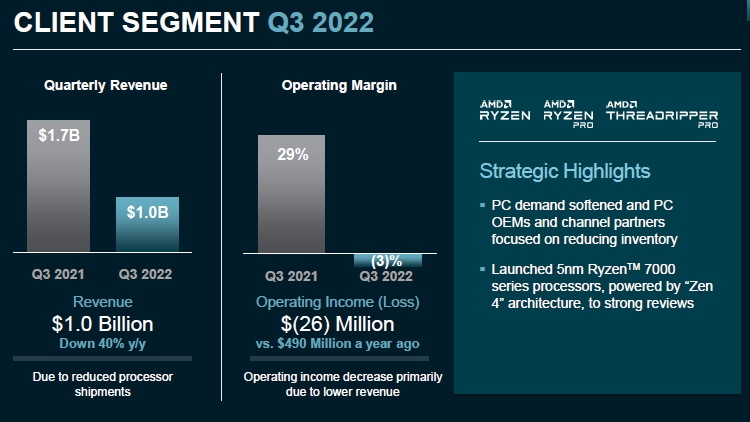
The company's total revenue was up 29% year-over-year, but in the consumer segment it collapsed by 40% due to Ryzen processors, and had to end the quarter with operating losses in this area.Image source: AMDNet revenue for AMD fell 93% to $66 million, but the company attributes this to the costs associated with the Xilinx takeover deal.
At the end of the quarter AMD's revenue was $5.6 billion, and while a 29% increase in annualized terms cannot be characteristic of previous quarters, it still looks decent against the backdrop of competitors.
Profit margin decreased during the year from 48% to 42%, operating expenses increased by 113% to $2.43 billion, and the quarter ended with an operating loss of $64 million.
The company explains this by the growth of expenses on research and development, as well as by the consequences of the Xilinx takeover deal.
Due to the need to reduce inventories and review product prices in the past quarter AMD lost at least $ 160 million.Image source: AMDAs the head of the company Lisa Su (Lisa Su) said at the conference call, \"the third quarter was worse than we expected because of the deteriorating PC market and a significant correction of inventories in the supply chain in this segment.
In fact, the value of inventory at the end of the quarter increased 77% to $3.37 billion.
Even in such a difficult environment, the CEO added, the company managed to increase revenue in the data center, embedded and gaming solutions segments.
At least in the area of game consoles there was a positive trend.Image source: AMDIn the segment of data centers revenue grew by 45% year on year to $1.6 billion due to the popularity of central processors EPYC family.
Operating profit rose from $308 million to $505 million, and the operating margin rose from 28% to 31%.
The past quarter was AMD's tenth consecutive quarter in which its server processor sales volumes in cash terms broke a record.
EPYC processors of new Genoa generation are in high demand, as pointed out by AMD, although their formal announcement is only scheduled for November 10.
Shipments of Xilinx Programmable Matrixes and Pensando Computing Accelerators are up noticeably.
Lisa Su said she expects revenue growth in the server segment next year, especially cloud solutions in the U.S., but the Chinese market will be weak.Image source: AMDIn the client segment, AMD saw a 40% drop in revenue to $1 billion compared to the same quarter last year.
Processor shipments declined due to inventory surpluses while demand in the PC market declined, all of which resulted in an operating loss of $26 million in the segment.
Nevertheless, the shift in the supply mix in favor of the more expensive Ryzen desktop models allowed the average selling price to increase year-over-year.
The company only needs to add that the Ryzen 7000 processors with Zen 4 architecture introduced in the last quarter received praise in published reviews.
By the end of 2023, according to Lisa Suh, the capacity of the PC market should shrink by 10%.
This year, the market will shrink by the full 20%.Image source: AMDIn the gaming segment, which recently includes both graphics cards and components for gaming consoles, AMD managed to increase revenues by 14% year-on-year to $1.6 billion.While revenues in the direction of graphics cards declined, gaming consoles provided a positive trend, partially compensating for this.
In fact, gaming console components have been breaking revenue records for six consecutive quarters.
Operating profit in this segment fell from $231 million to $142 million.
The company had to generate less revenue from graphics solutions and faced increased inventory, as well as downward price adjustments.
The operating profit margin dropped from 16% to 9%.
Gaming consoles were in high demand because of Microsoft and Sony's preparations for the new season.
On the profile slide of the presentation AMD also did not forget to mention the preparation for the announcement of graphics solutions generation RDNA 3 with chips produced by 5nm technology.
Novelties are to significantly increase performance compared to current generation products.
As expected, they will be presented this week.AMD's revenue in the segment of embedded solutions grew by an impressive 1549% to $ 1.3 billion as a result of changes in the accounting structure and the acquisition of Xilinx at the beginning of the current

AMD investigates reports of abnormal Ryzen 7000 performance in some games on Windows 11 PCs

AMD investigates reports of abnormal Ryzen 7000 performance in some games on Windows 11 PCs

AMD investigates reports of abnormal Ryzen 7000 performance in some games on Windows 11 PCs

AMD has released a statement about abnormal performance variations in the Ryzen 7000 processors in some games when running Windows 11 compared to running Windows 10.
The company itself noted that it has not yet registered any performance variations in some games depending on the operating system, although complaints do come in.Image source: Resul Kaya/unsplash.com \"We are currently investigating, but based on testing so far have not found a significant difference in gaming performance depending on the OS versions in different work scenarios and with different games,\" AMD reported.
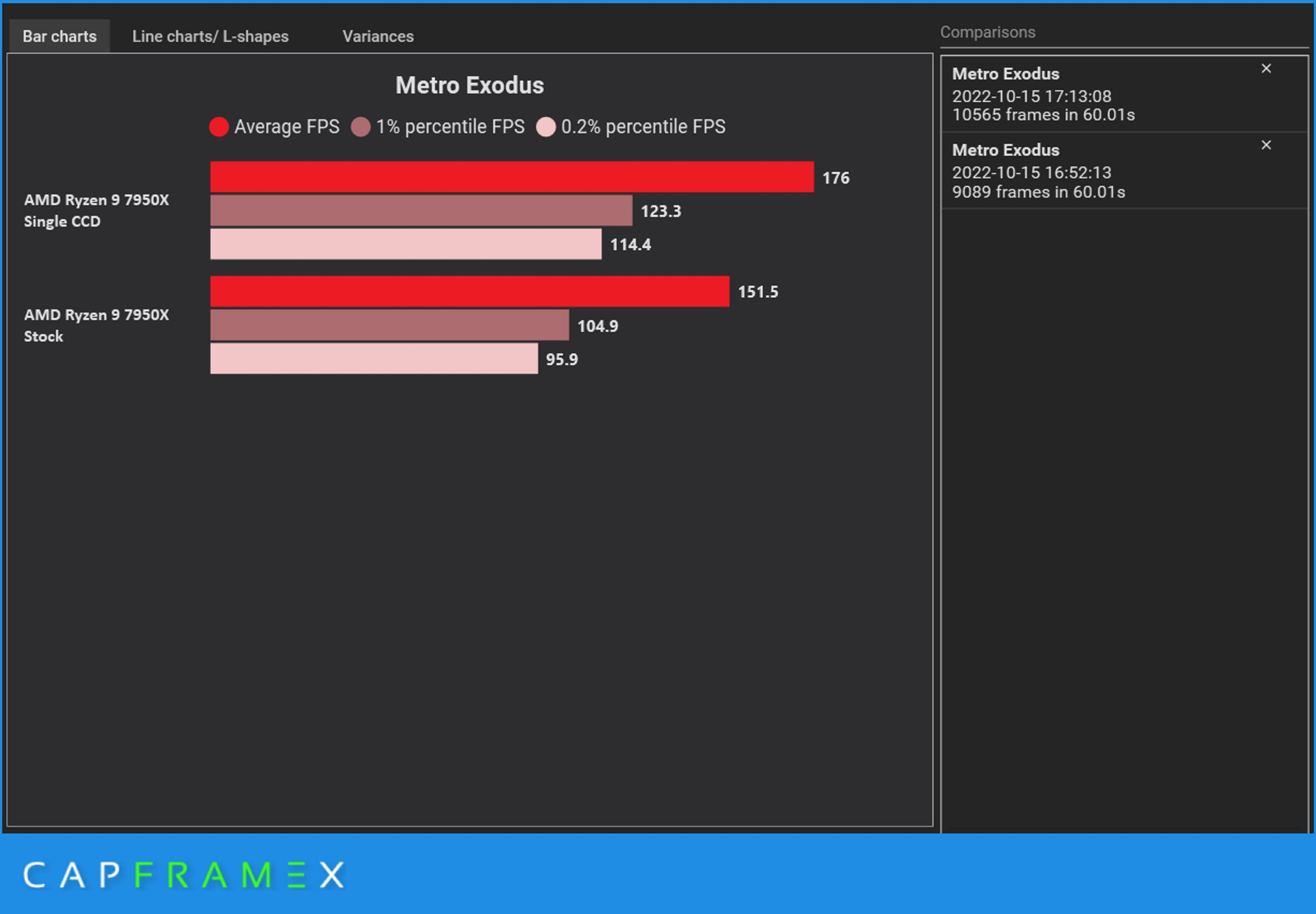
According to experts HotHardware portal, they have not observed any anomalies in reviews of Ryzen 9 7950X and 7900X, instead, experts noted the benefits of the new architecture Zen 4 compared to Zen 3.By the way, an interesting feature of these processors is that the second chiplet off (CCD - Core Chiplet Die) can even improve performance in some games.
This difference is clearly demonstrated by the example of Metro Exodus, running on a PC with Ryzen 9 7950X running Windows 11 22H2.Image source: CapFrameXAccording to AMD, such things happen quite regularly and may indicate, for example, the need for software optimization.
For a fresh platform, which is the Socket AM5, and the new architecture (Zen 4) it is normal to have some problems at first - the main thing is to have them solved later.
\"Many factors affect gaming performance, including game engine, processor architecture, graphics gas pedal and memory choices.
As new architectures come to market, there are often performance anomalies that must be addressed by the component vendor or game publisher.
This is not a new or unexpected phenomenon,\" the company said.Additionally, AMD said that as anomalies are identified, the company will share information about them with ecosystem partners and game developers so that they can properly optimize their products.

10.31.2022

Intel says it's already winning back its position in the PC market from AMD and isn't going to stop

Intel says it's already winning back its position in the PC market from AMD and isn't going to stop

Intel says it's already winning back its position in the PC market from AMD and isn't going to stop

Intel management at its quarterly reporting event began by saying that revenue in the customer area, while down 17% year over year, has consistently grown by 6%.
The sales structure of Intel components in this sector changed so that the average selling price increased.
The company was able to strengthen its position in the customer segment, and the Intel management is full of confidence that it will be able to do so in the future.Image source: Intel CEO Patrick Gelsinger even let it slip that in the third quarter Intel stepped up work with those of its customers who were willing to accelerate the purchase of the product in light of the upcoming price hikes in the fourth quarter.
According to the company's management, this led to the strengthening of Intel's position in the client segment in the third quarter.
At the same time, revenue in the segment as a whole fell by 17% year-on-year due to the majority of customers having excess products in stock.If we consider revenue from products for the desktop segment, in the third quarter, Intel's revenue increased by 3.3% year-on-year to $3.22 billion, which for the declining market as a whole is not so bad.
In the notebook segment, revenue for the year was down 25.8% to $4.4 billion.
As Patrick Gelsinger pointed out, in the PC segment the company has \"fundamentally increased its market share\", and its existing product lines in terms of competitive positioning are very strong.Intel management is not confused by the possibility of a decline in PC sales in the global market to levels below those seen before the pandemic, although they are convinced that this will not happen at all.
It's just that so many computers were sold during the pandemic that if they have to be replaced sooner or later with new ones, Intel will definitely get its piece of the pie.
According to Gelsinger, Intel's product line is positioned in such a way that it can expect to further increase its market share.
Moreover, the sagging demand is more pronounced in the segment of low-cost PCs, and Intel is now focusing on more expensive offerings.As the head of Intel added, Alder Lake and Raptor Lake processors are showing impressive performance, and preparations for the Meteor Lake release next year are in full swing.
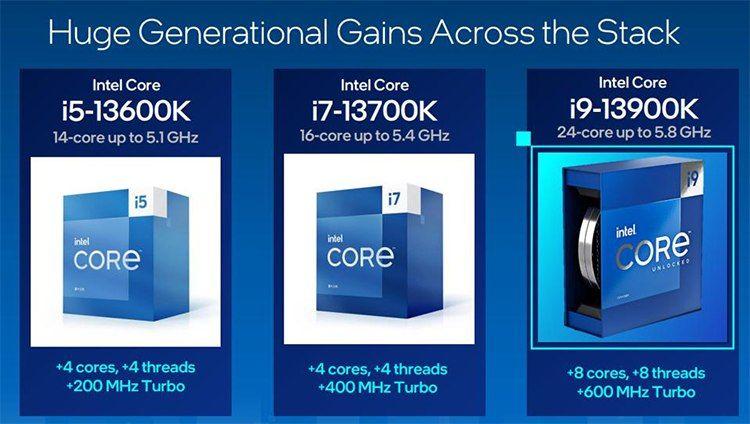
The recently unveiled Raptor Lake processors do show superiority over existing AMD solutions in terms of performance, according to independent tests.
At the same time, Intel products also turn out to be cheaper, so it is easy to explain the confidence of the company's management in the revenge on the consumer market.

AMD confirmed that Radeon RX 7000 graphics cards will not receive the new 12+4-pin 12VHPWR power connector

AMD confirmed that Radeon RX 7000 graphics cards will not receive the new 12+4-pin 12VHPWR power connector

AMD confirmed that Radeon RX 7000 graphics cards will not receive the new 12+4-pin 12VHPWR power connector

AMD has confirmed that the next generation Radeon RX 7000 graphics cards will not be equipped with the new 12+4-pin 12VHPWR power connector found on the older GeForce RTX 40 series graphics cards from NVIDIA.
Source image: AMDThe fact that the new series of AMD graphics cards will not use the new 12 + 4-pin connector, which in recent days have raised questions, confirmed via his Twitter page AMD Corporate Vice President Scott Herkelman (Scott Herkelman).In a communication with the users of social network Herkelman commented on the picture of the melted power connector 12VHPWR on the video card NVIDIA GeForce RTX 4090.
In response to the publication, AMD Corporate Vice President said that neither the current Radeon RX 6000 series graphics gas pedals, nor the upcoming series of graphics cards on the RDNA 3 architecture will not use this connector for power.It turns out that the new AMD graphics cards will be equipped with conventional 8-connector PCIe power connectors that can pass up to 150W of power to the gas pedal.
Models with high power consumption, in turn, may be equipped with two, and perhaps three or more such connectors.All the details about the new graphics cards Radeon RX 7000 on RDNA 3 architecture will be available on November 3.
On this day, AMD has planned the presentation of new gas pedals.

AMD will unveil EPYC Genoa server processors on the evening of November 10

AMD will unveil EPYC Genoa server processors on the evening of November 10

AMD will unveil EPYC Genoa server processors on the evening of November 10

AMD will unveil next-generation EPYC server processors on the evening of November 10.
The company officially announced this on its website.
The manufacturer did not indicate which series the new chips will belong to, but it is very likely that we are talking about EPYC Genoa processors.Image source: AMDIt is currently known that EPYC Genoa processors will be able to offer up to 96 physical cores on the Zen 4 architecture with support for up to 192 virtual threads.
AMD is going to release a wide range of chips with different numbers of cores.
The minimum is unknown, so let's just note that the current EPYC Milan series includes models with the number of cores from 8 to 64.
We also know from leaks that EPYC Genoa processors will get 1 Mbyte of L2 cache per each core.
L1 cache size is 32 Kbytes for instructions and data, L3 cache size - 4 Mbytes per each core.
New processors will be launched together with new AMD Socket SP5 platform (LGA 6096).
The new processor socket will support 12-channel DDR5 RAM controller and PCIe 5.0 interface.AMD will present new EPYC processors during live broadcast starting at 20:00 PM Moscow time on November 10.
You will be able to watch it on AMD website or on official AMD YouTube channel.

AMD announced the presentation of Radeon RX 7000 - RDNA 3 graphics will be presented on November 3

AMD announced the presentation of Radeon RX 7000 - RDNA 3 graphics will be presented on November 3

AMD announced the presentation of Radeon RX 7000 - RDNA 3 graphics will be presented on November 3

AMD has announced an online broadcast titled \"Together we advance_gaming\", which will be held on November 3 at 23:00 Moscow time.
This will be an online event dedicated to Radeon RX 7000 graphics cards based on RDNA 3 architecture, according to a press release that was published on AMD's official website.
AMD will unveil the new AMD high-performance and energy-efficient architecture RDNA 3, which will provide a new level of performance, efficiency and functionality for gamers and content creators,\" - noted in the press release.AMD graphics processors based on RDNA 3 architecture will be the first GPU company, consisting of several chips.
They will be manufactured at TSMC manufacturing facilities using 5-nm process technology.
AMD has demonstrated Navi 3x graphics processor (presumably Navi 31) back in August this year, but did not disclose any details about it.According to unofficial sources, AMD plans to introduce two Radeon RX 7000 graphics cards based on RDNA 3 this year, starting their sales in the second half of December.
AMD's graphics gas pedals are expected to get next-generation Infinity Cache buffer memory.
During a recent Ryzen 7000 processor presentation, AMD head Lisa Su said that the next-generation graphics will provide 50 percent more performance per watt of power consumption compared to current solutions, that is, compared to the Radeon RX 6000 based on the RDNA 2 architecture.

10.24.2022

AMD Ryzen sales plummeted by 40% last quarter - company underperformed by $1 billion, shares fell

AMD Ryzen sales plummeted by 40% last quarter - company underperformed by $1 billion, shares fell

AMD Ryzen sales plummeted by 40% last quarter - company underperformed by $1 billion, shares fell

The third fiscal quarter is barely over on the calendar of many companies, but that doesn't stop them from summing up the preliminary results of this reporting period.
AMD did not wait for full statistics to be published, and this week was forced to admit that revenue fell short of its own expectations by an average of $1 billion, and in the client area, mainly represented by Ryzen processors, and even fell by 40% year on year.Image source: AMD Management said that in the third quarter the company generated no more than $5.6 billion, while its own forecast earlier mentioned a range of $6.5 to $6.9 billion.
Profit margin instead of the expected 54% was barely close to 50%.
Such statements caused the decline in the company's share price after the end of the trading session by 4.5%.Speaking about the results of the quarter in more detail, CEO Lisa Su (Lisa Su) said that \"the PC market in the past quarter significantly sagged.
Even AMD's competitive range of desktop and mobile processors could not overcome the negative macroeconomic trend and customers maintaining substantial inventory of products yet to be sold.Specifically on the customer side, AMD reduced revenue by 53% sequentially and 40% year over year, to $1 billion.In the data center segment (server processors and gas pedals) revenue increased by 8% sequentially and 45% year over year, to $1.8 billion.
The Gaming segment (graphics and console chips) was another \"ray of light in a dark realm,\" with core revenues flat quarter over quarter, up 14 percent year over year to $1.6 billion.
Finally, the Embedded Solutions business increased revenues by 4 percent sequentially to $1.3 billion, primarily as a result of the Xilinx acquisition completed this year.
AMD incidentally had to write down $160 million due to product price adjustments and unrealized product inventory.
It is noteworthy that operating expenses in the third quarter even decreased from $1.6 to $1.5 billion against expectations.By the way, overall AMD revenue decreased by 15% only in sequential comparison, in annual terms it increased by a solid 29%, although against the background of the achievements of previous quarters such dynamics and does not seem expressive.

10.03.2022

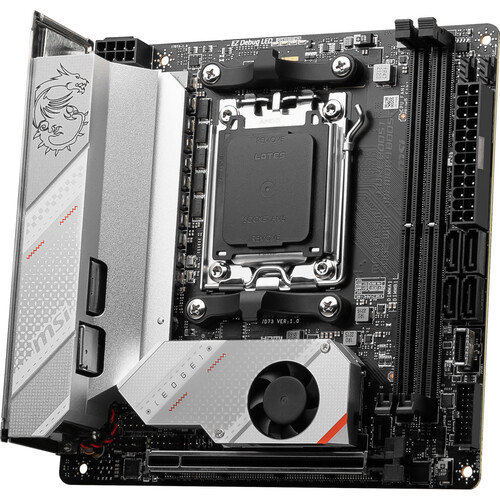
First AMD B650-based motherboards showed up in US store - the cheapest one costs $200

First AMD B650-based motherboards showed up in US store - the cheapest one costs $200

First AMD B650-based motherboards showed up in US store - the cheapest one costs $200

Only the flagship chipset X670 and X670E motherboards are offered for AMD Ryzen 7000 processors, which are not so cheap yet.
In the near future, more affordable AMD B650 and B650E motherboards will be available for sale.
But even among them, it may be difficult to find a budget model.
American retailer B&H Photo Video has published prices of several B650-based motherboards, starting from $200.
MSI MPG B650 Carbon WIFI has the highest price among the reviewed models at $329.99.
At the same price you can find solutions based on the older AMD X670, albeit with basic equipment.
On the other hand, MSI PRO B650M-A WIFI is the cheapest amongst the devices announced by the retailer with a $199.99 price tag.
Of course this is not the full range of new motherboards even from MSI itself - obviously there will be a version of the MSI PRO B650M-A without Wi-Fi module and it will be cheaper.
But don't count on a significant difference.
On average, the price is about $250.
Models are available in Mini-ITX, Micro-ATX and ATX form factors of the MSI PRO, MAG and MPG series.
MSI MEG flagship series will feature only AMD X670 and X670E boards.At the end we should mention that AMD itself at the time of Ryzen 7000 processors and Socket AM5 platform announcement in August announced that the motherboards price for new chips will start from $125.
We would like to add that AMD B650 and B650E motherboards are expected to be announced on October 4.

AMD processor plans: Ryzen 7000 with 3D cache will be released soon, and Threadripper and APU on Zen 4 - by the end of next year

AMD processor plans: Ryzen 7000 with 3D cache will be released soon, and Threadripper and APU on Zen 4 - by the end of next year

AMD processor plans: Ryzen 7000 with 3D cache will be released soon, and Threadripper and APU on Zen 4 - by the end of next year

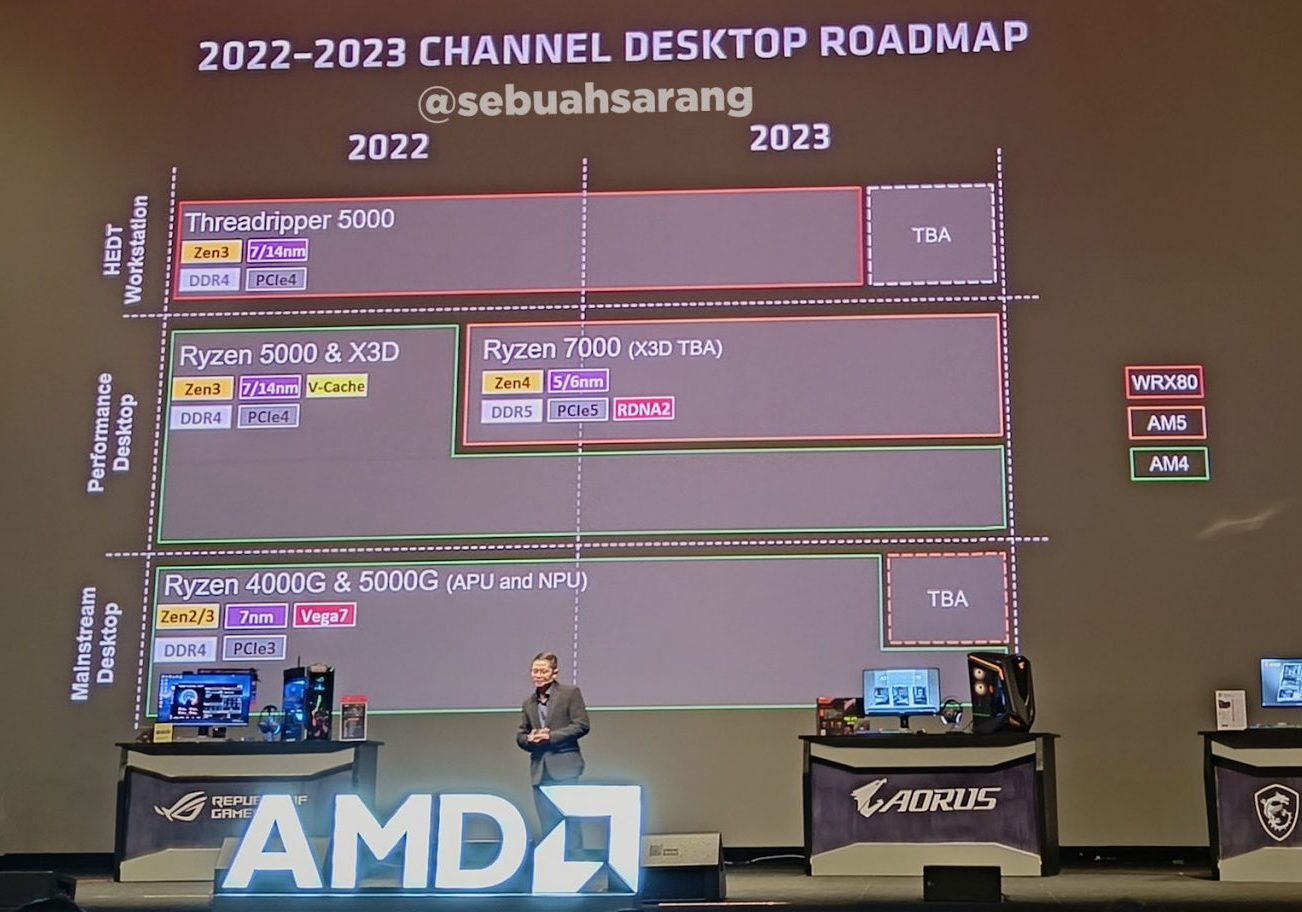
AMD has shared with partners plans for desktop processors in 2022-2023 - a \"road map\", not intended for the public, appeared on the web.
Judging by the presented plan, AMD intends to continue releasing Ryzen 5000, 4000G and 5000G processors under Sunset AM4, and the powerful Ryzen Thredripper 5000 will not get successors until the end of 2023.AMD plans to introduce a new generation of high-performance desktop processors, which will replace the current Ryzen Threadripper 5000, only by the end of 2023.
Their name, as well as details about the characteristics, are not specified.
According to previous rumors, the new items were codenamed Storm Peak, and will probably go on sale as Ryzen Thredripper 7000.
We can assume that these processors will get Zen 4 cores, DDR5 and PCIe 5.0 support, and other Ryzen 7000 features.Also, AMD will continue to produce and sell Ryzen 5000 and 5000X3D processors in parallel with the new Ryzen 7000 at least until the end of 2023.
Also, AMD's slide confirms that the company is preparing Ryzen 7000X3D processors, which will be equipped with additional 3D V-Cache.
Note that Ryzen 7 5800X3D is currently the only desktop processor with extended 3D V-Cache.
And it is one of the company's fastest solutions for gaming, overtaking in some cases even the newly released Ryzen 7000.
So maybe the release of Ryzen 7000X3D processors will allow AMD to strengthen its position in the gaming area.Finally, AMD plans to update Ryzen G-series desktop hybrid processors, which feature quite productive integrated graphics, by the end of 2023.
They will probably join the Ryzen 7000G series and offer a combination of Zen 4 cores and RDNA 2 or RDNA 3 graphics.
At the same time AMD will continue to produce the current desktop hybrid Ryzen 4000G and 5000G processors, even after the release of new products.
Thus it turns out that at least until the end of 2023, the Socket AM4 platform will not lose relevance.

Intel XeSS AI scaling tested on Intel, NVIDIA and AMD graphics cards - results differ

Intel XeSS AI scaling tested on Intel, NVIDIA and AMD graphics cards - results differ

Intel XeSS AI scaling tested on Intel, NVIDIA and AMD graphics cards - results differ

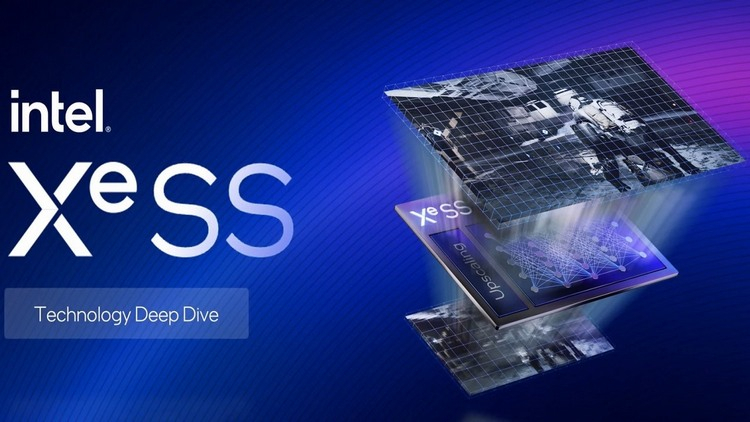
Intel launched XeSS scaling technology this week.
Since Intel's Arc A7 series graphics cards in desktop version are not available yet, new solution can be tested on mobile versions of Arc, budget A380 desktop, as well as AMD and NVIDIA products.
Journalists from Tom's Hardware and PCGamer conducted a series of tests.
Testing was conducted in the game Shadow of the Tomb Raider.Image source: IntelIntel XeSS available in two versions: one designed for cores XMX on Arc processors, and the second works with DP4a instructions, which are supported by most modern graphics cards, including models of families NVIDIA Pascal, Intel Graphics 11th generation, as well as AMD Vega 20, Navi and newer.
Source image: pcgamer.comJournalists from PCGamer took NVIDIA GeForce RTX 2080 Ti graphics card as a test case and compared its performance in three modes: with scaling disabled (native rendering) as well as with XeSS and DLSS.
At 3440 × 1440 resolution, it showed 95 fps, whereas with XeSS and DLSS in Quality mode the results were 112 and 119 fps respectively.Image source: tomshardware.comJournal of Tom's Hardware ran a more thorough testing using previous and current generation NVIDIA and AMD graphics cards at 2560 × 1440 pixels.
The results were quite interesting: Intel XeSS worked on all tested models but not always provided a significant performance boost, and in some cases, there was even a significant decrease in performance.
Authors of the article explained the negative effect due to the fact that some models support DP4a instructions only in emulator mode - this affected, in particular, AMD Vega and Navi first-generation GPUs.Image source: tomshardware.comSignificant increase in performance in some cases, associated with insufficient amount of video memory, although 6 GB - not so little for the game four years ago.
Modern models of video cards mainly confirmed the effectiveness of XeSS compared to native rendering.
Especially curious was the result for budget Intel Arc A380, whose performance, varying the settings, managed to increase from the \"native\" 26.5 to 58.7 frames per second - more than twice.