Showing posts with label analytics. Show all posts

12.09.2022

Next year the desktop market will almost stop falling

Next year the desktop market will almost stop falling

Next year the desktop market will almost stop falling

Not the easiest year for the computer market is coming to an end, so DigiTimes Research experts have shared their forecasts for next year and summed up the current one.
The latest one for the desktop market, according to the authors of the study, was not as bad as the one for laptops.
The supply of mobile PCs fell by 20%, and desktop PCs fell by only 11%.
Next year, the decline in the desktop market will be limited to 2.1%.Image source: AppleAccording to the source, during the three quarters of this year, the corporate sector supported the demand for desktop systems, and only in the fourth quarter should the volume of their shipments consistently fall by 11.7%.
Most manufacturers have accumulated impressive inventories in their warehouses, so they are in no hurry to deliver new products to customers.For all of 2022, DigiTimes Research predicts that 86.4 million desktops will be delivered globally in finished form.
That's 10.9 percent less than the results for 2019, which is taken as a base for comparison because of the lack of a pandemic factor.
Next year, no more than 84.6 million desktops will be delivered to the market, a decline of 2.1% from this year.In the first quarter of the outgoing year, 21 million desktops were delivered, in the second quarter shipments peaked at 24.3 million units, but in the third has already dropped to 22 million.They are expected to fall to 19.2 million units in the fourth quarter.
Almost 13% of the segment is comprised of all-in-one, one-piece computers.
By the end of the year 11.06 million units should be delivered.
The peak of popularity of such PCs reached in 2021, when 14.32 million units were sold.
For this reason this year the number of monoblocks shipped on the market will decrease by 22%.The largest contract manufacturer of monoblocks previously was Quanta Computer, which serves the interests of Apple, but at the end of the year it dropped to the third place.
Compal and its main client Lenovo is on the second place, and the first this year will go to HP Inc.
Wistron, which produces monoblocks for Dell, will be in fourth place.
The three Taiwanese contract manufacturers together control 72% of the market.
Next year, shipments of desktop monoblocks could grow by several percent, according to DigiTimes Research analysts.
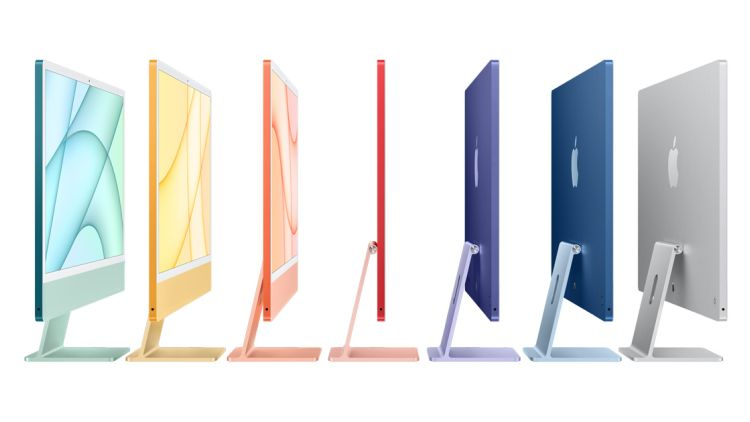
In their view, a return to growth in demand for Apple iMacs should contribute to this.

11.29.2022

If the chip production in Taiwan stops completely, the industry will need at least 5 years to recover

If the chip production in Taiwan stops completely, the industry will need at least 5 years to recover

If the chip production in Taiwan stops completely, the industry will need at least 5 years to recover

The meeting of top political leaders of China and the US was designed to ease tensions in the Taiwan issue.
A significant portion of semiconductor components are manufactured in Taiwan, and stability in the region is extremely important for the entire global economy.
Some experts believe that in the case of a complete shutdown of Taiwan enterprises, the semiconductor industry will be able to recover only in five years.Image source: TSМSimilar estimates in his interview with Barron's shares the author of the book \"War for chips: the battle for the most important technology in the world\" Chris Miller - Tufts University professor from the United States.
In his opinion, the U.S.
authorities underestimate the possible consequences of a regional conflict that could put Taiwan`s enterprises out of business.
Not only do the island produces up to 90% of advanced semiconductor components, but also the local production volume of chips is so large that no other region in the world can compete with it so far.
Up to a third of the annual increase in computing power in the world is provided by Taiwanese enterprises, according to expert estimates.
In the professor's opinion, the semiconductor crisis of 2020 and 2021, which paralyzed the work of the global automobile industry, is only a pale shadow of the likely problems that an armed conflict involving Taiwan would cause.
Even the PRC's \"nonviolent\" methods of influencing the island's economy can have a significant impact on the determination of Taiwan's leadership to remain independent.By the way, Chris Miller highlights the role of qualified personnel in the formation of the modern semiconductor industry.
The same founder of TSMC, Morris Chang, according to the author of the book, is the man to whom the whole world should be grateful for the technology we now have at our disposal.
For the United States, however, it is important to maintain a sensible immigration policy, since many of the leaders of major technology corporations are migrant workers or their direct descendants, and their role in shaping U.S.
industry and the economy is hard to dispute.

11.18.2022

NVIDIA gaming revenue collapsed by more than half, but server revenue grew by 31%--the company's net income fell by 72%

NVIDIA gaming revenue collapsed by more than half, but server revenue grew by 31%--the company's net income fell by 72%

NVIDIA gaming revenue collapsed by more than half, but server revenue grew by 31%--the company's net income fell by 72%

NVIDIA's long-awaited quarterly report was not a complete disappointment for analysts, as revenue of $5.93 billion slightly exceeded their expectations, and only earnings per share of $0.27 missed forecasts.
On the other hand, NVIDIA expects revenue in the fourth quarter not to exceed $6 billion, while investors were expecting a little more at $6.09 billion.
Only the server and automotive segments maintained positive year-over-year revenue dynamics.Source image: NVIDIAIn this area NVIDIA's revenue in the third quarter rose by 31% compared to the same period last year to $3.833 billion.
In fact, about 65% of all revenue in the last quarter the company received exactly from sales of components for data centers, and the presence of positive Consistent growth was hampered by weak demand in China, but even so, revenue increased by 1%.
As for the impact of U.S.
sanctions on the supply of calculator gas pedals in China, NVIDIA managed to largely offset it by the supply of alternative solutions to the PRC market - we are talking about recently introduced A800.The total revenue of the company at the same time decreased by 17% year-on-year, to $5.931 billion.
Consistent decline reached 12 %.
In the gaming segment, the company generated only $1.574 billion in revenue, down 51% from the same quarter last year, and down 23% from the second fiscal quarter.
By the way, the fourth quarter of fiscal 2023 is already on the NVIDIA calendar, so the captions in the table may be confusing to the uninformed reader.Image source: NVIDIAAccording to NVIDIA representatives, the dynamics of gaming revenue in the third quarter reflected the decline in supply of GPUs to its partners, who had to find ways to reduce accumulated inventory as quickly as possible.
Demand for graphics cards was undermined by both macroeconomic problems and the impact of lockdowns in China.
While a 51 percent year-over-year decline in gaming revenue was blamed on declines in both desktop and mobile graphics chip sales, the 23 percent sequential decline was primarily driven by mobile graphics solutions.There were few comments from the CFO about the impact of the cryptocurrency sector on NVIDIA's business.
According to Colette Kress, the transition of Ethereum to a new mathematical model reduced the degree of suitability of video cards for cryptocurrency mining.
In turn, this contributed to the influx of used graphics cards in the secondary market and reduced the demand for new graphics cards in some regions of the world, especially in its budget part, according to NVIDIA.In the direction of professional visualization NVIDIA's revenue decreased by 60% to $ 200 million, in annual comparison, the decline reached 65%.
In contrast, the automotive segment increased 86 percent to $251 million in year-over-year revenue and 14 percent in sequential revenue - primarily due to demand for autopilot systems.
For OEM and other, NVIDIA revenue decreased 69% year-over-year to $73 million and sequential revenue decreased 48%.
Sequential decrease in NVIDIA explain the decline in demand for Jetson platforms and components for notebooks, and revenue from sales of CMP gas pedals for cryptocurrency mining in the past quarter was negligible, although a year ago, reached $ 105 million.
Operating expenses of NVIDIA in the third quarter rose by 7% sequentially to $ 2.576 billion and by 31% year on year.
Operating income increased 20% sequentially to $601 million, but was down 77% year over year.
Net income rose 4 percent sequentially to $680 million, but was down 72 percent year over year.
NVIDIA's revenue per share also fell proportionally, from $0.97 last year to $0.27 this year.
It is noteworthy that NVIDIA's overall revenue in the segment of computing and network solutions grew by 27% year over year to $3.816 billion, although as you can guess in this case, the company helped the server segment.
Graphics sales alone were 24 percent less than the previous quarter, and 48 percent less than the year before - only $2.115 billion.
As a side note, NVIDIA was forced to write off $702 million in the third quarter due to a backlog in its inventory, but it was mainly due to problems with its server component A100 sales in China.
The breakdown was as follows: $354 million was for products that were already in stock, while $34 million was for products that were out of stock.

11.04.2022

Qualcomm: smartphone sales will fall more than 10% this year, and Apple will not give up its modems in 2023

Qualcomm: smartphone sales will fall more than 10% this year, and Apple will not give up its modems in 2023

Qualcomm: smartphone sales will fall more than 10% this year, and Apple will not give up its modems in 2023

In the third quarter Qualcomm managed to increase revenues by 22% to $11.39 billion, but not the most optimistic forecast for the smartphone market caused the company's stock price to decline by 7.56% after the close of trading.
According to this provider of mobile processors, at the end of the current calendar year, the smartphone market will shrink not by 5-6%, but by 10-12%.
Since the beginning of this quarter, the company will also stop hiring new staff.Image source: Qualcomm TechnologiesIn the current quarter, as stated by representatives of Qualcomm, the company's revenue will be in the range of $9.2 to $10 billion, which is a couple of billion dollars below the most modest expectations of analysts.
Apparently, this also contributed to Qualcomm's share price decline after the release of financial statistics.
The company's representatives also noted that a sharp decline in demand and an improvement in the supply of components led to an increase in product inventories.
Qualcomm will have to spend the accumulated surplus products in the warehouses for about a couple more quarters.
The company has been running QCT, which supplies chips for smartphones and other devices that transmit data over wireless channels, and has generated $9.9 billion in revenue last quarter, up 28 percent from the same period last year.
Smartphone chip shipments brought Qualcomm $6.57 billion in revenue last quarter, increasing revenue by 40% over the same quarter last year.
The automotive business grew 58% to $427 million, while the Internet of Things added 24%, giving Qualcomm a core revenue of $1.92 billion.
Finally, radio frequency components dropped 20% to $992 million.Technology licensing and patents brought Qualcomm $1.44 billion last quarter, up 8% from a year earlier, but this revenue line still fell short of analysts' expectations.
The head of the company, Cristiano Amon, acknowledged that Qualcomm cannot stay away from the negative impact of macroeconomic conditions on the entire semiconductor industry.
Operating costs are expected to be reduced not only by suspending the expansion of the staff from October this year, but also by other measures.
Regarding the relationship with customers, it was said that the license agreement with Samsung Electronics has been extended until 2030, and in the next quarter the Korean giant will increase the share of Qualcomm chips in its mobile devices.
Almost all of the iPhones next year will use Qualcomm modems, though the company previously expressed fears that it will not get more than 20% of Apple's orders because it has time to introduce modem solutions of its own design.
In a couple of years, in the opinion of Qualcomm's management, Apple will still be able to almost completely abandon the components of the first brand.
According to the forecasts of Bloomberg, the first smartphones Apple with modem components of its own design will not appear until 2024.

11.03.2022

AMD's number of customer processors shipped in the third quarter fell 43%

AMD's number of customer processors shipped in the third quarter fell 43%

AMD's number of customer processors shipped in the third quarter fell 43%

At the quarterly reporting event, company executives talked about changes in the processor supply mix only in relative terms, but the 10-Q reporting form released later allowed for specific numerical figures.
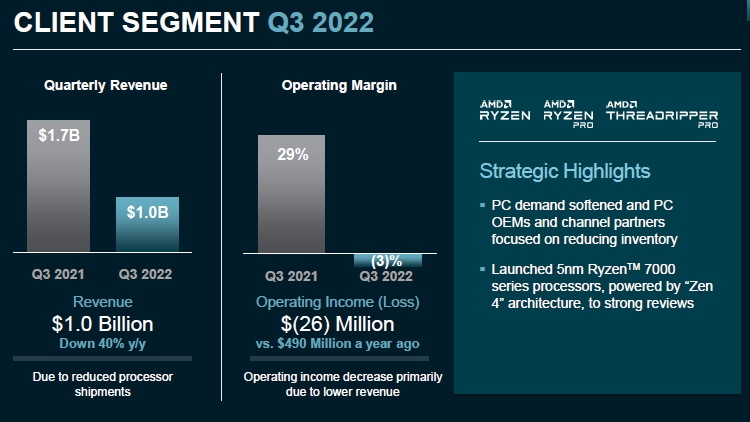
AMD said the number of CPUs shipped in the quarter was down 43 percent, though the year-over-year average selling price was up 5 percent.Source image: AMDRemind that AMD's third-quarter revenue in the customer segment fell 40 percent from $1.7 billion to $1.0 billion, due to significant inventory build-up in customers' warehouses while demand decreased.
While AMD has seen a 43 percent year on year decline in volume terms for the segment, the average selling price has even increased 5 percent although yesterday AMD officials said the number was down in sequential terms.AMD attributes the decline in processor shipments in volume terms to an accumulation of substantial inventory in the customer warehouse and a decline in demand for the product, but the year on year increase in average selling price is due to an increase in the share of more than 10 percent of the total sales volume.
In this comparison, the number of CPUs sold to customers has decreased by 18%, and their average price has increased by 28%, but in this case due to the shift in demand towards more expensive mobile Ryzen models.
Apparently, by the third quarter, the moment of inertia in sales of mobile processors AMD exhausted itself, and only desktop versions of Ryzen among the more expensive ones were in sane demand.
By the way, AMD explained how its revenue changed in the gaming segment, which includes not only discrete graphics cards, but also components of game consoles.
On an annualized basis in the third quarter, it grew 14% from $1.4 billion to $1.6 billion, but since the beginning of the year growth reached 34% and corresponded to the level of revenue of $5.2 billion.
The engine of growth were gaming consoles, as noted yesterday, but gaming graphics cards have not only declined in revenue, but also reduced the number of shipped units.
The weakness in video card demand is attributed to worsening macroeconomic conditions.

11.02.2022

AMD prepares for further revenue decline - PC market situation will improve only in 2023

AMD prepares for further revenue decline - PC market situation will improve only in 2023

AMD prepares for further revenue decline - PC market situation will improve only in 2023

AMD quarterly conference revealed that the company's revenue in the consumer segment on the background of declining demand for new PCs decreased by 40% compared to the same period last year.
At the same time, the trends in which the market is developing at the moment are not so unambiguous as to characterize them by any single definition.
It is only clear that now the market is falling, but recovery is not far off, believe AMD.Source image: AMDFirst, AMD CEO Lisa Su (Lisa Su) explained that revenue in the client area in the third quarter decreased, among other reasons, due to lower number of processors sold.
Their average selling price also declined in a sequential comparison, as more expensive processors were depleted faster in terms of inventory.
In year-on-year comparisons, the average selling price went up, and this can be explained by the continuing tendency to shift the focus towards more expensive models.
The head of AMD even added that the company's position is strong in the premium, gaming and corporate customer market segments, and it expects to strengthen its position in these areas going forward.
In the long term, the price structure of AMD products supply in the client segment should not change, as the head of the company is convinced.As noted earlier today, AMD management expects to reduce the number of computers sold in the whole market by 20% this year, and next year's decline will be limited to 10%.
The company will continue to actively get rid of inventory in the fourth quarter, and this process is somewhat accelerated in a sequential comparison, and in general by the end of the year AMD will be in better shape, but it should be understood that the revenue in the current quarter slightly reduced in the client segment, as well as in the gaming.
In the latter case, such dynamics can be explained by the fact that the peak demand for components for gaming consoles occurred in the third quarter, and in the fourth quarter it traditionally declines.
New gaming video cards with RDNA 3 architecture, which will be presented this week, though will be able to revive the market in the fourth quarter, losses from the decline in demand for game consoles components will not be able to cover.
But next year AMD expects to maintain revenue in the gaming segment at the level of the current year, which, given the high base effect formed by the last stages of the cryptocurrency boom is quite optimistic.In general, speaking of the PC market, AMD management expects to overcome major problems in the current quarter and early next year, and the rest of 2023 should already contribute to the PC market recovery, according to Lisa Su.
In the customer segment, she promises to introduce some new products (most likely the new Ryzen 7000), which, combined with the recently announced Ryzen 7000 processors, will help revive interest in the brand's products.Moreover, at retail, even in the third quarter, sales volumes of Ryzen 5000 processors grew, according to Lisa Su, but only when it comes to desktop models.
With the expansion of the range of motherboards with socket AM5 more affordable models in the current quarter will increase the popularity of the new family of Ryzen 7000 processors, as the company's management expects.
AMD is not ready for the aggressive pricing policy for the sake of reducing the inventory, because it is important for it to maintain the profitability indicators.
Last year, for example, the company did not fight for the segment of Chromebooks, because it was based on too cheap processors, the release of which was unprofitable for the company.

Ryzen processor sales collapsed by 40% - AMD has negative profits in the customer segment

Ryzen processor sales collapsed by 40% - AMD has negative profits in the customer segment

Ryzen processor sales collapsed by 40% - AMD has negative profits in the customer segment

AMD quarterly report was released a few hours ago, and in terms of revenue dynamics only slightly disappointed analysts, who were ready for the loss of the former momentum of the PC market.
The company's total revenue was up 29% year-over-year, but in the consumer segment it collapsed by 40% due to Ryzen processors, and had to end the quarter with operating losses in this area.Image source: AMDNet revenue for AMD fell 93% to $66 million, but the company attributes this to the costs associated with the Xilinx takeover deal.
At the end of the quarter AMD's revenue was $5.6 billion, and while a 29% increase in annualized terms cannot be characteristic of previous quarters, it still looks decent against the backdrop of competitors.
Profit margin decreased during the year from 48% to 42%, operating expenses increased by 113% to $2.43 billion, and the quarter ended with an operating loss of $64 million.
The company explains this by the growth of expenses on research and development, as well as by the consequences of the Xilinx takeover deal.
Due to the need to reduce inventories and review product prices in the past quarter AMD lost at least $ 160 million.Image source: AMDAs the head of the company Lisa Su (Lisa Su) said at the conference call, \"the third quarter was worse than we expected because of the deteriorating PC market and a significant correction of inventories in the supply chain in this segment.
In fact, the value of inventory at the end of the quarter increased 77% to $3.37 billion.
Even in such a difficult environment, the CEO added, the company managed to increase revenue in the data center, embedded and gaming solutions segments.
At least in the area of game consoles there was a positive trend.Image source: AMDIn the segment of data centers revenue grew by 45% year on year to $1.6 billion due to the popularity of central processors EPYC family.
Operating profit rose from $308 million to $505 million, and the operating margin rose from 28% to 31%.
The past quarter was AMD's tenth consecutive quarter in which its server processor sales volumes in cash terms broke a record.
EPYC processors of new Genoa generation are in high demand, as pointed out by AMD, although their formal announcement is only scheduled for November 10.
Shipments of Xilinx Programmable Matrixes and Pensando Computing Accelerators are up noticeably.
Lisa Su said she expects revenue growth in the server segment next year, especially cloud solutions in the U.S., but the Chinese market will be weak.Image source: AMDIn the client segment, AMD saw a 40% drop in revenue to $1 billion compared to the same quarter last year.
Processor shipments declined due to inventory surpluses while demand in the PC market declined, all of which resulted in an operating loss of $26 million in the segment.
Nevertheless, the shift in the supply mix in favor of the more expensive Ryzen desktop models allowed the average selling price to increase year-over-year.
The company only needs to add that the Ryzen 7000 processors with Zen 4 architecture introduced in the last quarter received praise in published reviews.
By the end of 2023, according to Lisa Suh, the capacity of the PC market should shrink by 10%.
This year, the market will shrink by the full 20%.Image source: AMDIn the gaming segment, which recently includes both graphics cards and components for gaming consoles, AMD managed to increase revenues by 14% year-on-year to $1.6 billion.While revenues in the direction of graphics cards declined, gaming consoles provided a positive trend, partially compensating for this.
In fact, gaming console components have been breaking revenue records for six consecutive quarters.
Operating profit in this segment fell from $231 million to $142 million.
The company had to generate less revenue from graphics solutions and faced increased inventory, as well as downward price adjustments.
The operating profit margin dropped from 16% to 9%.
Gaming consoles were in high demand because of Microsoft and Sony's preparations for the new season.
On the profile slide of the presentation AMD also did not forget to mention the preparation for the announcement of graphics solutions generation RDNA 3 with chips produced by 5nm technology.
Novelties are to significantly increase performance compared to current generation products.
As expected, they will be presented this week.AMD's revenue in the segment of embedded solutions grew by an impressive 1549% to $ 1.3 billion as a result of changes in the accounting structure and the acquisition of Xilinx at the beginning of the current

10.31.2022

Intel says it's already winning back its position in the PC market from AMD and isn't going to stop

Intel says it's already winning back its position in the PC market from AMD and isn't going to stop

Intel says it's already winning back its position in the PC market from AMD and isn't going to stop

Intel management at its quarterly reporting event began by saying that revenue in the customer area, while down 17% year over year, has consistently grown by 6%.
The sales structure of Intel components in this sector changed so that the average selling price increased.
The company was able to strengthen its position in the customer segment, and the Intel management is full of confidence that it will be able to do so in the future.Image source: Intel CEO Patrick Gelsinger even let it slip that in the third quarter Intel stepped up work with those of its customers who were willing to accelerate the purchase of the product in light of the upcoming price hikes in the fourth quarter.
According to the company's management, this led to the strengthening of Intel's position in the client segment in the third quarter.
At the same time, revenue in the segment as a whole fell by 17% year-on-year due to the majority of customers having excess products in stock.If we consider revenue from products for the desktop segment, in the third quarter, Intel's revenue increased by 3.3% year-on-year to $3.22 billion, which for the declining market as a whole is not so bad.
In the notebook segment, revenue for the year was down 25.8% to $4.4 billion.
As Patrick Gelsinger pointed out, in the PC segment the company has \"fundamentally increased its market share\", and its existing product lines in terms of competitive positioning are very strong.Intel management is not confused by the possibility of a decline in PC sales in the global market to levels below those seen before the pandemic, although they are convinced that this will not happen at all.
It's just that so many computers were sold during the pandemic that if they have to be replaced sooner or later with new ones, Intel will definitely get its piece of the pie.
According to Gelsinger, Intel's product line is positioned in such a way that it can expect to further increase its market share.
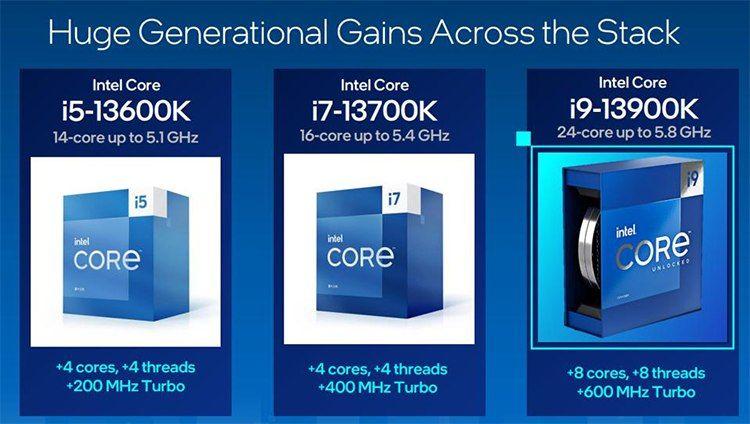
Moreover, the sagging demand is more pronounced in the segment of low-cost PCs, and Intel is now focusing on more expensive offerings.As the head of Intel added, Alder Lake and Raptor Lake processors are showing impressive performance, and preparations for the Meteor Lake release next year are in full swing.
The recently unveiled Raptor Lake processors do show superiority over existing AMD solutions in terms of performance, according to independent tests.
At the same time, Intel products also turn out to be cheaper, so it is easy to explain the confidence of the company's management in the revenge on the consumer market.

Intel has returned to profitability despite falling revenue

Intel has returned to profitability despite falling revenue

Intel has returned to profitability despite falling revenue

Intel Corp.'s third-quarter revenue fell 15% to $15.3 billion, in full compliance with its management's projections.
By the middle of the decade, Intel hopes to cut annual expenses by $8-10 billion, with savings reaching $3 billion as early as next year.According to the head of the company, staff cuts will not be a significant factor in savings, although they will start already in the current quarter.Image source: Intel Net income at Intel in the past quarter fell by 59% from $5.9 to $2.4 billion using Non-GAAP method and operating profit margin fell from 31.8 to 10.8 %.
Profit margin fell from 58.3% to 45.9% year over year.
At the same time, the company managed to increase spending on research and development by 12% to $5.4 billion.
Intel was forced to end the quarter with operating losses, but due to the tax refunds it showed a net profit.
The period ended with an operating loss of $175 million, but a net profit of $1.02 billion.In the client computing area, which is most dependent on PC market conditions, Intel's revenues fell 17% year over year to $8.1 billion, but grew sequentially by 6% due to an increase in average selling price.
Intel expects PC sales to dip 15 to 19 percent this year, primarily in the consumer and education sectors, as well as inventory adjustments in the OEM segment, but year-over-year sales should remain above pre-pandemic levels for the foreseeable future.
At the end of next year, PC sales should either remain at current levels or decline slightly.
According to the Intel representatives, from 270 to 295 million computers will be sold next year.
The head of the corporation even said that Intel was able to significantly strengthen its position in the PC segment in the third quarter.Image source: IntelIn the server segment last quarter, revenue at Intel dropped by an impressive 27% to $4.2 billion, but in the reporting documents the company proudly announced that it had started production of those models of processors Sapphire Rapids family, which were aimed at mass consumption, and also expects to slightly increase its market share in this segment by the end of the year.
In the past quarter, Intel's server revenue was undermined by weak demand in the Chinese corporate sector.Image source: IntelThe immediate issue of the upcoming staff reductions at the quarterly event Intel management spoke reluctantly, only noting its inevitability.
Intel's freelancers and contractors will be the first to suffer, they will feel Intel's desire to save money as early as this quarter.
Marketing and advertising costs will be cut.
Quantitative figures for staff reductions are not specified, but CFO Davis Zinsner let it slip that they will be significant.
CEO Patrick Gelsinger added that production costs would be prioritized over payroll in the search for cost savings.
By early October, the company had 131,500 employees.According to Intel's management, the company is on track to implement a plan to master five new process technologies in four years.
There were no delays in learning Intel 4 and Intel 3 technologies, the first prototypes of chips made with the Intel 20A and Intel 18A technologies were already running in the company's labs, and this also applies to products for a large third-party customer - at least the digital design of the respective product is ready and the first working samples exist.
In the customer segment, the company is going to introduce Meteor Lake processors (Intel 4) next year, at the same time Emerald Rapids servers will appear.
On schedule, the company is preparing to launch server processors in 2024.
The Meteor Lake series stepping design should be completed this quarter, and Intel's server segment managed to get the first Intel 3 Granite Rapids processor components last quarter, systems based on their samples are already working in Intel labs.
For the first time, the company will use ultra-hard ultraviolet (EUV) lithography as part of its Intel 4 and Intel 3 processors.
This will endow the respective products with breakthrough performance in terms of performance per watt of power consumption and density, according to Intel.Image source: IntelSome of Intel's business areas showed positive revenue growth in the third quarter.
Among them were networking and edge computing solutions, which grew revenue 14% to $2.3 billion and kept operating income at $75 million, despite an 85% decline from the same period last year.

10.24.2022

AMD Ryzen sales plummeted by 40% last quarter - company underperformed by $1 billion, shares fell

AMD Ryzen sales plummeted by 40% last quarter - company underperformed by $1 billion, shares fell

AMD Ryzen sales plummeted by 40% last quarter - company underperformed by $1 billion, shares fell

The third fiscal quarter is barely over on the calendar of many companies, but that doesn't stop them from summing up the preliminary results of this reporting period.
AMD did not wait for full statistics to be published, and this week was forced to admit that revenue fell short of its own expectations by an average of $1 billion, and in the client area, mainly represented by Ryzen processors, and even fell by 40% year on year.Image source: AMD Management said that in the third quarter the company generated no more than $5.6 billion, while its own forecast earlier mentioned a range of $6.5 to $6.9 billion.
Profit margin instead of the expected 54% was barely close to 50%.
Such statements caused the decline in the company's share price after the end of the trading session by 4.5%.Speaking about the results of the quarter in more detail, CEO Lisa Su (Lisa Su) said that \"the PC market in the past quarter significantly sagged.
Even AMD's competitive range of desktop and mobile processors could not overcome the negative macroeconomic trend and customers maintaining substantial inventory of products yet to be sold.Specifically on the customer side, AMD reduced revenue by 53% sequentially and 40% year over year, to $1 billion.In the data center segment (server processors and gas pedals) revenue increased by 8% sequentially and 45% year over year, to $1.8 billion.
The Gaming segment (graphics and console chips) was another \"ray of light in a dark realm,\" with core revenues flat quarter over quarter, up 14 percent year over year to $1.6 billion.
Finally, the Embedded Solutions business increased revenues by 4 percent sequentially to $1.3 billion, primarily as a result of the Xilinx acquisition completed this year.
AMD incidentally had to write down $160 million due to product price adjustments and unrealized product inventory.
It is noteworthy that operating expenses in the third quarter even decreased from $1.6 to $1.5 billion against expectations.By the way, overall AMD revenue decreased by 15% only in sequential comparison, in annual terms it increased by a solid 29%, although against the background of the achievements of previous quarters such dynamics and does not seem expressive.

9.22.2022

Intel and AMD are poised for a worse PC market this year than predicted

Intel and AMD are poised for a worse PC market this year than predicted

Intel and AMD are poised for a worse PC market this year than predicted

Intel and AMD executives recently not only spoke at industry analyst conferences but also met with them privately.
Bernstein experts, for example, spoke with both Intel CFO David Zinsner and AMD server division head Dan McNamara.
Both believe that the third quarter was worse than expected, and therefore the results of the whole year may adjust accordingly.Image source: AMDAt least, this forecast is true for the PC market.
According to Zinsner, the situation in this market has deteriorated more than the 10 percent reduction laid down in the July forecast relative to the results of 2021.
Intel's CFO is not yet ready to give specific figures for the decline, but added that the situation in the server segment has also deteriorated due to weaker demand in China and the difficult macroeconomic environment.AMD representative in his comments to analysts Bernstein made it clear that the PC market is now in turmoil, and customers are showing demand below expectations.
Earlier the company had expected the PC market turnover to shrink by 15% for the year, but now there is every chance that the reality will be worse than expected.
In spring both companies were counting on the improvement of the PC market in the second half of the year, but now they timidly pin such hopes on the fourth quarter, and only in some areas of activity.
AMD, for example, is convinced that the release of new gaming video cards of this brand will contribute to the growth of demand for profile products in the fourth quarter.

9.20.2022

NVIDIA: gamers need to realize that current graphics card prices are \"normal\"

NVIDIA: gamers need to realize that current graphics card prices are \"normal\"

NVIDIA: gamers need to realize that current graphics card prices are \

Almost halfway through her 40-minute speech at the Goldman Sachs technology conference, NVIDIA CFO Colette Kress was forced to dedicate to the overproduction crisis in the gaming graphics card segment.
According to her, the prices have reached a level close to normal now, and by the spring of next year the company will be able to return to the growth of its product supplies.
Not far off would be the announcement of a new graphics architecture, she confirmed.Image source: NVIDIAIn the previous five years, Colette Kress explained that NVIDIA had been growing revenues in the gaming segment by an average of 20% annually, about half of that increase came from an increase in the average selling price of graphics cards, and the other half was actually due to an increase in the number of graphics cards shipped.
Since the pandemic began, NVIDIA revenue in the gaming segment has increased by 70%, primarily due to an increase in the average selling price, although the volume of shipments also increased.
In the long term, NVIDIA management sees room for further growth in the average selling price of gaming graphics cards, but right now the environment is not conducive to this.
Firstly, the warehouses have accumulated a lot of current generation video cards.
Secondly, the period of pandemic (and cryptocurrency boom - author's note) formed such a high base for comparison, that the figures achieved then will be difficult to overcome in the current economic environment.Speaking about the consequences of the cryptocurrency boom, Colette Kress never dared to quantify the impact of this factor on the company's revenue in 2021, although after the previous wave of \"cryptocurrency fever\" she conducted a corresponding analysis.
The impact of the secondary video card market on the current situation with the sales of new NVIDIA CFO considers limited.
According to her, unlike the used car market, it is very difficult to assess the state of a used video card, and for this reason game lovers prefer to buy new graphics cards.The demand for graphics processors, according to Ms.
Kress, is very high even now, just a large number of finished products in stock, and therefore the company has to reduce the volume of supply from its side.
\"Our ultimate goal is to meet that demand, and to help people realize that graphics processor prices are already close to normal levels, which is what we were hoping for,\" the NVIDIA CFO said.
The company is working to get rid of inventory surpluses through pricing methods to stimulate demand.
The situation will normalize in a couple of quarters or so.
According to Colette Kress, by the end of the fourth fiscal quarter (i.e.
January), we could already be talking about normalization of graphics card inventory in stock.
In the period from February to April, the supply of chips for gaming graphics cards from NVIDIA should return to growth.Characteristically, the company has a surplus production in the segment of solutions for professional visualization.
That is, the problem with the imbalance of supply and demand do not exist only in the gaming sector.

In a year and a half of the cryptocurrency boom, AMD and NVIDIA made as much money on graphics cards as in six years

In a year and a half of the cryptocurrency boom, AMD and NVIDIA made as much money on graphics cards as in six years

In a year and a half of the cryptocurrency boom, AMD and NVIDIA made as much money on graphics cards as in six years

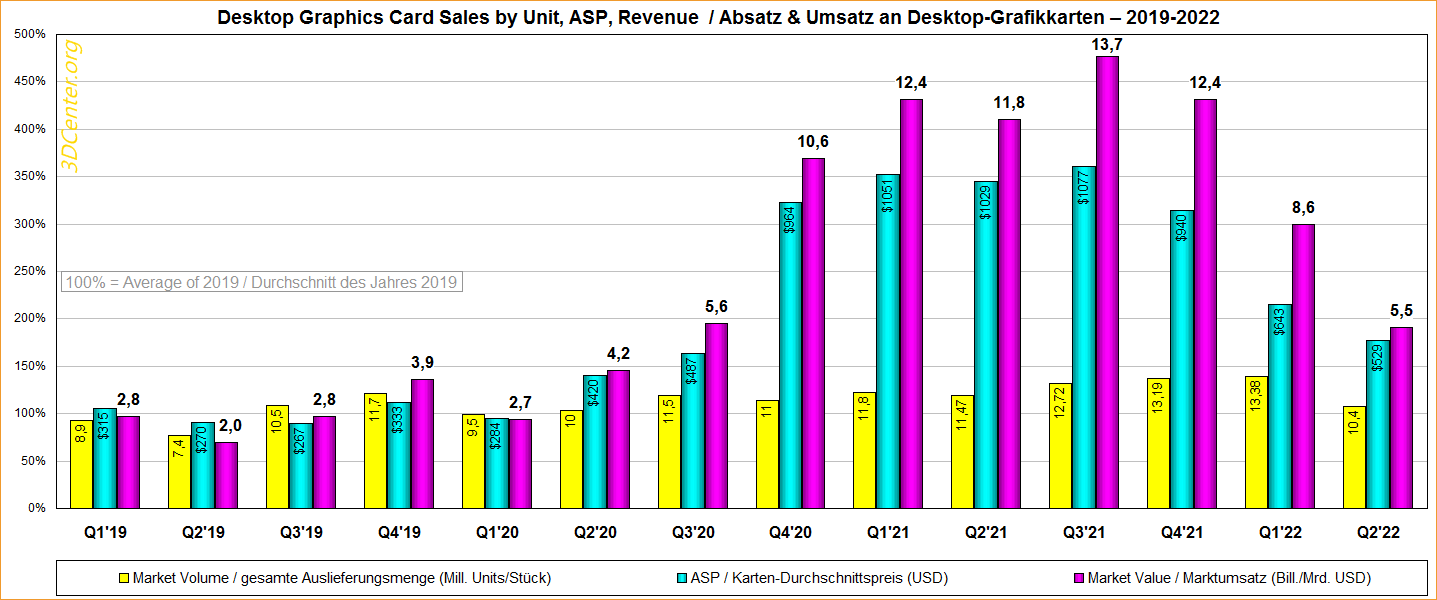
The editors of German-language resource 3DCenter did an enormous job last weekend by analyzing the volume of revenue and sales of graphics cards according to Jon Peddie Research statistics for the last 14 quarters, not including the current one.
The authors of the study concluded that the period of the latest cryptocurrency boom allowed market participants to generate revenue corresponding to six years of normal operation.Image source: NVIDIAThis period should be understood as six quarters, beginning in the fourth quarter of 2020 and ending in the first quarter of 2022.
The average quarterly figures for this period show a marked increase not only in the number of video cards sold, but also in their average price and the resulting revenue.
As might have been expected, the value indicators grew faster than the physical ones.
As a basis for comparison, the authors took 2019, which was not yet affected by the pandemic or the cryptocurrency boom.
On average, video card sales that year averaged 9.63 million units per quarter, revenue did not exceed $2.88 billion, and the average price of a video card was capped at $299.
Image source: 3DCenterIn the midst of the 2021 cryptocurrency boom, the average numbers picked up: video cards sold 27% more in the quarter, revenue rose 302% to $11.58 billion, and the average price jumped more than three times to $945.
If you consider all six quarters combined, the number of video cards sold increased by 41% in annual terms, while revenue increased five-fold.
In fact, as the authors of the study explain, in a year and a half of boom, market participants managed to get the same amount of revenue that in normal circumstances would have taken them six years.Alas, even now video card prices are far from 2019 levels, as they are on average 76% higher and reach $529 per video card.
The authors of the original publication estimate that at least 15.8 million video cards were produced for the needs of miners during the boom year and a half.
If a significant portion of them will flood the secondary market, it will make it difficult for the participants of the primary market to sell new products.
Image source: 3DCenterIt is noteworthy that in the midst of the cryptocurrency boom, AMD received a higher increase in sales volumes of video cards, as it started from lower values, occupying about 20% of the discrete market.
In the fourth quarter of 2021, for example, AMD year-on-year increased its video card sales volumes by half to 3 million units, while NVIDIA was limited to an increase from 9.1 to 10.2 million units.
Obviously, the limiting factor was the production capacity of suppliers, so AMD increased its market share from 17% to 23%.
In the first quarter of this year, AMD's share generally increased to 24%, but by the second quarter it managed to fall to 20%.

9.12.2022

For NVIDIA, the situation in the gaming graphics card segment will start to change for the better in January

For NVIDIA, the situation in the gaming graphics card segment will start to change for the better in January

For NVIDIA, the situation in the gaming graphics card segment will start to change for the better in January

Like NVIDIA management, outside analysts are expressing hope that the release of new GeForce RTX 40 family gaming graphics cards, combined with efforts to rid inventory from previous generation products, will allow the company to overcome the acute phase of its overproduction crisis by the end of this year.
The fourth quarter should be the toughest period for NVIDIA in the gaming market.Image source: NVIDIAAnalysts at Stifel this week stressed that NVIDIA has an excellent long-term outlook, but the short-term remains murky as it is difficult to predict when it will get rid of surplus gaming GPUs and begin to build core revenues again.
The market for computing gas pedals in the long term can provide NVIDIA to enter the segment with an annual turnover of up to $1 trillion, and the company will get a significant share of this market.Demand in the gaming segment will not grow until the end of the current fiscal year, which in the calendar NVIDIA will end by the end of January, as explained by representatives Stifel.
In terms of the prospects of demand recovery in the gaming segment, the fourth quarter will be the \"bottom\" from which NVIDIA will further push on its way to revenue growth.
In addition, in the fourth quarter, the company's revenue will be positively influenced by the beginning of mass deliveries of calculation gas pedals with Hopper architecture.
Now, according to the representatives of Stifel, NVIDIA significantly limited the supply of gaming graphics processors, and the release of new products from the family Ada Lovelace will push them to increase, but the revenue will affect not until the next calendar year.

9.09.2022

Intel CEO says that the company will continue to lose market positions, but everything will change in 2025

Intel CEO says that the company will continue to lose market positions, but everything will change in 2025

Intel CEO says that the company will continue to lose market positions, but everything will change in 2025

Intel CEO Patrick Gelsinger's strategic plans consider 2025 as a turning point, because by that time the company must not only regain its technological leadership, but also stop bearing the increased costs inevitable in the pursuit of this goal.
Until 2025, Intel will have to lose market share in the server segment, as Gelsinger realizes.Image source: IntelWith his views on the matter, he shared at the recent Technology Conference TMT, as explained by the resource Tom's Hardware.
According to the head of the company, Intel's management proceeds from the principle that its server business increases the turnover every calendar year.
Having reached the bottom in the second and third quarters of this year, Intel expects to bring the business back to growth, but over the next couple of years, these rates will still lag behind the rest of the market, allowing the main competitor to continue to strengthen its position.
Only from 2025 will Intel start to regain its lost position in the server segment, according to Gelsinger.By 2024, Intel expects to find decent competitiveness, and in 2025 to become the undisputed leader in lithography technology.
According to Gelsinger, the Sierra Forest server processors coming out in 2024, which will be manufactured using Intel 3 technology, will be a worthy alternative to server processors on the rival Arm architecture.
Intel's solution will offer an attractive performance to power ratio, and customers won't have to think about migrating software to the Arm platform.
Perhaps the only problem for Intel may be an earlier release of 5-nm AMD EPYC processors with 128 energy-efficient x86-core, which is scheduled for 2023.At the same time, the head of Intel stressed that the company's refusal to release Optane-type memory is not the only step to optimize the areas of its activities.
He attributes the future of the company mainly to logical components, and in the refusal to produce memory Gelsinger even sees a certain ironic symbolism - forty years ago, she already took a similar step, and then her business went up the hill.
What kind of business will be cut next, the head of Intel did not specify.

8.26.2022

NVIDIA reported collapsed sales of graphics cards in the second quarter and expects further decline in the third quarter

NVIDIA reported collapsed sales of graphics cards in the second quarter and expects further decline in the third quarter

NVIDIA reported collapsed sales of graphics cards in the second quarter and expects further decline in the third quarter

NVIDIA management managed to warn investors about the sharp decline in revenue in the gaming segment for the second quarter in advance, so the publication of quarterly reports this week did not end with special shocks.
At least, a 4.5% drop in the company's shares after the close of trading could hardly be called a catastrophe.
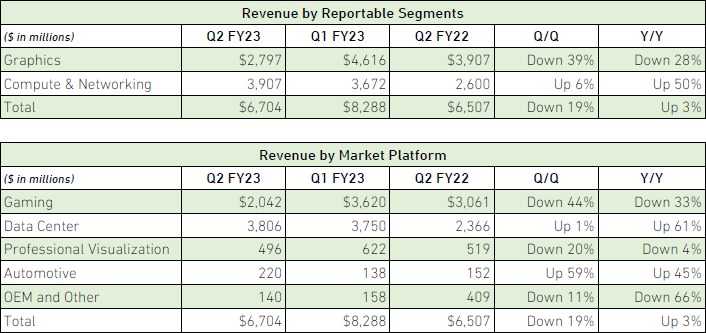
Recall, the company's revenue in the gaming segment decreased by 44% sequentially to $2.042 billion, on a year-over-year basis it decreased by 33%.Source image: NVIDIAIn NVIDIA's quarterly reports there is another segmentation: revenue from graphics solutions decreased by 39% sequentially to $2.8 billion, on a year-over-year basis it decreased by 28%.
The company's total revenue, while falling 19 percent sequentially to $6.704 billion, increased 3 percent year over year, and that was due to the data center and telecommunications segment, which accounted for $3.907 billion of that total.
Deliveries of telecommunications solutions and computing gas pedals, as well as other server components, helped to increase profile revenue by one and a half times compared to the previous year.
Strictly in the data center business, revenue was up 61 percent to $3.806 billion.
Colette Kress, chief financial officer at NVIDIA, stressed that in the server business, revenue was below expectations because of the continued shortage of components.On the reasons for the sharp decline in gaming revenue NVIDIA management preferred to speak evasively in prepared statements, preferring to blame the deteriorating macroeconomic situation for the drop in demand for graphics cards.
At the same time, there was no denying that measures were taken to help reduce the price of graphics cards and increase their sales.
In the third quarter, according to the CFO, difficult market conditions will persist.
A whole paragraph in the material with Colette Kress' comments was devoted to the volatility of the cryptocurrency market, its ability to affect the gaming revenue of NVIDIA and the inability of the company itself to accurately assess the extent of this impact.
It was just noted that the supply of cryptocurrency mining gas pedals to professional market participants for the second quarter in a row almost wiped out, although a year ago it provided the company with $266 million in revenue.Image source: NVIDIAThe transcript of Colette Kress' speech at the quarterly event allows to reveal a little more about the reasons for the decline in gaming revenue in the second quarter.
The decline in demand for gaming solutions in Europe, according to NVIDIA executives, was caused by the Ukrainian events, and in China it was triggered by lockdowns.
Demand for NVIDIA gaming solutions fell harder than expected, with both shipments in quantitative terms and the average selling price affected.
The company is working with partners to adjust retail prices in order to review the positioning of senior models of graphics processors in preparation for the release of carriers of the new architecture.
In the long term, as the company's CFO explained, NVIDIA expects stable demand in the gaming segment.
Colette Kress even said in one comment that \"new gaming products are on the horizon.\" The 61% revenue growth in the data center segment was mainly attributed to an increase in equipment shipments to large customers in North America, while the Chinese segment, due to the difficult economic conditions in the region, created the grounds for negative revenue dynamics.Visualization Solutions business brought NVIDIA 4% less revenue than a year ago, and the sequential decline has reached The company's total revenue in the current period will not exceed $5.9 billion compared to $6.7 billion in the previous period.
This is almost a billion dollars lower than analysts expected, which is why the NVIDIA stock price and rushed down after the publication of statements, which in part of the second quarter was already predetermined.
Gaming and professional imaging solutions will cut into the company's core revenues in the third quarter, management expects.Colette Kress's comment piece explains that NVIDIA's profit margin declined from 66.7% to 45.9% in the second quarter due to one-time expenses of $1.22 billion, mostly related to inventory for the server and gaming market segments.
Of that amount, approximately $570 million was written off due to higher inventory levels and $650 million relates to a liability for purchasing products beyond the quantities required under long-term contracts.

The global semiconductor industry's capital spending for 2021 and 2022 will exceed $338 billion

The global semiconductor industry's capital spending for 2021 and 2022 will exceed $338 billion

The global semiconductor industry's capital spending for 2021 and 2022 will exceed $338 billion

As demand for electronics declines in the consumer sector, it is more common to hear of intentions to cut capital spending from memory manufacturers, which is only natural.
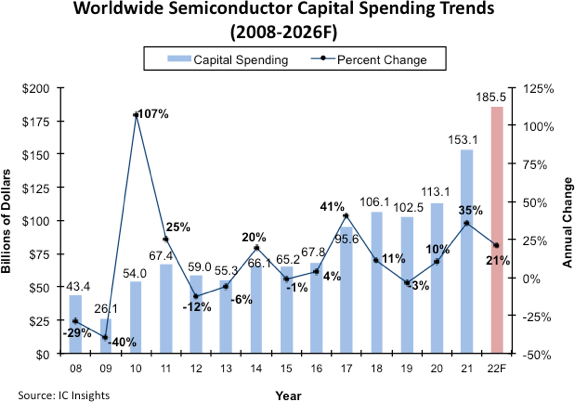
Experts note that even caution, which is currently displayed by some market players will not prevent the semiconductor industry from ending the year with a record $185.5 billion in capex.Source image: IntelAccording to IC Insights, analysts expect the growth of CapEx in the industry to reach 21% by the end of 2022.
This is less than last year's growth of 35%, and less than the forecasted value at the beginning of this year (24%), but the nuance is that for the third consecutive year, the capital expenditure of the semiconductor industry is growing consistently by double-digit percent.
This was last seen from 1993 to 1995 inclusive.Image source: IC InsightsIc Insights analysts previously expected semiconductor capital spending to increase to $190.4 billion this year, but difficult macroeconomic conditions and signs of an overproduction crisis in some market segments suggest that growth will be limited to 21 percent and that spending will not exceed $185.5 billion.
In any case, together with the last year market participants will spend an impressive $338.6 billion for the construction of new enterprises.
At the same time, conveyors of vertically integrated producers of chips are still loaded more than 90%, and contract manufacturers load their capacities at 100%, still not being able to meet the entire demand.
Most likely, as the authors of the forecast summarize, next year the industry will face a decrease in the amount of capital expenditures, as market participants will need to assess the situation after three years of active growth.

8.12.2022

Back in the 90s: Desktop CPU sales have slipped to the level of 30 years ago

Back in the 90s: Desktop CPU sales have slipped to the level of 30 years ago

Back in the 90s: Desktop CPU sales have slipped to the level of 30 years ago

Mercury Research experts this week updated CPU shipments for the second quarter, and it was disappointing for the desktop segment: year-on-year shipment volumes fell by 15 percent, to their lowest level since the mid-1990s.
Source image: AMDAccording to the representatives of the analytical agency, it is the minimum number of delivered desktop processors for any of the quarters from the middle of the last decade of the last century to the present.
In the first quarter, desktop processor shipments declined consistently by a record 30 percent, so the situation the industry is now seeing has been incremental.For more than a decade, according to Mercury Research, laptops have been actively displacing desktop systems.
By the end of last year, PC manufacturers had accumulated a surplus of desktop processors, and these two factors combined to provide a sharp decline in new processor shipments in this segment.However, mobile processors were also shipped 30% less in the second quarter than a year ago.
Shipments of all x86-compatible processors combined in the second quarter declined year-over-year by a record 19% in the 28-year history of surveillance.
Having no data for the period before 1994, Mercury Research experts make the assumption that the PC processor market in the last quarter faced the largest decrease in sales volumes since 1984.
By the way, it did not prevent AMD from increasing its market share of all x86-compatible processors to 31,4% by the end of the second quarter, which is a historical record for this vendor.

8.11.2022

NVIDIA's gaming graphics card sales plummeted 44% in the quarter: Company blames \"macroeconomic situation\"

NVIDIA's gaming graphics card sales plummeted 44% in the quarter: Company blames \"macroeconomic situation\"

NVIDIA's gaming graphics card sales plummeted 44% in the quarter: Company blames \

To brighten a languid Monday evening with unexpected revelations about fiscal Q2 results, NVIDIA decided to admit that total revenue for the period is unlikely to exceed $6.7 billion from the previously forecasted $8.1 billion, and that gaming revenue will be limited to $2.04 billion at all, down 44% sequentially and 33% year over year.
Source image: Getty ImagesFor NVIDIA the publication of preliminary results for the quarter is an event out of the ordinary, and the reason for such extraordinary measures was the lowering of the forecast for gaming revenue in the fiscal quarter, which ended July 31.
In the text of the official press release management of the company preferred to write off all the failures to the \"macroeconomic difficulties\", which prevented NVIDIA partners from selling video cards in stock.
Since the unfavorable macroeconomic conditions are expected to continue in the current quarter, the company decided to make adjustments to the pricing policy, encouraging early sales of stocked gaming graphics cards.
In total, as summarized in an official report, at the end of the second quarter had to write off up to $1.32 billion due to the current situation in the gaming market.Such failures, according to the head and founder of NVIDIA Jensen Huang (Jensen Huang), do not cancel the willingness of the company to serve the growing promising market segments like artificial intelligence systems.
NVIDIA CFO Colette Kress (Colette Kress) added that the significant write-downs in the second quarter were due to large advance payments to the company's suppliers, which were made at a time of severe semiconductor component shortages.
In the near future, NVIDIA will have to focus on maintaining the profitability of the business by limiting the growth of operating costs.
At the same time Colette Kress promised not to refuse to buy back the company's shares, expecting to maintain NVIDIA stable sources of cash.Image source: NVIDIAThe column names in the table above should not be confusing - in the NVIDIA financial calendar at the end of July ended the second quarter of fiscal year 2023.
Previously, NVIDIA had expected to maintain a profit margin in the range of 65.1 to 67.1 percent, depending on the method of calculation, but the actual value of this indicator in the second quarter should approach 43.7 or 46.1 percent, depending on the method.Source image: NVIDIAThe other segments of NVIDIA partially offset the discouraging dynamics in the gaming area, but we must understand that the latter in the second quarter provided the company almost a third of all revenue.
The server segment was the main driver of total revenue, generating $3.81 billion for the quarter, up 1% sequentially and 61% year-over-year.
The professional imaging solutions business declined to $0.5 billion in revenue, down 20% sequentially and 4% year-over-year.
The automotive segment saw revenue rise to $0.22 billion (up 59% sequentially and 45% year over year), but in absolute terms it is still too small an amount to make a serious difference.
Finally, the OEM line of business generated only $0.13 billion in revenue, down 12% sequentially and 66% year-over-year.
In the same period last year, this revenue item was influenced by shipments of specialized CMP gas pedals for cryptocurrency mining, but in the first quarter of this year they almost went to zero.Overall, NVIDIA revenue for the second quarter should decline by 19% to $6.7 billion sequentially, but grow by 3% year-over-year.
The latter element of the dynamics is a credit to the company's predominantly server business.
NVIDIA promises to publish a full quarterly report on August 24, at which time it will be possible to talk in more detail about the factors contributing to such dynamics of changes in the financial performance of the company.
NVIDIA shares opened today's trading session with 8% decrease, but at the moment of writing the difference with the closing rate of the previous session decreased to 4.5%.

7.13.2022

Decline in mining will force NVIDIA to say goodbye to super profits for years to come

Decline in mining will force NVIDIA to say goodbye to super profits for years to come

Decline in mining will force NVIDIA to say goodbye to super profits for years to come

AMD and Intel will report second quarter financial results later this month and NVIDIA will do so only in August, but industry analysts are already forming their predictions about the impact of recent events on these companies.
According to Citi, the decline in demand for gaming graphics cards due to the cryptocurrency market will affect NVIDIA's revenue up to and including 2024.Source image: NVIDIAThe authors of the briefing note explain that two factors will play against NVIDIA: the decline in demand for PCs in general, and increased stocks of graphics cards in retail chains.
According to representatives of Citi, the decline in revenue from gaming products in the next two years will have a negative impact on total revenues, which this year will decrease by 9% of the previously projected level.
Next year, Citi analysts cut NVIDIA's revenue by 7% in their forecasts, and extended the effect of the current phenomena to 2024, reducing the projected revenue for that period NVIDIA by 5%.
The forecast for the price of its shares was lowered from $315 to $285, but it is argued that the weakness of the gaming segment is already built into current quotes - now the price of NVIDIA shares slightly above $150.Experts KeyBanc outlined the prospects of NVIDIA gaming revenue decline more specifically, stating the possibility of its reduction by 20% by the third quarter of 2022 compared to the second quarter.
The second half of the year as a whole, according to the authors of the analytical note, will be difficult for NVIDIA, Intel, AMD and Qualcomm.
Experts believe that NVIDIA shares will rise in price only up to $230, and in the near future the company's revenue will be negatively affected by inflation, the recession in the cryptocurrency market and the approaching announcement of GeForce RTX 40-series graphics cards.AMD will not remain aloof from such phenomena, according to representatives of KeyBanc.
The company's shares will rise to $130 from the current $76.36, and AMD's revenue growth will be limited not only by the decline in demand for PCs, but also by surplus gaming-class GPUs, which will inevitably form after the loss of interest from miners to buy new graphics cards.J.P.
Morgan experts see in the upcoming market trends and factors favorable to NVIDIA.
In particular, demand for server components from cloud service providers, in their opinion, will remain at a high level not only until the end of this year, but next year as well.
Accordingly, this will benefit not only NVIDIA, but also competitors AMD and Intel, as well as Micron and Western Digital Corporation.