Showing posts with label chip. Show all posts

12.28.2022

TSMC celebrated the launch of 3nm chip production in Taiwan

TSMC celebrated the launch of 3nm chip production in Taiwan

TSMC celebrated the launch of 3nm chip production in Taiwan

Earlier this month, TSMC held an event to mark the start of construction of a semiconductor plant in Arizona, and today in Taiwan the company celebrated the start of mass production of chips on the island.
Notably, such ceremonies are quite unusual for TSMC.According to the publication Focus Taiwan, Taiwan's TSMC today celebrates the beginning of mass production of chips in accordance with the 3-nm process technology.
The Fab 18 plant will start producing the latest and most advanced chips on the territory of South Taiwan Science Park in Tainan.It is very important that such celebratory ceremonies are not typical for TSMC.
Analysts do not rule out that the manufacturer demonstrates loyalty to its native island amid large-scale investments in the United States.
Industry experts say the company is holding the ceremony to show it intends to keep Taiwan as a major hub for chip research, development and manufacturing despite the fact that it is now investing heavily at the other end of the world.Note that Apple will be among the first to receive 3-nm chips.
Although Apple is now claiming the A16 chipset is produced according to the 4nm process, in fact TSMC is treating it as a 5nm variant with some refinements.
The first 3nm chipsets that will be available in Apple products will be the M2 Pro and M2 Max, which will be shipped to Macs in 2023.TSMC factories in Arizona will produce 4nm chips first and only later will produce 3nm chips.
The company's Taiwanese plants will begin producing advanced 3nm products first, with 2nm chipsets due to begin production in 2025.

11.18.2022

AMD and Analog Devices have settled a long-standing patent dispute and agreed to cooperate

AMD and Analog Devices have settled a long-standing patent dispute and agreed to cooperate

AMD and Analog Devices have settled a long-standing patent dispute and agreed to cooperate

U.S.
chip maker Advanced Micro Devices Inc (AMD) and Analog Devices Inc (ADI) have decided to wind down litigation related to possible infringement of semiconductor technology patents.
The respective joint press release was issued last night.Image source: AMDThe companies said they have reached agreements on \"mutually agreed terms\" and are \"committed to pursuing technological cooperation to provide next-generation solutions to their customers from the communications and data center markets.\" Details of the agreement were not disclosed, and representatives from both companies have so far refrained from commenting.The issue arose back in 2019, when Massachusetts-based ADI filed a lawsuit against Xilinx Inc, now part of AMD.
ADI claimed that technology used in chips that enable wireless communications and developed by Xilinx violated some patents related to converting analog data to digital data.ADI claimed that Xilinx copied its innovations when the companies collaborated on the development of another Xilinx technology.
According to 2020, Xilinx denied allegations of patent infringement, and in February of this year it was acquired by AMD for about $50 million, the latter at the same time got a lawsuit.The court hearing was previously scheduled for March, but last year the court suspended the procedures related to the lawsuit due to the need for a number of formal actions related to the relevant technologies at the U.S.
Patent Office.
On Monday, the case was dismissed due to an agreement between the parties.

11.11.2022

Sony, NEC and other Japanese companies will work together to restore the country's position in the chip market

Sony, NEC and other Japanese companies will work together to restore the country's position in the chip market

Sony, NEC and other Japanese companies will work together to restore the country's position in the chip market

Japan was one of the leaders in the semiconductor industry a couple of decades ago, but over time it has long lost its leading position in the relevant market.
To remedy the situation, Japanese tech giants including Sony and NEC will spend about $500 million on a new company designed to restore Japan's leading role in microchip manufacturing.Image source: Moughit Fawzi/unsplash.com \"Semiconductors should be a critical component in the development of new advanced technologies like AI, digital industries and healthcare,\" Economy, Trade and Industry Minister Yasutoshi Nishimura said during a recent briefing.
According to the Nikkei Asian Review, Rapidus, which is being established, will develop a new generation of semiconductors that will use sub-2nm process technology.
Contract manufacturing could start around 2030.As the trade war between the U.S.
and China picks up steam and Washington has limited China's access to semiconductor technology, Japan is rushing to revive its semiconductor industry, which has stagnated in recent years, to provide its own automakers and IT companies with advanced solutions in the field.
Japan does not rule out that China will try to take Taiwan under its control, which is currently the largest center for the production of advanced semiconductors.Under the new strategy, Japan will encourage foreign semiconductor manufacturers to build factories in the country, in particular, funds of over $2.7 billion to build a plant in Kumamoto prefecture will be allocated to TSMC - the plant will supply semiconductors to Sony and car parts manufacturer Denso Corp.In July Japan pledged $635.5 million in subsidies to help manufacturers The funds will also be allocated to U.S.
Micron Technology to expand production in Hiroshima.Image source: Jezael Melgoza/unsplash.comThe establishment of the new company signals the beginning of a new phase of Japan's semiconductor strategy.
In addition, the country continues to deepen technological cooperation in the relevant field with the U.S.
- in July, Japan and the United States agreed to establish a joint research center for the development of fast and energy-efficient semiconductors to 2 nm.
The center is expected to be ready by the end of this year.Japan has a lot of catching up to do.
The country's most advanced production lines are capable of producing 40-nm chips - it has not had the opportunity to invest in the industry comparable to rival states, which those states have been actively spending on industry development since the 2010s.Rapidus has already secured funds from the Organization for the Development of New Energy and Industrial Technology, Japan's national research center.
Businesses like Toyota, Nippon Telegraph and Telephone Corp, as well as Kioxia Holdings, for example, are also investing in the company.

Chip imports to China fell markedly in 2022 amid US sanctions, especially in October

Chip imports to China fell markedly in 2022 amid US sanctions, especially in October

Chip imports to China fell markedly in 2022 amid US sanctions, especially in October

Chip imports to China fell by more than 13% from January to October, according to Chinese customs, as the world's largest semiconductor market is affected by the growing trade standoff between the US and the Middle Kingdom as well as a general economic slowdown.
Source image: TSMSZThe first 10 months of the year, China imported 458 billion integrated circuits, which is 13.2% less than the 527.9 billion chips imported into the country in the same period last year.
In October the decline in imports markedly accelerated - during the first 9 months of decline was an average of only 12.8%.Decrease in supply volumes is also due to the fact that in 2021 the import of integrated circuits took off - during the first 10 months of growth then was 21.2% year-on-year, so it is difficult to keep up with these figures now.
But despite the decline in the volume of imports, higher prices for chips led to an increase in the value of supplies during this period by 1.3%, leaving $351.2 billion.
In general, chips have long been a major item of imports to China, at one time by the value of purchases such imports overtook crude oil and consumer goods.
Nevertheless, it began to decline at the beginning of this year, the first year-on-year decline since 2020.
The drop in imports in October was 13.7% (to 41.1 billion) compared to October 2021.
By comparison, 47.6 billion chips were imported in September.
The accelerated decline in purchases comes amid Washington's strengthening of export controls and coincides with a global decline in demand for semiconductors as a whole.Source image: TSMC7 October, the Bureau of Industry and Security - a unit of the U.S.
Department of Commerce announced a series of measures to control technology exports to China aimed at weakening the Chinese high-performance semiconductor sector - not only exports to the Middle Kingdom chips themselves, but also equipment for their manufacture, special permits for the production of semiconductors, and a number of other measures.
At the same time, the value of sold year-on-year increased by 6.2%.
The problem may be partly related to the outbreak of coronavirus in the country - due to sanitary restrictions, the ability to fulfill orders was also affected.

11.10.2022

TSMC will build another plant in Arizona for $12 billion - 3-nm chips will be produced there

TSMC will build another plant in Arizona for $12 billion - 3-nm chips will be produced there

TSMC will build another plant in Arizona for $12 billion - 3-nm chips will be produced there

Taiwan's TSMC is preparing to implement another project with multi-billion dollar investments - the company intends to expand the chip factory under construction in Arizona (USA).
In the coming months, the chipmaker plans to announce the construction of an advanced factory north of Phoenix, next to the already under construction facilities that were announced in 2020.
The volume of investments, according to some reports, will be the same as 2 years ago - $ 12 billion.Image source: Maxence Pira/unsplash.comThe company began to actively develop chip production in the U.S.
after Washington has promised semiconductor manufacturers all sorts of grants and incentives for the construction of enterprises on American soil.
Future plant TSMC will produce chips in accordance with the 3-nm process, one of the most advanced to date.In TSMC said that the official ceremony of installation of the first batch of equipment for the manufacture of chips at the first plant in Arizona will be held in December - the beginning of construction was announced two years ago and the beginning of production is scheduled for 2024.
While previously the company was going to produce 5-nm chips in Arizona, now we are talking about more advanced 4-nm variants.
Mass production should begin in 2024.
The timing of commissioning of the second plant is still unknown.The expansion indirectly indicates the manufacturers' optimism about the demand for semiconductors in the long term, even against the backdrop of disappointing market indicators for the current year.
Demand for some chips collapsed after two years of rapid growth during the pandemic, during which demand for computer hardware and electronics skyrocketed.
Many companies, including TSMC, had to go into savings mode and cut capital spending in the short term.Despite the downturn in the industry, semiconductor company executives still expect that in the next decade, global sales will exceed $1 trillion, so intensive investment in manufacturing infrastructure continues, especially since such plans in recent years are actively supported by the United States and Europe, hoping to move the \"center of power\" semiconductor industry from Asia.
Intel and Micron are also trying to save money in the short term, while investing heavily in future projects based on strong demand.This year, the U.S.
has distributed grants for chip production in the amount of $39 billion; the funds themselves will be allocated from next year.
In addition, it also provides tax incentives for equipment for the production of semiconductors.
Europe also intends to increase its production share in the global market of semiconductors up to 20% by 2030.
Large plants typically take several years to build and equip, so companies must make investment decisions in advance.Image source: Robert Murray/unsplash.comThe enormous subsidies in the US and Europe for chip production are a reflection of political leaders realizing their critical importance in the military and civilian sectors.
The active development of the relevant industry in China has caused deep concern in the West, after which the U.S.
stopped promoting the idea of freedom of market relations and imposed tough sanctions on Chinese companies, which include a ban on both exports to the country of advanced chips and equipment for their production.In addition, the United States and its allies are concerned that the most advanced technologies of semiconductors are concentrated in Taiwan, an island that China considers part of its territory.
It is known that in addition to the U.S., TSMC is considering expanding production in Japan and allows the construction of a multibillion-dollar plant in Singapore.

11.04.2022

Experts explained why electronics manufacturers are \"swimming\" in chips, while automakers suffer from chip shortages

Experts explained why electronics manufacturers are \"swimming\" in chips, while automakers suffer from chip shortages

Experts explained why electronics manufacturers are \

Recently, news about a total chip shortage has been replaced by information about a mitigation of the situation.
What's more, some reports suggest that TSMC is asking its employees to take a leave of absence as computer makers have noticeably reduced orders, and orders from smartphone makers have declined even further, a trend that will continue into 2023.
Meanwhile, while some manufacturers are not experiencing any shortage of semiconductors, many companies are still suffering from acute shortages.Image source: МicronAs Forbes reports, while TSMC's leading customers - Apple, AMD, Intel, MediaTek, NVIDIA, and Qualcomm are constantly developing more and more advanced processors, they are currently very \"conservative\" about sales forecasts and, therefore, production orders.
In other words, the leading electronics component vendors do not need many chips yet.This is not surprising, because in this sector demand is largely determined by demand for PCs, which, according to Gartner, in April 2021 rose to record levels, sales of the top six PC manufacturers grew at a double-digit percentage rate, and for some time, even triple-digit sales of Chromebooks.
This trend could not last forever, and figures have already appeared on the sale of certain models of Chromebooks for literally $79 (in the US) - even components for them cost more, but the market is already crowded, and demand is satisfied for almost years to come.
At the same time for the release of new models manufacturers have to free up their warehouses from old and expect high demand for components in this segment in the foreseeable future is not necessary.
For example, in its latest earnings report Micron Tecnology reported that demand in the calendar year 2022 will on average be lower than supply, which will lead to a build-up of large stocks in the warehouses of suppliers.
Scarcity typically initiates massive investments in building new capacity and mastering new process technologies, resulting in the occasional oversupply crisis.
Surplus is observed in many industries-but not in all.
In particular, there is no abundance on the market of chips for cars.
The point is that most of the semiconductors for cars are produced according to the so-called \"mature\" process technologies, and most of the demand is for 90-nm semiconductors.
These were considered the most advanced solution around 2002, 20 years ago.
Nevertheless, they are quite in demand, since many components simply do not need ultra-modern technology, and the process of transition to it is costly and long.Image source: BMWFactories continue to use the old tools for production and, since this segment is not the most profitable, for most manufacturers there was no need to invest in new capacity.
Such semiconductors weren't quite enough already by the beginning of the pandemic, and 2020 recorded about an eight-week period in which most auto factories had to partially or completely suspend operations due to sanitary restrictions, after which they withdrew their semiconductor orders.Meanwhile, explosive growth in other sectors requiring chips has put \"obsolete\" production capacity to full use, and as Forbes reports, when automakers tried to restart orders, delivery times for them catast

10.24.2022

Russian Aquarius will produce processors on RISC-V architecture

Russian Aquarius will produce processors on RISC-V architecture

Russian Aquarius will produce processors on RISC-V architecture

Sanctions limiting the access of domestic companies to technology are forcing Russian business to look for new solutions.
According to Kommersant, citing high-ranking industry sources, Aquarius, widely known in the domestic IT market, is organizing the production of microelectronics on the RISC-V architecture and expects to receive subsidies from the Ministry of Industry and Trade for this.
Other Russian business also shows increased attention to the open architecture.Image source: AquariusAccording to the publication's sources, last year \"Aquarius\" was in talks with Russian suppliers of IP-blocks for RISC-V and was recruiting a team of developers.
Direct production may be organized at Zelenograd-based Mikron, which recently announced its intention to expand chip production.
Although there are rumors that Aquarius may receive a subsidy from the Ministry of Industry and Trade for this project, the Ministry itself has not yet commented on the information.Because RISC-V is an open processor architecture and the technology is freely available to everyone, companies around the world are showing increasing interest in it.
Although its performance is inferior to the popular x86 and Arm, the experts do not exclude the possibility that in the future the RISC-V processors will be able to compete with these solutions.
It is known that Chinese companies, which are also experiencing sanctions pressure from a number of countries, are showing great interest in the technology.According to Kommersant, Akvarius has confirmed work on two projects related to the development of service chips on RISC-V.
As for cooperation with \"Mikron\", \"Aquarius\" believes that it will be possible to work with the plant when it becomes ready \"to cooperate on the production of products on 90 nm technology\".
It is known that the Russian Yadro which is a part of the \"IKS Holding\" also announced its plans to develop RISC-V processors, and in September 2021 the \"Varton Investment Company\" (controls Baikal Electronics) bought a 34% stake in the Russian developer of IP-blocks for RISC-V processors CloudBear.
According to \"Kommersant\", the development and production of microcontrollers on the corresponding architecture is already engaged in the electronics manufacturer Milandr.Image source: AquariusIn late September an association headed by Anna Serebryanikova, who is already president of the Big Data Association, is reportedly established, the prospects of the technology are being studied by a division of Marvel Distribution - F+ tech, which produces phones.
Moreover, Open Mobile Platform (OMP), the developer of Aurora OS controlled by Rostelecom, has also indicated its readiness to participate in relevant projects.According to experts, the possibility of free use of RISC-V makes the platform most promising for Russian chipmakers, because cooperation with companies that own technologies for other types of architectures is virtually impossible today, while there are even ready-made solutions on RISC-V, for example - developed and distributed by Chinese Alibaba.

9.26.2022

Intel to build advanced chip packaging plant in northern Italy

Intel to build advanced chip packaging plant in northern Italy

Intel to build advanced chip packaging plant in northern Italy

The Italian government and Intel have chosen the commune of Vigazio, located near Verona in the Venice region of northern Italy, as the preferred site for a large microchip manufacturing plant.
This is just part of Intel's plan, announced last March, to invest €80 billion to build new production facilities in Europe over the next 10 years.Image source: IntelIts initial investment of €4.5 billion is planned for Italy, but it could grow in the future.
Intel said that the plant in the country will create 1,500 jobs at the plant itself, as well as 3,500 jobs at the company's suppliers and partners.
Production will be launched in the period from 2025 to 2027.
In particular, the company will organize the assembly and packaging of chips in accordance with new technological solutions.According to Reuters sources, the parties detailed the nuances of the agreement in early September.
Vigazio is located near Verona and is close to the Brenner freeway and railroad -- another site in the Piedmont area was also on the short list of potential sites for construction.
One of the reasons for choosing Vigazio is the region's connection to Germany, in particular Magdeburg, where, according to sources, Intel intends to build two more plants.
It is known that earlier it was also considered the possibility of building factories of the company and in other Italian provinces.The closest associates of outgoing Italian Prime Minister Mario Draghi (Mario Draghi) intends to conduct behind the scenes negotiations with his successors to ensure that the deal with the semiconductor manufacturer is preserved.
Earlier it was reported that official Rome is ready to invest 40% of all planned Intel expenses in Italy.
It is necessary that the draft agreement is also supported by the new government, which is likely to announce the deal before it is completed.It is known that to develop the semiconductor industry, Rome is also in talks with Franco-Italian STMicroelectronics, Taiwan chip makers MEMC Electronic Materials and TSMC, as well as Israeli Tower Semiconductor, which Intel acquired earlier this year.

9.20.2022

Intel accidentally showed the specifications of three flagship Raptor Lake processors

Intel accidentally showed the specifications of three flagship Raptor Lake processors

Intel accidentally showed the specifications of three flagship Raptor Lake processors

In the Canadian section of the Intel website for a short time appeared information about three Core thirteenth generation processors (Raptor Lake family).
The data was promptly removed, but they managed to spread online sources.Image source: IntelThe page on Intel's gaming PC build site listed the Core i5-13600K, Core i7-13700K and Core i9-13900K models.
According to the given description, the first of the named chips contains 14 computing cores, including six efficient and eight energy-efficient.
Up to 20 instruction threads can be executed simultaneously.
Named maximum clock speed productive unit - 5.1 GHz.Core i7-13700K processor, in turn, has 16 cores - eight performance and energy-efficient.
It is allowed to execute up to 24 instruction threads simultaneously.
Clock speed is up to 5.3 GHz.Finally, the senior model, Core i9-13900K, has 24 cores - eight efficient and 16 energy efficient.
The number of instruction threads reaches 32.
The maximum frequency of efficient core is 5.4 GHz.It should be noted that the senior chip also supports Thermal Velocity Boost (TVB), which allows two efficient cores to overclock to 5.8 GHz.The official announcement of Raptor Lake generation processors is scheduled for September 27 - it will be held at the Intel Innovation event.

9.05.2022

Meta and Qualcomm agree to jointly develop chips for virtual reality devices

Meta and Qualcomm agree to jointly develop chips for virtual reality devices

Meta and Qualcomm agree to jointly develop chips for virtual reality devices

Meta* has signed an agreement with Arm processor developer Qualcomm to create special custom chipsets designed for next-generation Quest series VR headsets.
The companies announced this at the IFA in Berlin.Image source: 3D NewsThe two companies will work together to design future chipsets based on Qualcomm's Snapdragon XR platform.
As reported by Reuters, the agreement demonstrates the dependence of Meta * of Qualcomm, even as the company began developing their own solutions for virtual, augmented and mixed reality devices.According to the head of Meta * Mark Zuckerberg (Mark Zuckerberg), \"Unlike cell phones, building VR brings new, multi-dimensional challenges in spatial computing...\" For example, there are a number of challenges to be met in optimizing the price and form factor of the devices.
According to Zuckerberg, Meta* is still in the early stages of development, and \"deep technical integration\" with a processor developer will help VR technology move toward a multi-dimensional computing platform.Meta* has been actively investing in wearable device technology like transparent AR/VR glasses.
For years, the company has relied on off-the-shelf Qualcomm chipsets to build its own VR devices, including the latest version of the Quest 2 headset, which is based on the Snapdragon XR2 chip.Image Source: 3D NewsThe chipsets being co-built will not be exclusively used by Meta*.
However, they will be optimized for Quest system specifications.
Financial terms of the deal have not yet been disclosed.
The agreement covers only VR-devices and Meta* will continue to develop its own semiconductor solutions with other functionality.According to Meta*, there may be situations in which the company prefers off-the-shelf semiconductor solutions, but it is working on customization with industry partners while developing its own solutions.
Moreover, Meta* can use both its own and partner platforms in the same products.
* Included in the list of public associations and religious organizations in respect of which there is an effective court decision to liquidate or ban their activities on the grounds provided by Federal Law № 114-FZ \"On Counteracting Extremist Activity\" dated 25.07.2002.

8.29.2022

Qualcomm will release a 4nm Snapdragon 6 Gen 1 chip with 5G and Wi-Fi 6E support

Qualcomm will release a 4nm Snapdragon 6 Gen 1 chip with 5G and Wi-Fi 6E support

Qualcomm will release a 4nm Snapdragon 6 Gen 1 chip with 5G and Wi-Fi 6E support

Network sources have obtained detailed specifications of the Snapdragon 6 Gen 1 mobile processor, which will soon be announced by Qualcomm.
The chip will find application in mid-range smartphones with 5G support.Image source: QualcommThe released data, judging by the slide below, was leaked by Qualcomm itself.
The new processor will be made with 4-nm technology.
It will get Kryo computing cores clocked up to 2.2 GHz and an Adreno graphics gas pedal with support for OpenCL 2.0 FP, Vulkan 1.1, OpenGL ES 3.2.The integrated Snapdragon X62 5G modem will provide the ability to work in the frequency range below 6 GHz and in the millimeter wave range.
Data transfer speeds towards the subscriber will theoretically be able to reach 2.9 Gbps.The Snapdragon 6 Gen 1 platform includes support for Wi-Fi 6E and Bluetooth 5.2, LPDDR5-2750 RAM with a maximum capacity of 12GB, USB 3.
Developers will be able to equip the devices with Full HD+ display with up to 120 Hz update rate, cameras with resolution of up to 48 million pixels or dual cameras with 25 + 16 million pixels configuration.
More detailed product specifications are listed below: Image source: Qualcomm / Evan Blass

8.19.2022

MIT professor suspected of spying for China helped discover \"best material\" for semiconductor manufacturing

MIT professor suspected of spying for China helped discover \"best material\" for semiconductor manufacturing

MIT professor suspected of spying for China helped discover \

A team of researchers at the world-renowned Massachusetts Institute of Technology (MIT) announced the discovery that cubic boron arsenide has better characteristics for microchip production than silicon, calling it \"the best material for semiconductors ever found.
Notably, the team that made the discovery included a scientist of Chinese descent, previously suspected of spying for China.Image source: Muzammil Soorma/unsplash.comIn July, scientists from MIT, University of Houston and other academic institutions have proven that cubic boron arsenide conducts both heat and electricity better than the commonly used silicon in semiconductor production.
According to the study, cubic boron arsenide is 10 times more efficient conductor of heat than silicon.
It is also a better conductor for both electrons and electron holes - this is especially important for semiconductor performance.
Materials like boron arsenide, if they can be used commercially, could change the \"rules of the game\" in the industry.The research team included Gang Chen (Gang Chen), formerly head of the Department of Mechanical Engineering at MIT - for a year he was under investigation for suspicion of espionage, after which the U.S.
Department of Justice dropped the charges for insufficient evidence.
According to Fortune, during the Trump era, the Justice Department's China Initiative began investigating dozens of Chinese scientists and Chinese-American scientists, accusing them of having ties to Chinese agencies to transfer advanced technology to Beijing.It could be decades before commercial use of boron arsenide chips - if the technology is even recognized as suitable for use.
Nevertheless, the material is expected to produce better, faster and more compact chips than today - results that, according to Fotrune, the U.S.
could be deprived of because of pressure on specialists like Chen.Image source: Lucas Vasques/unsplash.comIt is known that authorities arrested the Chinese-born Chen (naturalized in the United States back in 2000), in January 2021.
He was accused, among other things, of hiding ties to Chinese agencies in grant applications from the U.S.
Department of Energy.
The prosecutors stressed the allegiance to China.
The scientific community, including scientists at MIT, criticized the arrest and wrote an open letter saying, \"They are all Gan Chen.
Under President Joe Biden, the Justice Department dropped all charges after the Department of Energy reported that no one had ever asked for information about Gang Chen's ties to China.
A month after the Chen case was dismissed, the Justice Department also terminated the China Initiative.Scientists stressed that this \"witch hunt\" discourages researchers - particularly those from China - from moving to the United States, making the United States unable to capitalize on their intellectual potential.
According to one study, the U.S.
would need to increase the staff of semiconductor manufacturing specialists by 50 percent in order to shift the center of chip production from Asia to North America.
At the same time, talent will have to be recruited from abroad, including China.

7.07.2022

TSMC controls 70% of global production of chips for smartphones

TSMC controls 70% of global production of chips for smartphones

TSMC controls 70% of global production of chips for smartphones

Counterpoint Technology Market Research company released the results of the study of the global market of microchips for cellular devices in the first quarter of this year.Image source: pixabay.comThe presented statistics takes into account the production of \"systems on a chip\" (SoC), discrete application processors and individual modems.
Different manufacturing technologies are considered.Shipments of the listed products from January to March inclusive decreased year over year by 5%.
This can be explained by the seasonal factor, the current geopolitical situation and oversupply in the last quarter of 2021.Source image: Counterpoint Technology Market ResearchBut if we consider the industry in monetary terms, growth in annual terms was 23%.
This significant increase is due to an increase in the share of more expensive products with 5G mobile communications support.Approximately 69.9% of all smartphone chips produced during the quarter came from the lines of TSMC.
Another 30% was the share of Samsung.
All other market players together control only 0.1%.
In the segment of products manufactured by advanced technology with 4 and 5 nanometers, Samsung leads with 60%.
The remaining 40% belong to TSMC.
Image source: Counterpoint Technology Market Research

7.01.2022

Xiaomi has invested in a microchip development company - perhaps the company wants new branded processors for smartphones

Xiaomi has invested in a microchip development company - perhaps the company wants new branded processors for smartphones

Xiaomi has invested in a microchip development company - perhaps the company wants new branded processors for smartphones

Chinese company Xiaomi, according to DigiTimes resource, has invested in a young Chinese developer of semiconductor chips.
According to observers, Xiaomi thus intends to bring to the market smartphones with new processors of its own (or almost their own) development.Image source: mi.com Xiaomi already has experience in creating processors for mobile devices.
So, back in 2017, the company announced a chip Surge S1, which received eight Cortex-A53 processing cores clocked at up to 2.2 GHz, a Mali-T860 graphics gas pedal and a 4G modem with support for VoLTE technology.As it is now known, Xiaomi has invested in the firm Zhuhai Xinshijie Semiconductor Technology, registered June 23, 2022.
Among its activities are the development, production and sale of integrated circuits, as well as solutions for semiconductor devices.The authorized capital of Zhuhai Xinshijie Semiconductor Technology is 200 million yuan, or about $29.9 million.
Investment firm Zhuhai Hengqin Jianyun Investment owns 34% of the startup, the fund Guangdong-Macao Semiconductor Industry Investment - 22%.
Xiaomi-affiliated entity Hubei Xiaomi Changjiang Industry Fund Partnership (L.P.) owns 15% of the shares.On when Xiaomi may announce smartphones with new mobile processors, nothing has been reported yet.
It may take quite some time.

6.27.2022

Qualcomm to unveil flagship Snapdragon 8 Gen2 processor in mid-November

Qualcomm to unveil flagship Snapdragon 8 Gen2 processor in mid-November

Qualcomm to unveil flagship Snapdragon 8 Gen2 processor in mid-November

Qualcomm has announced that the annual Snapdragon Tech Summit 2022 event will be held from November 14 to 17.
One of the main announcements is expected to be the presentation of the flagship Snapdragon 8 Gen2 mobile processor.Image source: QualcommNow, the current Snapdragon 8 Gen1 chip was introduced last November 30 at the Snapdragon Tech Summit.
This product contains eight processing cores, including a powerful Kryo Prime core clocked at up to 3.0 GHz, three 2.5 GHz Kryo Performance cores and four 1.8 GHz Kryo Efficiency cores.The Snapdragon 8 Gen2 processor is rumored to get an architecture with four clusters in a 1 + 2 + 2 + 3 configuration.
Allegedly will be combined one powerful core Cortex X3 (Makalu-Elp), two-core Cortex A720 (Makalu), two-core Cortex A710 (Matterhorn) and three-core Cortex A510 (Klein-R1).In equipment news will also include a graphics gas pedal Adreno 740 and modem 5G.
Production of the product will take the company TSMC using 4-nm technology.
One of the first smartphones based on Snapdragon 8 Gen2 may become Xiaomi 13 and Xiaomi 13 Pro.

6.10.2022

Rumor: Snapdragon 8 Gen 2 processor will consist of four clusters

Rumor: Snapdragon 8 Gen 2 processor will consist of four clusters

Rumor: Snapdragon 8 Gen 2 processor will consist of four clusters

Internet sources have released information on the characteristics of Qualcomm's next-generation flagship mobile processor: the chip is expected to enter the commercial market as Snapdragon 8 Gen 2.
Image source: QualcommThe current Snapdragon 8+ Gen 1 product combines a single Kryo Prime core (Arm Cortex X2) clocked at up to 3.2 GHz, three Kryo Performance cores (Arm Cortex A710) at up to 2.8 GHz and four Kryo Efficiency cores (Arm Cortex A510) at up to 2.0 GHz.
The Snapdragon 8 Gen 2 processor is said to get an unusual four-cluster architecture in a 1 + 2 + 2 + 3 configuration.
This is one powerful core Cortex X3 (Makalu-Elp), two-core Cortex A720 (Makalu), two-core Cortex A710 (Matterhorn) and three-core Cortex A510 (Klein-R1).Image source: GMArenaThe Snapdragon 8 Gen 2 (SM8550) will be manufactured using the same 4-nanometer process technology as the Snapdragon 8+ Gen 1.
It is said that the new processor will include a powerful Adreno 740 graphics gas pedal and advanced 5G modem.
Announcement of the product is expected closer to the end of the year.

6.09.2022

MediaTek came out to the leaders by the number of supplied processors for smartphones

MediaTek came out to the leaders by the number of supplied processors for smartphones

MediaTek came out to the leaders by the number of supplied processors for smartphones

Counterpoint Technology Market Research company released the results of the study of the global market of single-chip platforms (SoC) for smartphones in physical terms in the first quarter of this year.Image source: MediaTekThe day before it was reported that Qualcomm was leading by the amount of revenue from mobile SoC and baseband solutions in the first quarter of 2022 with a share of 44 %.
Next comes Apple and MediaTek with the result 26% and 19% respectively.However if we consider the market in terms of supplies in pieces, the picture looks different.
The largest supplier of processors for smartphones is MediaTek with a share of 38%.
It is noted that sales of 5G products of this company for the year jumped by 20%.
The products of Dimensity 700 and Dimensity 900 series are in high demand.Image source: Counterpoint Technology Market ResearchThe second place in terms of supplies in physical terms is occupied by Qualcomm, which took 30% of the global market.
The Snapdragon 700 and Snapdragon 800 chips are in demand among smartphone developers.Rounding out the top three is Apple with 15%.
Unisoc, Samsung and Huawei HiSilicon are next with 11%, 5% and 1%, respectively.

6.08.2022

Qualcomm leads the market of chips for smartphones with the share of 44%

Qualcomm leads the market of chips for smartphones with the share of 44%

Qualcomm leads the market of chips for smartphones with the share of 44%

Counterpoint Technology Market Research estimated the balance of power in the global market of chips for smartphones.
The report covers the application processor (SoC) and baseband solutions that support cellular communications in mobile devices.
If we consider the sphere of 5G, the growth was at 36%.The undisputed leader is Qualcomm with a share of 44%.
During the year, revenues of this company from sales of SoC and baseband chips soared by 56%, reaching $ 6.3 billion.Second place is occupied by Apple, which received 26% of the total market revenues.
Smartphones of iPhone 13 family continue to be in high demand.Image source: Counterpoint Technology Market ResearchThe bottom three is MediaTek with a share of approximately 19%.
During the year, the company increased revenue by 29%, which contributed to good demand for solutions that support 5G.In addition, the top players in the industry included Samsung, Unisoc and Huawei HiSilicon: their result was respectively 7%, 3% and 1%.

5.21.2022

Qualcomm introduced the Snapdragon 7 Gen 1 processor for advanced mid-range smartphones

Qualcomm introduced the Snapdragon 7 Gen 1 processor for advanced mid-range smartphones

Qualcomm introduced the Snapdragon 7 Gen 1 processor for advanced mid-range smartphones

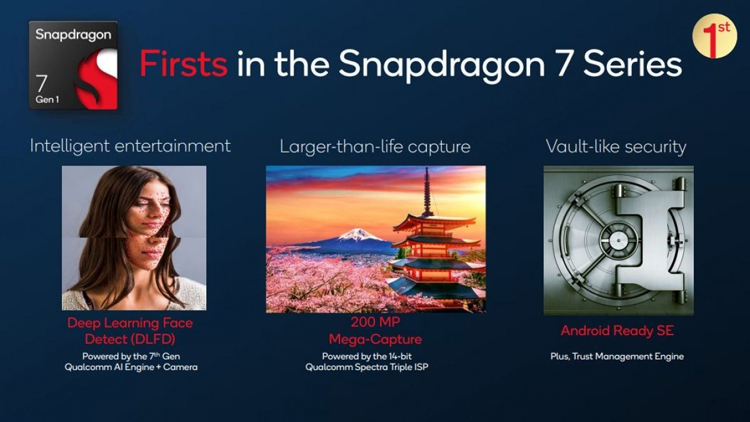
Qualcomm introduced the Snapdragon 7 Gen 1 mobile processor, which will be produced at Samsung's facility using 4-nanometer technology.
The chip is designed for use in very advanced mid-range smartphones.Image source: QualcommThe product combines eight computing cores.
This is one core Cortex-A710 Prime with a clock frequency of 2.4 GHz, three cores Cortex-A710 Performance with a frequency of up to 2.36 GHz and four cores Cortex-A510 Efficiency with a frequency of 1.8 GHz.The equipment includes a graphics gas pedal Adreno 662 and modem Snapdragon X62 5G, which provides data download speeds up to 4.4 Gbit/s.
The processor allows up to 16 GB of memory LPDDR5-3200 and QHD+ displays with a refresh rate of 60 Hz.
It supports photography with a resolution of up to 200 million pixels.Among other things mentioned controllers Wi-Fi 6E and Bluetooth 5.3, support for HDR10 and HDR10 +, as well as aptX Voice, aptX Lossless, aptX Adaptive and LE audio.
Smartphones on the new platform will be able to be equipped with Qualcomm Quick Charge 4+ technology.

Qualcomm introduced an improved flagship processor Snapdragon 8+ Gen 1 for powerful smartphones

Qualcomm introduced an improved flagship processor Snapdragon 8+ Gen 1 for powerful smartphones

Qualcomm introduced an improved flagship processor Snapdragon 8+ Gen 1 for powerful smartphones

Qualcomm announced the Snapdragon 8+ Gen 1 processor, designed for use in flagship smartphones.
The novelty is an improved version of the chip Snapdragon 8 Gen 1.Image source: QualcommThe Snapdragon 8 Gen 1 product combines eight computing cores, including a powerful Kryo Prime core clocked at up to 3.0 GHz, three Kryo Performance cores at 2.5 GHz and four Kryo Efficiency cores at 1.8 GHz.
The new Snapdragon 8+ Gen 1 platform got one Kryo Prime core clocked at up to 3.2 GHz, three Kryo Performance cores at up to 2.8 GHz and four Kryo Efficiency cores at up to 2.0 GHz.The other major components remained the same.
The novelty has a seventh-generation Qualcomm AI Engine, a next-generation Adreno graphics gas pedal with higher clock speeds and a Snapdragon X65 5G modem.
The Snapdragon 8+ Gen 1 processor claims a 10 percent increase in CPU and GPU performance over its predecessor, and a 30 percent improvement in CPU power efficiency.
Also noted a 30% reduction in GPU power consumption.Support for 4K displays with refresh rates up to 60 Hz and QHD+ with refresh rates up to 144 Hz, LPDDR5-3200 RAM, Wi-Fi 6E and Bluetooth 5.3.Devices on the new platform are preparing such companies as ASUS, Black Shark, Honor, iQOO, Lenovo, Motorola, Nubia, OnePlus, OPPO, Realme, RedMagic, Redmi, Vivo, Xiaomi and ZTE.