Showing posts with label ryzen. Show all posts

8.30.2022

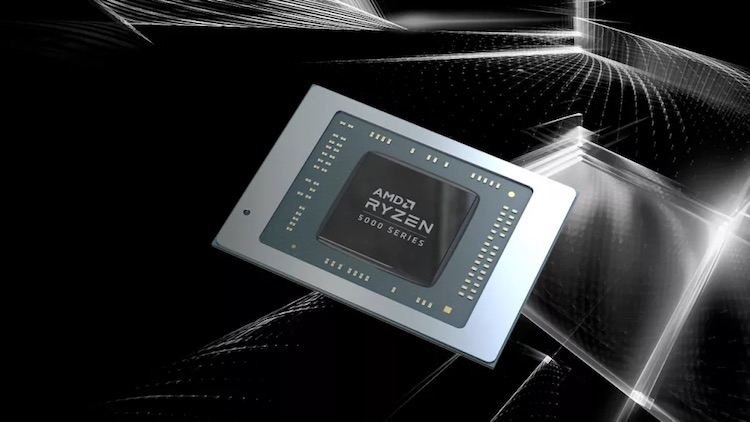
AMD is confident: there will be no shortage of Ryzen 7000

AMD is confident: there will be no shortage of Ryzen 7000

AMD is confident: there will be no shortage of Ryzen 7000

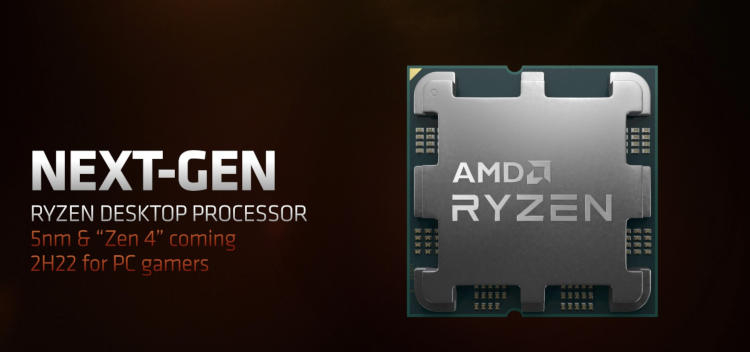
Announcing the Ryzen 7000 family of desktop processors, AMD CEO Lisa Su assured that no shortage is expected at the start of sales.
In her opinion, everyone will be able to buy the new products after September 27.Commenting on the availability of Ryzen 7000 on sale, Lisa Su said: \"If you look at the situation over the past 18 months, you can see a lot of problems, whether it's a lack of production capacity or logistical disruptions.
Right now, on AMD's part, we've had a serious increase in production volumes in terms of both semiconductor wafers and wafers.
So in the case of the Zen 4 launch we do not expect any supply constraints\".The Ryzen 7000 processors are scheduled for September 27, and AMD has a month to fill up supply channels.
That's time AMD will spend, Lisa Su said, to get the new products to store shelves around the world and just in time.
It is worth recalling that AMD has suspended the supply and official sales of its processors in Russia since the beginning of March.
Therefore, new AMD processors may appear in local stores only through parallel import with some delay.Ryzen 7000 processors for desktops are based on Zen 4 architecture and due to IPC and clock speeds growth offer 29 % performance increase comparing to their predecessors.
They support PCIe 5.0 and DDR5 memory.
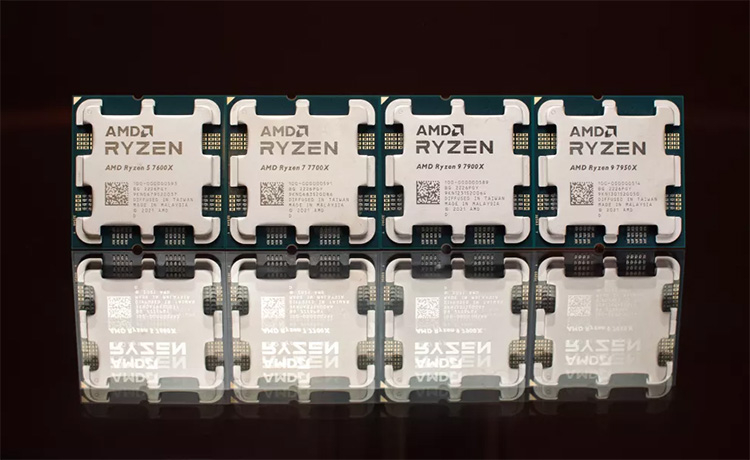
The lineup includes four models with the number of cores from 6 to 16 and price from $300 to $700.

AMD revealed plans: Ryzen 7000 with 3D cache, Threadripper on Zen 4 and all-new Zen 5

AMD revealed plans: Ryzen 7000 with 3D cache, Threadripper on Zen 4 and all-new Zen 5

AMD revealed plans: Ryzen 7000 with 3D cache, Threadripper on Zen 4 and all-new Zen 5

At last night's \"together we advance_PCs\" event, where AMD presented the Ryzen 7000 series desktop processors, some details about the company's future plans were revealed.
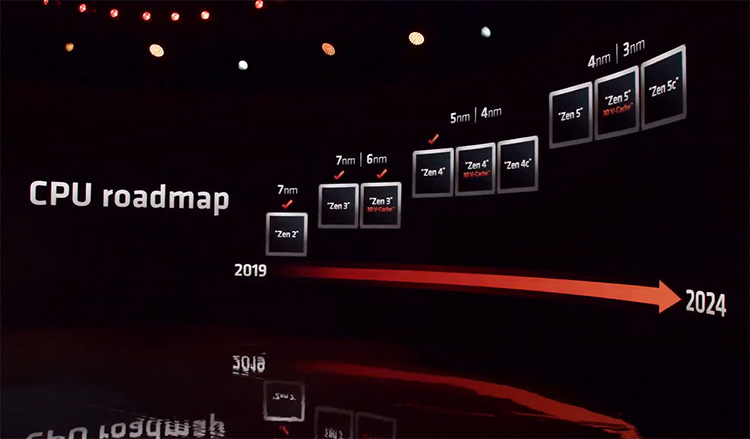
In particular, the next architecture after Zen 4, Zen 5 will come to the market in 2024.As for the near future, the next big processor announcement from AMD is scheduled for next year - the beginning of next year, the company intends to present a family of mobile Ryzen 7000 processors based on the Zen 4 microarchitecture.
Moreover, Mark Papermaster, AMD's technical director, promised during his speech that the Ryzen 7000 processors with additional 3D-cache chip (V-Cache), such as Ryzen 7 5800X3D, will be presented in the future.
On the other hand, he refused to give a definite date for Zen 4 server versions with 3D V-Cache technology, but the timing was more definite: these processors will appear in early 2023.
At the same time should go and designed for high-density servers processors EPYC Bergamo with Zen 4c-core - these chips, recall, will receive up to 128 cores, while the usual EPYC Genoa with the traditional architecture Zen 4 will be limited to 96 cores.Also AMD representatives mentioned the family of processors Ryzen Threadripper.
According to David McAfee, vice president and general manager of customer channels, AMD is looking very closely at releasing Ryzen Threadripper processors on the Zen 4 architecture.
However, due to changes in demand patterns and supply chains, we can only talk about variants \"without maximum configurations like Threadripper Pro, but with a broader lineup.
\"In addition, David McAfee promised that the Ryzen 7000 desktop processor family will not be limited to four models and will expand.
Additional processor models, covering a wider range of price categories, will be released early next year.As for the more distant prospects, the next to Zen 4 architecture Zen 5 is planned by AMD at the end of 2024, the processors based on it will be produced on the 4-nm process technology.
According to Papermaster, Zen 5 is a \"complete redesign of the core with further optimizations for AI tasks.
\"Along the way, AMD representatives have promised that the new platform Socket AM5, which comes out with the Ryzen 7000 processors, will remain relevant at least until 2025.
And this means that motherboards with socket AM5 will support not only Ryzen 7000, but also promising Ryzen processors based on Zen 5 architecture.

6.27.2022

AMD Ryzen 7 5800X3D has had its cover removed and solder replaced with \"liquid metal\" - temperature dropped by 10 °C

AMD Ryzen 7 5800X3D has had its cover removed and solder replaced with \"liquid metal\" - temperature dropped by 10 °C

AMD Ryzen 7 5800X3D has had its cover removed and solder replaced with \

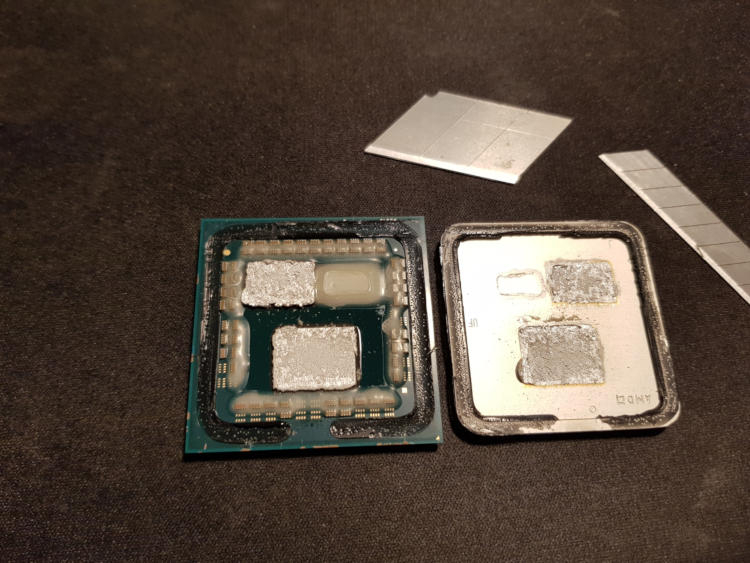
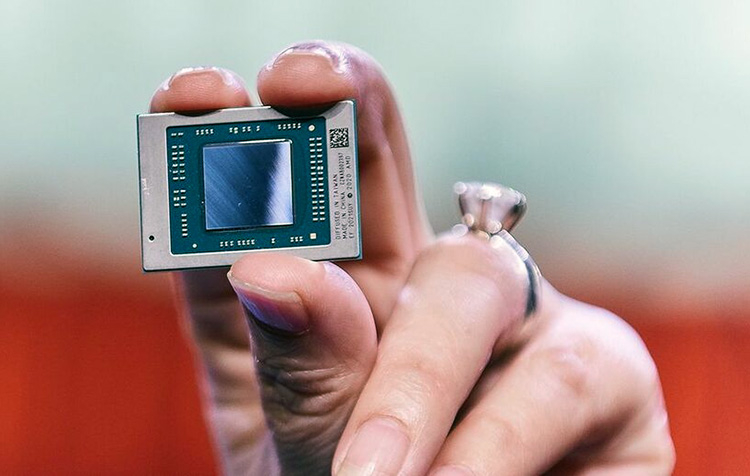
An enthusiast under the nickname Madness boasts of a successful operation to remove the cover from AMD Ryzen 7 5800X3D processor.
After further testing we found out that scalping significantly improves chip's performance: performance increased, power consumption decreased and operating temperature decreased by 10°C.
The game Forza Horizon 5 was used as a test load.Image source: twitter.com/Madness7771The operation was not easy: you had to push the blades of a paper knife through the edge of the lid, while feeding hot air at 150-200 °C from a heat gun.
The procedure was strenuous.
Having removed the lid, the enthusiast faced a choice: to replace the factory solder or to risk and install the cooler directly on the \"bare\" crystals.
Madness chose the former - instead of solder Thermal Grizzly Conductonaut \"liquid metal\" was used.CPU readings before (left) and after (right) operationThe effort was not wasted.
Under high loads Ryzen 7 5800X3D CPU showed 10°C lower temperature, slightly decreased power consumption, and clock speeds stabilized at the maximum value of 4450 MHz.
This processor does not support overclocking, although, of course, it would be interesting to see the results of overclocking tests - scalping would obviously provide a lot of room for maneuver.

5.23.2022

Ryzen 7 5800X3D Processor Overview: Final Point Socket AM4

Ryzen 7 5800X3D Processor Overview: Final Point Socket AM4

Ryzen 7 5800X3D Processor Overview: Final Point Socket AM4

Ryzen processors with 3D V-Cache technology, which expands cache memory with additional SRAM semiconductor crystal, were first mentioned by AMD exactly one year ago - at Computex 2021.
And at that time, this announcement has created a real furore.
On the one hand, through it AMD has confirmed its technological potential, as it showed its readiness to introduce an advanced technology of 3D-mounting of semiconductor chips and expand the chip design of its processors in the vertical direction.
On the other hand, it has promised to significantly strengthen the Ryzen 5000 series by the end of 2021, adding a flagship 12-core processor with a giant cache and significantly increased performance in gaming applications.However, these Napoleonic plans - at least in their original form - were not fated to materialize.
Promised Ryzen 9 5900X with 3D V-Cache technology never came out, and instead of it AMD released another consumer CPU with increased cache according to this technology - Ryzen 7 5800X3D.
And it frankly looks a lot less spectacular.
Firstly, Ryzen 7 5800X3D is just an octa-core CPU, which obviously cannot be a universal flagship solution, because 12- and 16-core solutions have been widely available in the desktop segment for a long time.
Secondly, by the end of this year there will be more progressive processors based on Zen 4 microarchitecture in AMD's arsenal, which will almost certainly eclipse the Ryzen 7 5800X3D due to the IPC index growth and DDR5 SDRAM support.
And third, with the introduction of the Alder Lake family late last year, the leadership in desktop processor performance has gone to Intel.
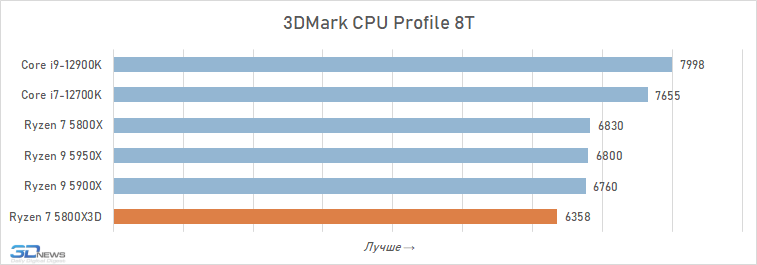
Because Alder Lake offers higher specific performance than Zen 3, Ryzen 7 5800X3D now has to solve a completely different problem: it does not set new performance records in games, but only tries to catch up with competitor processors in an extensive way - by multiplying the amount of cache memory.In other words, the Ryzen 7 5800X3D output ended up being quite stripped out, and it seems that AMD lost a lot from the fact that it missed the deadline and made the model not at all what it promised.
Nevertheless, that doesn't stop it from touting the Ryzen 7 5800X3D as \"the world's fastest gaming processor.\" However, there is a feeling that AMD overestimates the capabilities of its product: at least, many independent reviews could not confirm AMD's rightness in performance evaluations of the novelty.
And for this reason we decided to test Ryzen 7 5800X3D with our own hands.
Moreover it is not only unique by its design AMD processor, but also a kind of a final line in the history of Socket AM4 ecosystem: its development on Ryzen 7 5800X3D stops completely and no other CPU models will be available for this socket anymore.⇡# 3D V-Cache in detailsThe idea to expand cache capacity for better performance obviously did not come from AMD out of nowhere.
Moving large amounts of data closer to the processor cores, which dramatically increases the speed of access to them - a fairly simple trick, which AMD liked before.
AMD processors have long been distinguished by the amount of cache memory, and the company's marketing department uses the name Game Cache for it, explicitly stating that a capacious L3 cache is extremely useful for games.
The opposite is also true: Ryzen processors with reduced cache, such as Ryzen 5 5500, have rather modest gaming performance.Ryzen 7 5800X3D is a processor where the idea of increasing cache capacity in the name of maximum FPS is taken to the absolute limit: it has 96 MB of L3 per eight cores (12 MB per core).
But its main peculiarity is not even the impressive size of the cache, but the design, which is figuratively described in the model number of the processor with the ending \"3D\".
It means that in the Ryzen 7 5800X3D cache is expanded with an additional 3D V-Cache crystal, which is physically superimposed on the original processor chip on top - in the third dimension.
In words it sounds quite simple: an additional 64 MB SRAM chip is mounted on top of the 32 MB L3 cache present in the CPU chip and connected to it through connections.
But in reality it is much more complicated.
To place the superstructure in the form of a 3D-cache crystal on the processor chip, AMD had to work with TSMC on a special production technology, which would reduce the thickness of the combined from two parts - CCD (Core Complex Die) and 3D-cache - integrated device.
As a result, it is reduced to the height of a single chip of conventional processors, so Ryzen 7 5800X3D fits into exactly the same package as other Ryzen family processors and does not require any special cooling systems or their mounts.This is achieved by two techniques.
First

5.16.2022

Ryzen 5 5500 processor review: affordable six-core that is late

Ryzen 5 5500 processor review: affordable six-core that is late

Ryzen 5 5500 processor review: affordable six-core that is late

It so happened that the Ryzen 5000 series release coincided with the crisis on the semiconductor market and the peak of chip shortage, as a result of which AMD had to severely limit the variety of model range.
In November 2020, the company released only one model each with 6, 8, 12 and 16 cores, with the minimum price of a processor with Zen 3 progressive cores above $300.
This approach displeased AMD fans, but the company had no other choice: the production quotas which it managed to get from its manufacturing partner, TSMC, were not enough even to cover demand for expensive processors.
A year and a half passed since then, and the problem with the lack of production capacity for the manufacture of Zen 3 semiconductor chips weakened noticeably.
But AMD did not hurry to expand the Ryzen 5000 lineup - the situation was quite good for it, because by selling more expensive processors it was increasing its profits.
Yes, with this approach the users of low-cost systems had no opportunity to get processors with progressive microarchitecture at their disposal, but the company did not care much: it was quite successful in distributing obsolete solutions of Ryzen 3000 series among this audience.
And these processors were also in high demand, because the alternatives, which until recently were offered by Intel, did not have serious competitive advantages.However, with the appearance of Alder Lake the situation has changed dramatically.
Intel created a very successful processor family which was almost immediately available in all price segments.
Because of this, it turned out that with the advent of 2022 there was nothing suitable in AMD's range that the company could counter the competitor's punchy processors like Core i5-12600K, Core i5-12400 and Core i3-12100, which very quickly came out on top in the sales statistics.
So as soon as AMD realized that its market position had staggered and its share of the desktop market began to rapidly shrink, it immediately moved to retaliate.
Firstly, it aggressively reduced prices on all available Ryzen 5000 series processors by 25-30%.
Secondly, the lineup was replenished at once with several new products - available eight- and six-core carriers of the Zen 3 microarchitecture.
Thus, since the beginning of April, sales of the $300 Ryzen 7 5700X eight-core and two six-core models: the $200 Ryzen 5 5600 and the $160 Ryzen 5 5500 started on the global market.
Unfortunately, in Russia, which is now cut off from direct supplies, these models arrived with a noticeable delay and not at the prices AMD intended for them.
But nevertheless, the most affordable CPU among the new products, Ryzen 5 5500, still looks interesting.
In \"normal life\" it should be the cheapest six-core with modern microarchitecture, but in the current reality its Russian price is approximately equal to the cost of the youngest six-core Alder Lake, Core i5-12400, which is still quite good.
That is why the 3DNews lab immediately started a detailed testing of this promising product as soon as the opportunity presented itself.It is worth to remind that AMD has already tried to produce such budget six-core units, which became the cheapest variants in their class, for example Ryzen 5 3500 and 3500X.
However, they were only available in certain geographical regions and also had significantly reduced specifications.
In Ryzen 5 3500 and 3500X, for example, the company turned off SMT technology, which was a big hit to performance.
But the new Ryzen 5 5500 is a completely different breed of processor.
It is globally available, the SMT technology is in place, and the main difference from the older brothers is the reduction of cache memory, which at first glance does not look catastrophic loss and makes familiarity with it only more interesting.⇡#Ryzen 5 5500 in detailsThe Ryzen 5000 lineup has undergone very noticeable changes this spring.
Now there are eight representatives instead of four.
The expansion took place mainly \"downwards\", but among the new models there is also the innovative Ryzen 7 5800X3D with 3D V-Cache technology, which is positioned by the company as a kind of gaming flagship.
The composition of the family is listed in the table below, and, pay attention, a separate column - \"Current price\" is added to it.
It shows retail prices of Ryzen 5000 family members on the world market after the occurred price reduction (in Russia, of course, the situation with prices is different, and there is no point in discussing it within the scope of this article).
Cores/threadsFrequency, GHzL3, MbytesTDP, Wofficial priceCurrent priceRyzen 9 5950X16/323,4-4, 964105$799$559Ryzen 9 5900X12/243.7-4.864105$549$399Ryzen 7 5800X3D8/163.4-4.592105$449$449Ryzen 7 5800X8/163.8-4.732105$449$349Ryzen 7 5700X8/163.4-4.63265$299$

1.19.2022

Tesla Model 3 based on AMD processors got less range than Intel

Tesla Model 3 based on AMD processors got less range than Intel

Tesla Model 3 based on AMD processors got less range than Intel

The AMD Ryzen processor-based infotainment system originally appeared aboard the older Tesla Model S and Model X electric cars, but it's now being used by the younger cars in the line & ; the Model 3 and Model Y. Some customers have noted that the company has notified them of the electric cars' reduced range because of this change.

Previously, the Tesla Model 3 and Model Y's onboard system was satisfied with Intel Atom processors, which, against AMD Ryzen, had lower power consumption, though at the same time were inferior in speed. Modernization of onboard electronics, as noted by the resource InsideEVs, required Tesla in some regions of sales of electric cars to notify customers about changes in the consumer qualities of the delivered products & ; for example, it happened in Australia. The upgraded electric car Tesla Model 3 with AMD Ryzen processor on board, as explained, is able to drive 602 km on the conditional WLTP cycle, 22 km less than with the old multi-media complex. In general, depending on the type of drive, traction battery capacity and the size of the wheels, as noted by the source, the range of the Tesla Model 3 can be reduced by a value of 11 to 22 km. Curiously, the Tesla Model Y has survived this upgrade without any losses. On the contrary, the range of this crossover even increased by the value from 26 to 34 km on the conditional WLTP cycle. This can be explained by the presence of a higher-capacity battery or other optimizations related to energy consumption. In this case, the appearance of the more voracious AMD Ryzen processor simply did not affect the range to the extent that it is observed in the Tesla Model 3.

1.08.2022

Engineering samples of AMD Ryzen 7000 8- and 16-core processors on Zen 4 Raphael have been discovered on the Distributed Computing Network

Engineering samples of AMD Ryzen 7000 8- and 16-core processors on Zen 4 Raphael have been discovered on the Distributed Computing Network

Engineering samples of AMD Ryzen 7000 8- and 16-core processors on Zen 4 Raphael have been discovered on the Distributed Computing Network

Despite the fact that AMD Ryzen 7000 desktop chips on the Zen 4 architecture will not hit the market until the second half of the year, their engineering samples have already been found in business. And they were not used to mine cryptocurrencies, but to work in a network of voluntary distributed computing.

Two AMD Family 25 series models on the Zen 4 Raphael architecture have surfaced on the MilkyWay@Home distributed computing project website, where volunteers provide their home machines to process astrophysical data. Two chip names with different OPN codes (model designations), one 8-core and one 16-core, appeared in the database:

AMD Eng Sample: 100-000000665-21_N [Family 25 Model 96 Stepping 0] & ; 16 cores / 32 threads; AMD Eng Sample: 100-000000666-21_N [Family 25 Model 96 Stepping 0] & ; 8 cores / 16 threads.

In spite of the fact that one of the positions in chip description is written as «number of processors» in reality we are speaking not about cores, but about threads. For example, opposite the 16-core Ryzen 9 5950X, 32 «CPUs» are listed in the base. Opposite the item «Cache» for both chips of the Raphael family is a value of 1024 kBytes, and this is twice as much as the L2 cache of the processors on Zen 3 Vermeer. Systems with the new chips connected to the network anonymously, and it is not quite clear for what purpose they were used in this project, because voluntary distributed computing MilkyWay@Home on the BOINC platform can hardly be called a reliable benchmark.

As a reminder, AMD Raphael processors are expected to be released in the second half of the year. They will run on the all-new AM5/LGA1718 socket with DDR5 and PCIe Gen5 support. Recently, the company also assured that AM5 platform will be supported for a long time & ; at least not less than AM4.

12.18.2021

Two Chinese Zen-based CPUs beat AMD Ryzen 5 5600X in multi-threaded test

Two Chinese Zen-based CPUs beat AMD Ryzen 5 5600X in multi-threaded test

Two Chinese Zen-based CPUs beat AMD Ryzen 5 5600X in multi-threaded test

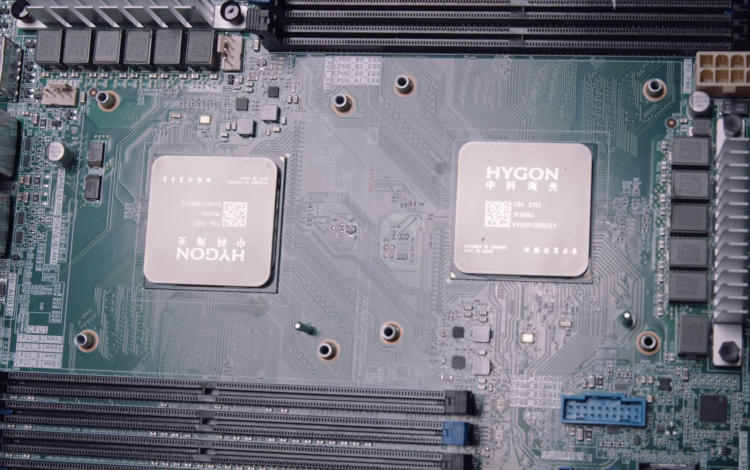
China's EJ Hardware video blog tested a duo of Chinese Hygon C86 3185 processors that are little known outside the country. The Zen architecture chips are produced as part of a joint project between AMD and Hygon the Chinese company has been licensed to produce the processors domestically.

Hygon C86 processors are manufactured using 14nm technology, and the line includes mainstream and server models from 4 to 32 Zen cores. Externally Hygon C86 are almost indistinguishable from AMD Ryzen and EPYC. What's more, they should fit AM4 and SP3, though in most cases they come soldered to the motherboard. Last year's Hygon C86 3185 chip has 8 Zen cores with multi-threading support (SMT), base clock speed is 2.0 GHz, peak & ; 3.4 GHz. The L2 cache capacity is 4 Mbytes, L3 & ; 16 Mbytes. In fact, the C86 3185 is an analogue of the Ryzen 7 1700X with a lower clock speed & ; they even have the same TDP (95W). In the comparison tests a motherboard with two C86 3185 processors soldered, that is 16 cores Zen was used. The server motherboard had some limitations: in particular, the memory frequency was locked to DDR4-1866 and there was no option to increase it. In the other corner of the ring» was the Ryzen 5 5600X processor: 6 cores Zen 3, the base clock speed 3.7 GHz and peak 4.6 GHz. This processor is made on 7nm technology, and its TDP is lower by 30W.

In single-core performance Ryzen 5 5600X was the clear leader & ; first generation Zen cores simply didn't stand a chance against Zen 3. In single-core Cinebench R20 and R23 tests American chip was 97% and 135% ahead. But in multi-core tests Cinebench R20 and R23 the leader was Hygon with the results 12 % and 13 % higher accordingly. In Blender and x264 HD Benchmark, C86 3185 was also better & ; it showed 23 % and 33 % less performance than Ryzen 5 5600X. But in PCMark 10 American chip was ahead by 59 %. Decent results Hygon C86 3185 showed in gaming test, the role of which went to Cyberpunk 2077. Combined with GeForce RTX 3080 Ti the processors provided adequate frame rates in both 1080p and 4K. The reviewers concluded that the undoubted advantage of the American processor is the newer Zen 3 architecture, although in multi-threaded tasks the opponents behave almost equally & ; in any case, the difference is not significant. Although China in this joint project aims not to break performance records, but to gain at least relative independence from foreign technologies.

8.31.2021

AMD has released an updated driver for its chipsets with critical vulnerability fixes

AMD has released an updated driver for its chipsets with critical vulnerability fixes

AMD has released an updated driver for its chipsets with critical vulnerability fixes

AMD has released an updated version of its chipset driver indexed 3.08.17.735 covering almost a dozen platforms. Although the developers didn't provide a detailed description of the new driver, we can understand that it contains critical security patches for Platform Security Processor subsystem, which is present in all AMD processors for the last eight years, including the latest Ryzen.

The PSP subsystem has similar capabilities to the Intel Management Engine chipset subsystem and is responsible for creating and maintaining a secure environment. The PSP and IME have been criticised by AMD and Intel for not disclosing these technologies, arguing that this can make it more difficult for hackers to exploit weaknesses and vulnerabilities in order to gain access to the processor and its subsystems.    While AMD has not disclosed details on what the mentioned driver fixes contain, it is obvious that it should be installed by all users of compatible devices. The driver is supposed to fix one or two vulnerabilities that affect all Ryzen processors. We're talking about Speculative Code Store Bypass and Floating-Point Value Injection and Transient Execution of Non-Canonical Accesses vulnerabilities, both of which can lead to data leaks. It should be noted that the driver's description does not mention these vulnerabilities, so we cannot say for sure that they will be fixed after this update is installed.

AMD prepares Ryzen 5000HS Creator Edition mobile processors with increased base frequency

AMD prepares Ryzen 5000HS Creator Edition mobile processors with increased base frequency

AMD prepares Ryzen 5000HS Creator Edition mobile processors with increased base frequency

Lenovo, according to online sources, is preparing to release the Yoga Slim 7 Pro portable computer equipped with the new AMD Ryzen 5000HS Creator Edition processors of the Cezanne family.

Two chips mentioned in particular are AMD Ryzen 7 5800HS Creator Edition and Ryzen 9 5900HS Creator Edition products. Both contain eight computing cores with the ability to simultaneously process up to sixteen instruction threads. The maximum heat dissipation value (TDP value) is 35W. Layer 3 cache size is 16 MB. Compared to Ryzen 7 5800HS and Ryzen 9 5900HS, Creator Edition versions have higher base frequency. So, the first of the two processors, it has been increased from 2.8 to 3.2 GHz, the second - from 3.0 to 3.3 GHz. At the same time maximum frequency in turbo mode remains unchanged - 4.4 and 4.6 GHz respectively.

It is known that the Yoga Slim 7 Pro laptop is aimed at content creators. Buyers will be able to choose between modifications with a 2.8K (2880 × 1800 dots) and 2.2K (2240 × 1400 pixels) display. Up to 16GB of RAM and up to 1TB of SSD capacity. Graphics is based on NVIDIA GeForce MX450 discrete gas pedal;

7.16.2021

AMD has begun to deal with the shortage of Ryzen 5000 mobile and the situation will continue to improve

AMD has begun to deal with the shortage of Ryzen 5000 mobile and the situation will continue to improve

AMD has begun to deal with the shortage of Ryzen 5000 mobile and the situation will continue to improve

XMG, a German computer maker, reported that shipments of AMD Ryzen 5000-series (Cezanne) processors have increased in recent weeks, and the situation is projected to improve for the entire third quarter. The company also said that while prices for top-tier PC components remain high due to supply constraints, shipments from Intel and NVIDIA remain stable. That said, XMG said nothing about the availability of AMD Radeon RX 6000-series graphics.

It is also reported that AMD Ryzen 5000G (Cezanne) desktop processors are starting to go on free sale. Their appearance in the retail market is expected in early August. As for the mobile Ryzen 5000, these chips have been in deep short supply since launch. Many companies have not even been able to release some planned models due to the shortage of AMD processors, but the company is ramping up shipments and the situation is quickly improving. Laptops based on the powerful Ryzen 7 5800H and Ryzen 9 5900HX are expected to start appearing in July and August.

XMG reports that the second quarter was particularly tough for AMD chip-based devices. Although AMD released Ryzen 7 and 9 on the Zen 3 microarchitecture back in the second quarter, it couldn't deliver enough products, and on top of that, it cut back on shipments of previous-generation processors. XMG predicts that it will be able to ship significantly more systems based on the Ryzen 5 and 7 4000 series and Ryzen 7 and 9 5000 series. However, it appears that most of these machines will be using NVIDIA graphics, as supplies of the Radeon RX6000 are still difficult to come by. According to XMG, other components besides processors and graphics cards have noticeably increased in price this year. The increase in prices affected LCD panels, audio chips, USB Type-C controllers and power controllers. Overall, XMG does not expect the shortage of components to end soon, but believes that soon it will be able to reduce the delivery time to customers, thanks to the gradual improvement of the market situation.

1.23.2021

Ryzen 5000 has allowed AMD to double its presence in gaming notebooks, but things aren't going well with graphics

Ryzen 5000 has allowed AMD to double its presence in gaming notebooks, but things aren't going well with graphics

Ryzen 5000 has allowed AMD to double its presence in gaming notebooks, but things aren't going well with graphics

AMD has promised to make impressive strides in gaming laptops this year, and so far, judging by the range of gaming laptops available for order or pre-order, the trend is indeed showing.

Video blogger GizmoSlipTech has compiled a list of gaming laptops with GeForce RTX 30-series accelerators that are available for purchase or pre-order. As of January 15, 28 of these laptops are based on Intel processors and 13 & ; based on AMD processors. That is, AMD owns quite a respectable share of 32 % of gaming laptops versus 68 % for Intel. But the list doesn't include several announced, but not yet released models like Lenovo Legion and Alienware m15 and m17, and also ASUS ROG Zephyrus G14, TUF 15 and TUF 17. Recall that Lenovo and ASUS models are based on AMD Ryzen, and Alienware & ; on Intel Core. Considering these models AMD share is already 36 % vs. 64 % from Intel.

AMD processors share among 2021 gaming notebooks (as of January 15)

Of course, Intel Core still dominates the models, but the dynamics are clear. In a similar selection in 2020, Intel accounted for 85 % of notebooks with GeForce RTX 20 or GeForce GTX 16 series gaming graphics cards.

Similar graph for 2020

AMD's key achievement & ; the emergence of notebooks where its processors are used in conjunction with high-end graphics cards like GeForce RTX 2070 or RTX 2080. In the days of the Ryzen 4000, the best AMD could have hoped for & ; was GeForce RTX 2060 graphics. AMD and notebook makers on this occasion explained that they were initially cautious in their predictions and didn't expect much demand for AMD processors in flagship gaming notebooks.

AMD's share of 2021 flagship gaming notebooks

Things are looking up for AMD this year. As many as nine laptops now use the Ryzen 5000 bundled with the GeForce 3070 or GeForce 3080 (up from zero last year). And that's just the start of the year & ; perhaps 2021 really will be AMD's stellar time in the mobile gaming PC market.

In 2020, AMD processors in flagship gaming laptops simply weren't there

Of course, it's one thing & ; announced models, and quite another & ; the actual number of systems sold. But while high-end laptops with AMD processors are selling out like hotcakes & ; supply is clearly not keeping up with demand. So the chances of success are very high.

Gaming notebook graphics accelerator manufacturers' shares

But the real dominance of high-end gaming notebook market is not Intel or AMD at all, but NVIDIA & ; the power of the latter is undivided, that is literally 100 %. AMD introduced several Radeon mobile graphics cards last year, but it's impossible to buy them in a real gaming notebook. And now the situation is exactly the same. But with RDNA 2 in 2021 AMD might start to change the situation in this area.

1.11.2021

65W AMD Ryzen 9 5900 and Ryzen 7 5800 frequencies revealed

65W AMD Ryzen 9 5900 and Ryzen 7 5800 frequencies revealed

65W AMD Ryzen 9 5900 and Ryzen 7 5800 frequencies revealed

A fortnight ago, the first reports about the new Ryzen 5000 series desktop processors appeared. It turned out that AMD is developing two Ryzen processors without the X suffix. Such solutions tend to offer lower operating frequencies.

According to @momomo_us, the upcoming Ryzen 9 5900 and Ryzen 7 5800 will use the same number of cores as the models of the same name with the X suffix. The 5900 & ; is a 12-core processor with 70 MB of cache, while the 5800 & ; is an 8-core with 36 MB of cache. At the same time, these processors will have important differences. Firstly, their power consumption will be limited to 65W, that is 40 W less than the X-series. Second, the Turbo mode speeds for these CPUs are 4.7GHz and 4.6GHz, respectively & ; 100MHz lower (base frequencies not disclosed).

pic.twitter.com/VG65pMZ6aM & ; 188号 (@momomo_us) January 9, 2021

The new processors will likely only be offered to OEM partners, and will not retail for those who prefer to build their own PCs. Ryzen 5 5600 has also been rumoured to cost $220, but there has been no further confirmation on the existence of such solutions yet.

AMD is also expected to release its AM4 processor family Cezanne & ; such as the Ryzen 7 5700G and Ryzen 5 5600G soon. The Cezanne APUs will allegedly be unveiled as early as next week during the CES 2021 virtual show. It's unclear when or if AMD even intends to offer these new processors to retail customers, as even the 4000G series has so far been limited to OEM partners only.

12.22.2020

AMD Ryzen of all generations compared in games and applications: Zen 3 chip is over 70% faster than Zen

AMD Ryzen of all generations compared in games and applications: Zen 3 chip is over 70% faster than Zen

AMD Ryzen of all generations compared in games and applications: Zen 3 chip is over 70% faster than Zen

The AMD Ryzen processor family debuted in 2016 with the Ryzen 7 1800X as the flagship 8-core and 16-threaded solution. That processor's maximum Turbo frequency was only 4.1GHz, a far cry from the numbers now available on some Ryzen processors. Then AMD updated its processor architecture more than once, and German website Golem decided to compare four Ryzen CPUs from different generations.

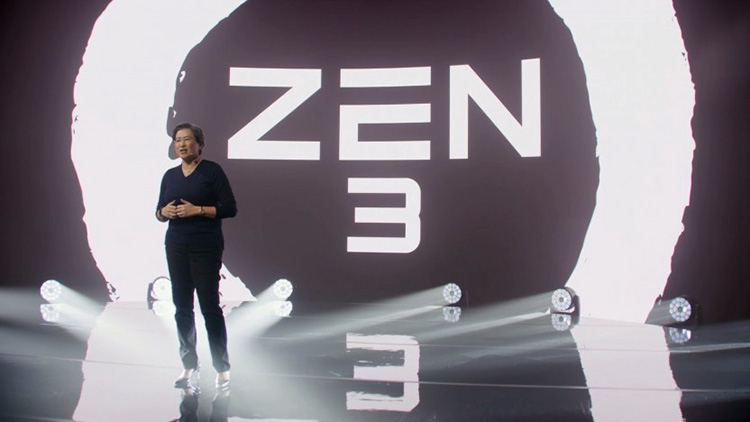
AMD head Lisa Su in front of the Zen 3 logo (Golem)

The journalists tested four CPUs with the same configuration of 8 cores and 16 threads, but different architectures. All of them were tested on X470 and X570 motherboards (depending on the supported CPU). It's worth to keep in mind that journalists set memory frequency to support respective AMD Zen architectures. The first generation only supported 2666MHz memory by default, Zen+ & ; 2933MHz, and the last two generations (Zen 2 and Zen 3) & ; DDR4 up to 3200MHz. Memory frequency can have a big impact on the performance of AMD Ryzen processors.

Performance of AMD Ryzen 8-core processors of 1000–5000 families (Golem, VideoCardz)

According to Golem's tests, AMD Ryzen 7 5800X on Zen 3 offers on average 80.9 % better performance than Ryzen 7 1800X in seven games & ; testing was done in Anno 1800 (Anno Engine), Counter-Strike: Global Offensive (Source Engine), Microsoft Flight Simulator (Asobo Engine), Grand Theft Auto V (RAGE), Kingdom Come Deliverance (Cry Engine), Planet Zoo (Cobra Engine) and A Total War Saga: Troy (TWW2 Engine).

Game performance of different generations of AMD Ryzen (Golem)

Zen 3 processor was also 72 % faster than Ryzen 7 1800X in common applications & ;  Tests are done with 7-Zip (Archive Reading), Adobe Premiere Pro (Video rendering), Blender (Cycles, 3D rendering), Cinebench R15/R20 (3D rendering), Faststone Image Viewer (Image Processing), Unreal Engine 4 (3D rendering) and y-Cruncher (AVX-512).

Application performance of different generations of AMD Ryzen (Golem)

A more detailed table was compiled by 3DCenter journalists, who took into account individual results. By their estimates based on the same tests, Zen 3 gain over Zen is 89 % in applications testing, and up to 84 % in games. And every new generation of Zen including even Zen+ brought 16 % to 27 % performance boost:

Performance of different generations of AMD Ryzen (Golem, 3DCenter, VideoCardz)

AMD is expected to release new desktop processors based on the Zen 3+ architecture, codenamed Warhol, sometime next year. They could still be part of the 5000 series or get the new name Ryzen 6000. Meanwhile, the first Zen 4-based processor should be released when AMD is ready to provide DDR5 memory support on desktop systems. Processors codenamed Raphael are expected to support the new memory technology and also move to the new AM5 socket.

12.21.2020

ASUS and MSI showed AMD Smart Access Memory on old AMD processors with Zen and Zen 2

ASUS and MSI showed AMD Smart Access Memory on old AMD processors with Zen and Zen 2

ASUS and MSI showed AMD Smart Access Memory on old AMD processors with Zen and Zen 2

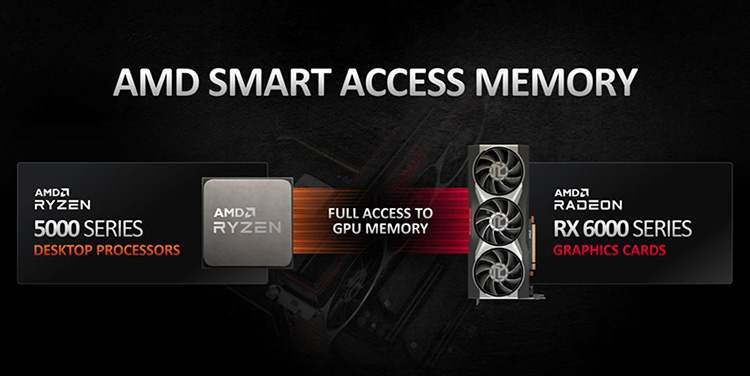
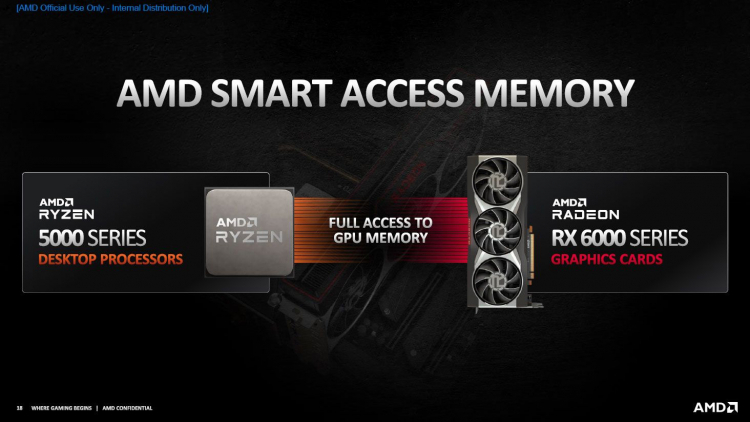
At the announcement of Radeon RX 6000-series graphics cards, AMD noted the Smart Access Memory (SAM) technology, which provides an increase in performance when the gas pedal works with Ryzen 5000 (Zen 3) processors. Previously, it was reported that Ryzen 3000 and older AMD chips, unlike Intel processors, do not support SAM technology, due to lack of the necessary hardware and PDEP instructions support. But it turns out that not everything is that simple.

To begin with, SAM is based on the Resizable BAR (Base Address Registers) technology which is part of the PCI Express interface specifications since v2.0 and is not exclusive to AMD. Whereas a regular Windows based PC can only directly access up to 256MB of graphics memory, the Resizable BAR technology allows you to expand the data channel allowing the processor to access the entire video memory array at once. This eliminates potential bottlenecks and provides performance boost in some games (up to 15 % according to AMD estimates). This is especially true nowadays when the amount of video memory used in games often exceeds even 10 GB. Resizable BAR quite works on a bunch of Radeon RX 6000 and Intel processors on ASUS and ASRock boards. Since it is part of the PCI Express specifications, NVIDIA also plans to add support for this technology to some of its graphics gas pedals.

Rumors regarding the lack of SAM support in Ryzen 1000, 2000 and 3000 chips were first refuted by Ian Curtress of Anandtech, who got an explanation from AMD itself. It turns out that SAM does not rely on the PDEP instruction and will work regardless of how well the instruction is supported by the processor.

Now MSI and ASUS have demonstrated how SAM works on various AMD Ryzen processor series that do not have the Zen 3 architecture. According to the published screenshots, AMD Ryzen 4000G and Ryzen 3000 series processors with Zen 2 architecture will also support SAM on AMD 500 series chipset motherboards. ASUS, on the other hand, has shown the possibility of using Re-Size BAR with the Ryzen 7 1700 processor based on Zen. Earlier this week Igors’LAB published a story that NVIDIA is also working on an alternative to AMD SAM technology. It is claimed that there are discussions within the company as to whether the GeForce RTX 30xx series should support this technology. It's unclear if any final decisions have been made on this, but given that NVIDIA has said it's considering adding Resizeble BAR support, it would be too late to back out.

Meanwhile, AMD hasn't made any public statements regarding potential SAM support on older Radeon graphics gas pedals.

12.04.2020

Ryzen 3000 and older AMD processors do not support AMD Smart Access Memory, but Intel does.

Ryzen 3000 and older AMD processors do not support AMD Smart Access Memory, but Intel does.

Ryzen 3000 and older AMD processors do not support AMD Smart Access Memory, but Intel does.

The situation with Resizable BAR (Base Address Registers) technology, which is part of the PCI Express interface specifications since version 2.0 and is the basis for AMD Smart Access Memory (SAM), continues to clarify. Recently we have written that SAM has worked on a bunch of Radeon RX 6000 and Intel processors, and now the details of older AMD processors are known.

techpowerup.com

Recall: AMD introduced SAM technology during the announcement of Radeon RX 6000 graphics cards and initially announced it only for Ryzen 5000 processors. While in conventional Windows-based PCs, processors can only access up to 256MB of graphics memory at the same time, this technology can expand the data channel, allowing the processor to use the entire video memory array at once and remove potential bottlenecks, achieving improved performance in some games.

It seems that it is no coincidence that AMD started talking about SAM support only with the launch of Zen 3 architecture; the fact is that AMD Ryzen 3000 processors of Matisse family based on Zen 2, as well as older solutions based on Zen+ and Zen do not support this feature. It turned out that PCI-Express bus of Ryzen 5000 Vermeer processors includes PCIe physical layer functionality called full-rate _pdep_u32/64, which is required for Resizable BAR.

Official data on performance boost from SAM on AMD Ryzen 5000 and Radeon 6000 platforms

More interesting is that Intel processors have been supporting this functionality since the 4th generation of Haswell's Core, which added a 20-band PCI-Express Gen 3.0 bus. This means that every Intel processor released since 2014 is technically capable of supporting Resizable BAR, and the question is only for motherboard manufacturers that release UEFI firmware updates for their products (i.e. Intel 8th and later series chipsets).

AMD is widely marketing SAM as a means to increase performance by 1–2 % for Radeon RX 6800 series graphics cards. Since this is part of the PCI Express specifications, NVIDIA also plans to add support for it to some of its GPUs.

11.25.2020

AMD Ryzen

AMD Ryzen


AMD Ryzen

    It’s no secret and many of the AMD Ryzen Review articles suggest that after the first time the Zen architecture launched, the balance in the market has changed. AMD and Intel are the two giants of the desktop CPU market. Especially, when it comes to gaming CPUs. And both companies are trying to do their best in this vital segment of the CPU market. Of course, it is always up to consumers to determine which one is the best. Everyone has reasons to choose between two brands or products. Or some may change their choices over time. Sometimes people think more about the price/performance. Or for some users, accessibility or brand image could be the decisive factors. We can generate many more factors or examples for explaining consumer choice. 

    Therefore, as of 2020, especially on the gaming CPU side, the competition is getting more and more intense. This time AMD has designed some spectacular CPUs. We are talking about the Ryzen 5000 series. They are kind of “the unique” Ryzen CPUs for various reasons. First the Zen 3 architecture and than the increased single-core performance is one of the two important factors that make this series "unique". 

    We are all familiar with the higher core and thread count on the Ryzen CPUs, starting from the initial Ryzen models. And we also know that the pricing strategy seemed a little bit more consumer-friendly, compared to the rival’s products. Considering the domination of Intel in the CPU market, that kind of approach becomes a necessity. On the other hand, it is also a must to respond and compete on the overall CPU performance field. And that is, mostly related to the gaming CPUs. Simply because it is the most profitable and popular segment in the CPU market. Besides, once you conquer the heart of the gamers, you don’t have to be worried about your brand and product perception anymore. So, seeing the increased number of positive AMD Ryzen review contents is a good sign for the company. And we will probably be seeing these signs more than ever after the Ryzen 5000 series.

11.17.2020

AMD confirmed that Smart Access Memory is an open technology, but so far only works with the Ryzen 5000.

AMD confirmed that Smart Access Memory is an open technology, but so far only works with the Ryzen 5000.

AMD confirmed that Smart Access Memory is an open technology, but so far only works with the Ryzen 5000.

AMD stated that its Smart Access Memory (SAM) technology is not closed and is not only designed for use in bundles of its own Ryzen 5000 series processors and Radeon RX 6000 family graphics gas pedals. The company has simply not yet worked with other manufacturers to enable its support, although it welcomes the opportunity to do so.

To remind: AMD introduced SAM during the announcement of the Radeon RX 6000 graphics cards. While in conventional Windows-based PCs, processors can only access part of the graphics memory (VRAM) at the same time, this technology can expand the data channel, allowing the processor to immediately use the entire video memory array and eliminate potential bottlenecks, achieving improved performance.

Recently, NVIDIA revealed exactly what SAM is built on in the new AMD Radeon RX 6000 graphics cards. The GeForce manufacturer also explained that the technology is not limited to PCIe 4.0 bus or AMD processors only. Moreover, NVIDIA said that in its labs, the SAM already runs on Ampere graphics cards with Intel and PCIe 3.0 processors.

Prior to this, there was a rather strange situation: AMD has traditionally advocated open technologies, and with the announcement of RDNA 2 said that Smart Access Memory will only work with its latest Ryzen 5000 processors. As a result, NVIDIA, which is usually condemned for being closed, became a bulwark of open standards and promised to introduce a similar feature for its graphics cards that works with any processor.

It turned out that AMD is simply going to limit itself to supporting and running SAM on a bunch of Ryzen 5000 processors and Radeon RX 6000 graphics cards. And the technology actually uses BAR resizing, a standard PCIe feature - so it can work on other hardware.