Showing posts with label processor. Show all posts

12.11.2022

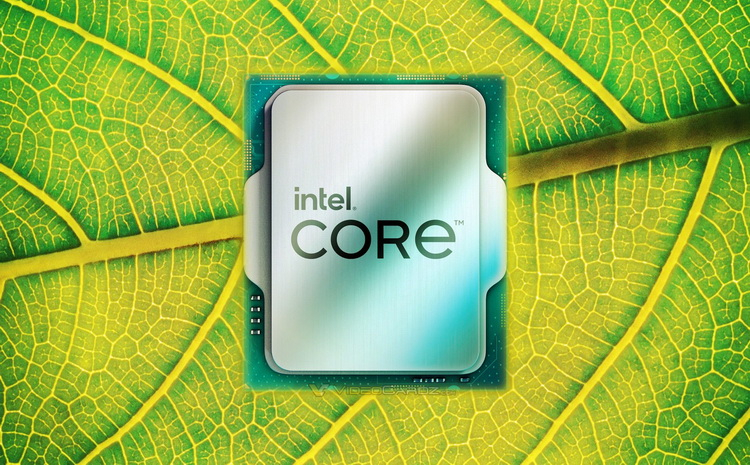
Core i9-13900K review: 350 Watt unit (not really)

Core i9-13900K review: 350 Watt unit (not really)

Core i9-13900K review: 350 Watt unit (not really)

Intel has long ago abandoned the \"tick-tock\" approach in development, but nevertheless, its echoes can still be caught when the company launches new products.
For example, the Alder Lake, which didn't quite fit this principle and introduced both a new process technology and a new architecture at once, was replaced by the new generation of Raptor Lake, which has clear signs of an intermediate technological step \"optimization\".
This stage became a popular method of processor improvement in the times of Skylake architecture domination and Intel doesn't give it up even today.
But there is an important difference: now the optimization steps are related not so much to the desire to maximize the lifecycle of old designs, as to increase the pace of CPU generation change.Raptor Lake is already the third family of Intel desktop processors since the beginning of 2021, and it would be strange to expect from it any dramatic innovations.
At the same time, Raptor Lake is a far cry from the kind of \"optimization\" the company resorted to when getting Coffee Lake and Comet Lake from Kaby Lake.
This time Intel's approach is much more thorough, and Raptor Lake isn't just Alder Lake with extra processing cores.
For one thing, Raptor Lake does inherit all the main features of Alder Lake.
It's a hybrid processor based on the same principles, built with performance and power-efficient cores with the same microarchitecture as before.
What's more, it's designed for the LGA1700 ecosystem and is fully compatible with older motherboards and supports both DDR5 and DDR4 memory.
On the other hand, Raptor Lake has a significant increase in clock speeds, which is due to improvements in the Intel 7 process technology.
In addition, the new processor has received a doubled number of E-core and, in addition, all of its cores have increased the amount of cache memory on Level 2.Thus, although Raptor Lake can not be called a full-scale upgrade, it has a sufficient set of advantages for both low- and multi-threaded loads.
And that means that from a user perspective, Raptor Lake should be better than Alder Lake literally everywhere: in resource-intensive content creation and processing applications as well as in gaming workloads.
How significant these improvements are from a practical point of view, and we will analyze in this article.⇡#Performance and energy-efficient cores Raptor LakeStarting the search for deep differences between Raptor Lake and Alder Lake, it is worth clarifying that they are produced by the same Intel 7 process technology, that is 10-nm norms (the full name of the technology process - 10 nm Enhanced SuperFin).
Moreover, the cores underlying Raptor Lake, too, can not be called new: it's not even a redesign, but rather what is called the word \"refresh\".
In fact, all internal improvements in the new CPU affect only cache memory and DDR4/DDR5 controller, but do not touch other functional blocks.
In this sense, Raptor Lake could not even be called a new code name, but simply Alder Lake 2.0.However, in the absence of explicit microarchitectural changes, the performance cores of Raptor Lake compared to Golden Cove cores of Alder Lake processors have received a much higher clock speed.
And this is due to evolutionary improvements in the manufacturing process.
While the lithography resolution hasn't changed, Raptor Lake uses an optimized version of Intel's 3rd generation SuperFin transistors with reduced channel resistance.
This allowed Intel engineers to reconsider the dependence of core frequency on their voltage and eventually achieve an increase in clock speeds without a noticeable increase in power supply voltage.
In describing the new relationship, Intel points out that at equal frequency, Raptor Lake can use 50 mV less voltage than Alder Lake, and at equal voltage its frequency can be 200 MHz higher.
Combining these improvements, engineers were able to push the maximum frequency of Raptor Lake's performance cores to 5.8 GHz, 600 MHz more than the frequency limit of Alder Lake! The optimized processor not only enabled higher frequencies, but also increased the transistor budget that was used to increase the number of cores.
While the Alder Lake chip contained eight performance and eight power-efficient cores, Raptor Lake doubled the number of power-efficient cores.
In other words, without changing technology norms, Intel made the first civilian processors with 24 cores (16 of which are energy efficient).
However, all this did not go unnoticed for power consumption and heat dissipation.
While the thermal package of the senior Raptor Lake remained at 125W, the limit of their maximum power consumption had to be pushed to 253W.
And that means

12.09.2022

The full specifications of the Core i9-13900KS 6GHz chip were revealed, and it was also up to 39% faster than its predecessor

The full specifications of the Core i9-13900KS 6GHz chip were revealed, and it was also up to 39% faster than its predecessor

The full specifications of the Core i9-13900KS 6GHz chip were revealed, and it was also up to 39% faster than its predecessor

As part of the Raptor Lake desktop processor announcement, Intel has confirmed that it plans to eventually release another flagship processor capable of automatically overclocking to 6GHz right out of the box.
Officially, the manufacturer did not disclose the name of this model, but apparently it was about Core i9-13900KS.
The latest major leak about Intel chips confirmed these assumptions and revealed the full specifications of the upcoming select CPU.Image source: VideoCardzCore i9-13900KS is a 24-core processor, which includes eight efficient P-core and 16 energy-efficient E-core.
The processor supports 32 threads.
Turbo Boost Max 3.0 technology allows its 1-2 highest performing cores to automatically overclock to 5.8 GHz.
Thermal Velocity Boost technology provides an extra 200 MHz of automatic overclocking to the same 6GHz.
The base frequency of the Core i9-13900KS large cores is also 200 MHz higher than the regular Core i9-13900K, at 3.2 GHz.
At the same time, the power-efficient cores of the KS version operate in the same frequency range - from 2.2 to 4.3 GHz.
Image source: Twitter / @9550proThe Core i9-13900KS rated power consumption increased from 125W to 150W.
However, the maximum power consumption has not changed and stands at 253W.
The chip supports the same memory standards as all other Raptor Lake processor models - DDR4-3200 and DDR5-5600.Shortly after the above leak, the first data about Core i9-13900KS performance in synthetic Geekbench test also appeared on the web.
The processor was tested with ASUS ROG Z790 Maximus Hero motherboard and 32 GB DDR5-7200 RAM.
Image source: GeekbenchDetailed telemetry data from three Geekbench tests indicate that the Core i9-13900KS automatically overclocked on multiple cores to 5893 MHz, but its average clock speed was 5867 MHz.Image source: GeekbenchIn the single-core performance test the processor scored up to 2319 points, and in the multi-core performance test it scored up to 26,774.
So, on average, its single-core performance is 10% better than its predecessor Core i9-12900KS (Alder Lake), and multi-core performance is 39% better.Image source: Geekbanksh Image source: VideoCardzThe Core i9-13900KS is expected to be officially launched in early January, at CES 2023.
It should go on sale during the first quarter of next year.

11.14.2022

MediaTek unveiled the 5G modem T800, Kompanio 520 and 528 processors for Chromebooks and Pentonic 1000 for smart TVs

MediaTek unveiled the 5G modem T800, Kompanio 520 and 528 processors for Chromebooks and Pentonic 1000 for smart TVs

MediaTek unveiled the 5G modem T800, Kompanio 520 and 528 processors for Chromebooks and Pentonic 1000 for smart TVs

Taiwan's MediaTek unveiled various chips designed for Internet of Things devices, Chromebooks and smart TVs that will appear as part of various products in 2023.
Image source: mediatek.com5G modem MediaTek T800 is designed for gadgets other than smartphones - that is, for Internet of Things devices.
It supports a wide range of bands, including millimeter and sub 6 GHz.
The maximum theoretical speed on the incoming channel is 7.9 Gbps and 4.2 Gbps on the outgoing channel, which exceeds the actual speed of today's networks.
The modem supports simultaneous operation of two SIM cards.
The T800 is manufactured using 4nm process technology, increasing battery life on end devices.The MediaTek Kompanio 520 and 528 chipsets are designed for entry-level Chromebooks.
Here 8-core processors are used: 2 Arm Cortex-A76 cores and 6 Cortex-A55 cores.
The A55 cores in both cases run at 2.0 GHz, while on the Kompanio 520 performance A76 have the same 2.0 GHz, and on the Kompanio 528 they are overclocked to 2.2 GHz - no other differences between the chipsets.
For graphics is responsible subsystem Arm Mali G52 MC2 2EE.
There is also a dual-core APU unit to work with artificial intelligence algorithms.LPDDR4x memory and eMMC 5.1 type drives are supported.
The chipsets also support installation of cameras up to 32 megapixels, have hardware optimization for VP9 decoding and H.265 encoding, and allow for video connectivity at up to 60 frames per second.
Chromebooks on these chipsets will be able to work with their own Full HD+ displays and optional Full HD monitors.Finally, the Pentonic 1000 platform is designed for 4K resolution TVs and up to 144Hz.
It supports Wi-Fi 6/6E, Dolby Vision IQ with Precision Detail (higher detail in bright and dark areas) and screen division into 8 streams, there is also a powerful AI-processor.
The central processor is a 4-core Arm Cortex-A73 with a frequency of 2.0 GHz, and the graphics is processed by Arm Mali-G57 MC2.
MediaTek specified that the devices on the new platforms will be available in 2023.

11.08.2022

The first smartphones with Wi-Fi 7 will be released this year - the standard itself has not yet been approved

The first smartphones with Wi-Fi 7 will be released this year - the standard itself has not yet been approved

The first smartphones with Wi-Fi 7 will be released this year - the standard itself has not yet been approved

The Wi-Fi 7 standard has not yet been approved, but devices with its support are already appearing on the market.
The first smartphones to support the new Wi-Fi will hit the market before the end of this year, all thanks to the new MediaTek Dimensity 9200 chip.
At the moment, the most progressive in this regard are considered gadgets and network equipment that support Wi-Fi 6 and Wi-Fi 6E.Image source: mediatek.comThe new high-performance mobile processor MediaTek Dimensity 9200, as compared to its predecessor demonstrates a 10% performance gain in multi-core loads, a 32% increase in performance on graphic tasks, as well as a decrease in energy consumption by 25%.But in terms of communication capabilities, one of the biggest advantages of the new single-chip platform is the new one.
In particular, the new standard offers connection speeds of up to 30 Gbit / s, compared with the current Wi-Fi 6E 4.8 Gbit / s, but the average speed of the Internet is now much lower.
Even Wi-Fi 6E, which involves using the 6 GHz band in addition to the 2.4 GHz and 5 GHz bands already present in Wi-Fi 6, is not widespread.
However, smartphone owners on the Dimensity 9200 will be ready for Wi-Fi 7 networks when compatible hardware begins to appear.

10.31.2022

Intel Core i9-13900K overclocked to 8812.85 MHz, an all-time CPU frequency record

Intel Core i9-13900K overclocked to 8812.85 MHz, an all-time CPU frequency record

Intel Core i9-13900K overclocked to 8812.85 MHz, an all-time CPU frequency record

The new Intel Core i9-13900K flagship processor went on sale today and set a new all-time overclocking record of 8.8 GHz.
Thus, the previous record, held for 8 years, was broken.
The new achievement probably won't last that long.Image source: HWBOT / ElmorThe previous world record for the highest CPU overclocking frequency was set in 2014.
That CPU turned out to be the AMD FX 8370, released the same year.
At that time, the chip was overclocked on a single core to a frequency of 8722.78 MHz.In all the time past, none of the presented Intel processors could not even come close to the previous record overclocking representative of the ancient AMD FX series.
That all changed with the release of the new Raptor Lake series processors, the flagship of which can automatically overclock up to 5,8 GHz on 1-2 cores out of the box.The leaks of recent months clearly hinted that the Core i9-13900K has a huge potential for overclocking.
It was obvious that the processor was capable of conquering higher clock frequencies.
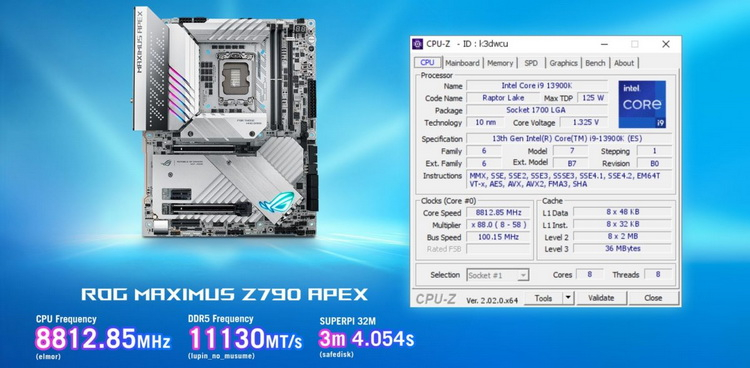
But few expected that the new chip which just went on sale would immediately set a new world overclocking record.An enthusiast with the nickname Elmor from Sweden entered into the HWBOT database his result of an extreme overclocking experiment with the Core i9-13900K using liquid nitrogen.
The overclocker managed to overclock the chip on a single core to a frequency of 8812.85 MHz, which is an absolute world record.
The ASUS Z790 ROG Maximus APEX motherboard was also used in the test system.
Source image: CPU-Z ValidatorNo less interesting detail is the fact that the last 12 years in setting new world records win systems based on ASUS motherboards, which will be a separate reason to be proud of this Taiwanese manufacturer.

10.03.2022

AMD processor plans: Ryzen 7000 with 3D cache will be released soon, and Threadripper and APU on Zen 4 - by the end of next year

AMD processor plans: Ryzen 7000 with 3D cache will be released soon, and Threadripper and APU on Zen 4 - by the end of next year

AMD processor plans: Ryzen 7000 with 3D cache will be released soon, and Threadripper and APU on Zen 4 - by the end of next year

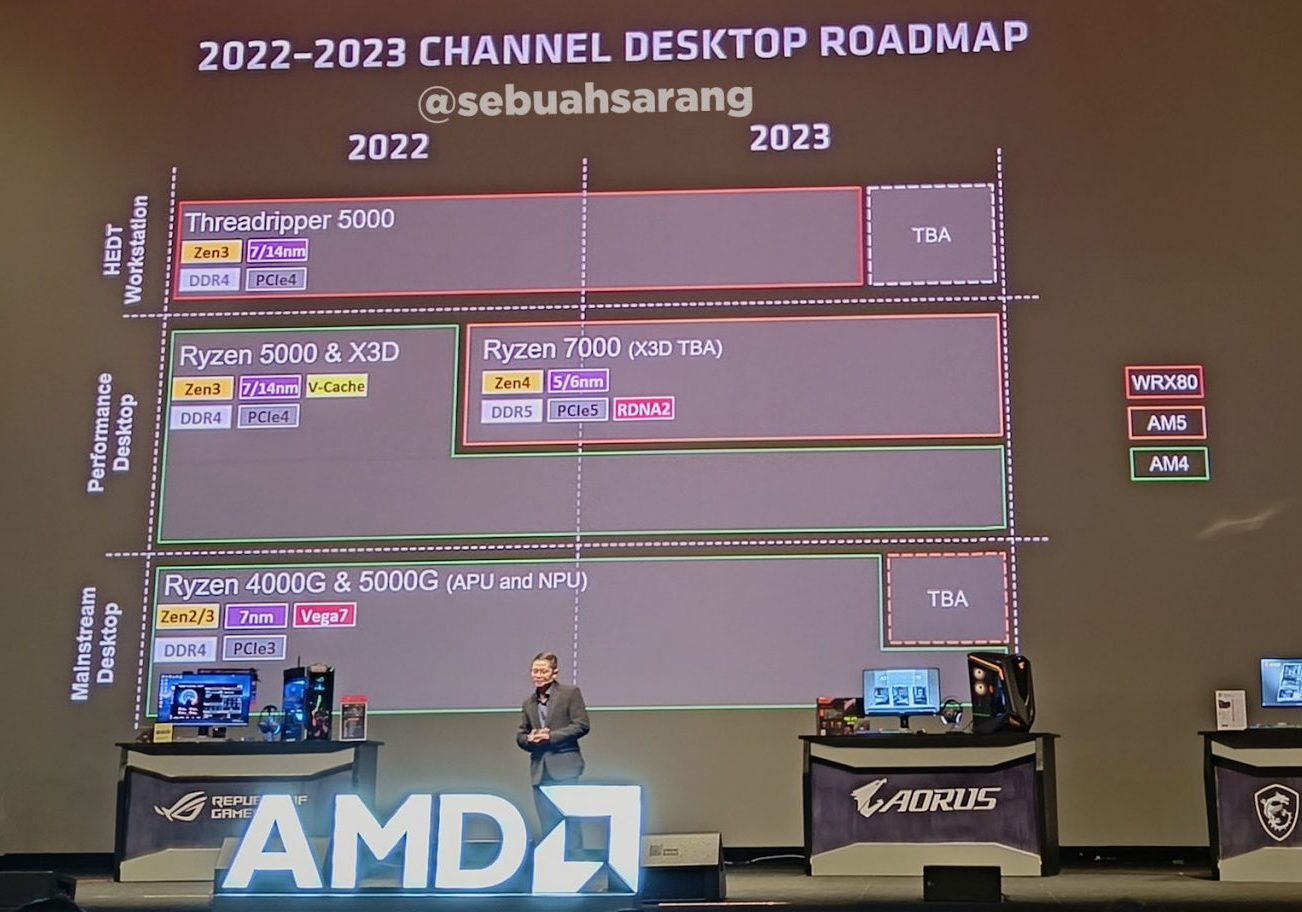
AMD has shared with partners plans for desktop processors in 2022-2023 - a \"road map\", not intended for the public, appeared on the web.
Judging by the presented plan, AMD intends to continue releasing Ryzen 5000, 4000G and 5000G processors under Sunset AM4, and the powerful Ryzen Thredripper 5000 will not get successors until the end of 2023.AMD plans to introduce a new generation of high-performance desktop processors, which will replace the current Ryzen Threadripper 5000, only by the end of 2023.
Their name, as well as details about the characteristics, are not specified.
According to previous rumors, the new items were codenamed Storm Peak, and will probably go on sale as Ryzen Thredripper 7000.
We can assume that these processors will get Zen 4 cores, DDR5 and PCIe 5.0 support, and other Ryzen 7000 features.Also, AMD will continue to produce and sell Ryzen 5000 and 5000X3D processors in parallel with the new Ryzen 7000 at least until the end of 2023.
Also, AMD's slide confirms that the company is preparing Ryzen 7000X3D processors, which will be equipped with additional 3D V-Cache.
Note that Ryzen 7 5800X3D is currently the only desktop processor with extended 3D V-Cache.
And it is one of the company's fastest solutions for gaming, overtaking in some cases even the newly released Ryzen 7000.
So maybe the release of Ryzen 7000X3D processors will allow AMD to strengthen its position in the gaming area.Finally, AMD plans to update Ryzen G-series desktop hybrid processors, which feature quite productive integrated graphics, by the end of 2023.
They will probably join the Ryzen 7000G series and offer a combination of Zen 4 cores and RDNA 2 or RDNA 3 graphics.
At the same time AMD will continue to produce the current desktop hybrid Ryzen 4000G and 5000G processors, even after the release of new products.
Thus it turns out that at least until the end of 2023, the Socket AM4 platform will not lose relevance.

10.01.2022

Intel made the Core i5-13600K 10% more expensive than its predecessor, but kept the prices of the new Core i7 and Core i9

Intel made the Core i5-13600K 10% more expensive than its predecessor, but kept the prices of the new Core i7 and Core i9

Intel made the Core i5-13600K 10% more expensive than its predecessor, but kept the prices of the new Core i7 and Core i9

Intel today unveiled its 13th generation Core processors.
The new additions got more cores and higher clock frequencies, but at the same time some models became more expensive.
Here we compare the prices of the new and old Intel processors and compare them to the AMD Ryzen 7000, which went on sale today.As it turned out, Intel raised the price only on the youngest of the presented new products, the Core i5 family processors.
So, if the last generation Core i5-12600KF chip was priced at $264, the new Core i5-13600KF will cost $294.
The difference is a bit more than 11%.
The Core i5-13600K has also become more expensive and was priced at $319, whereas last year's Core i5-12600K received a price tag of $289 - the difference is a bit more than 10%.
Intel ProcessorPrice, $ProcessorPrice, $Core i5-12600KF264Core i5-13600KF294Core i5-12600K289Core i5-13600K319Core i7-12700KF384Core i7-13700KF384Core i7-12700K409Core i7-13700K409Core i9-12900KF564Core i9- 13900KF564Core i9-12900K589Core i9-13900K589And other processors of the new generation kept the same prices, as their predecessors.
The flagship Core i9-13900K, for example, costs $589, and the more affordable Core i7-13700K costs $409.
AMD ProcessorPrice, $ProcessorPrice, $Ryzen 5 5600X299Ryzen 5 7600X299Ryzen 7 5800X449Ryzen 7 7700X399Ryzen 9 5900X549Ryzen 9 7900X549Ryzen 9 5950X799Ryzen 9 7950X699We note, Here we should also mention that AMD Ryzen 7000 series processors are on sale today compared to their predecessors, some models are even cheaper.
The Ryzen 77700X is priced at $399, $50 less than the Ryzen 7 5800X at the start of sales.
And the flagship Ryzen 9 7950X is even cheaper by $100 compared to its predecessor, to $699.

Intel unveiled the 13th generation Core processors - up to 24 cores and up to 5.8 GHz

Intel unveiled the 13th generation Core processors - up to 24 cores and up to 5.8 GHz

Intel unveiled the 13th generation Core processors - up to 24 cores and up to 5.8 GHz

Intel unveiled the 13th generation Core desktop processors, also known as Raptor Lake, as part of its Innovation event.
The new chips have a new architecture, more cores, and higher frequencies than their predecessors.
At the same time, some models went up in price.Raptor Lake processors, like their predecessors, use hybrid architecture, combining a powerful P-core and energy-efficient E-core.
The former are based on the new Raptor Cove architecture, and are distinguished by their increased L2 cache size.
Alder Lake has 1.25 Mbytes of L2 cache per core, while the new products have 2 Mbytes of L2 cache per core.
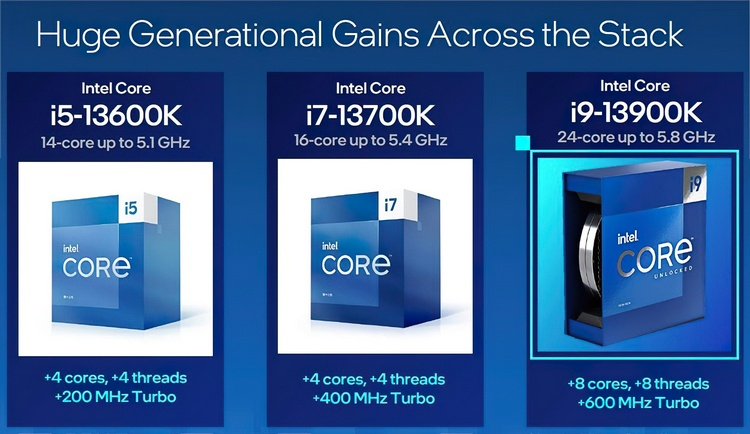
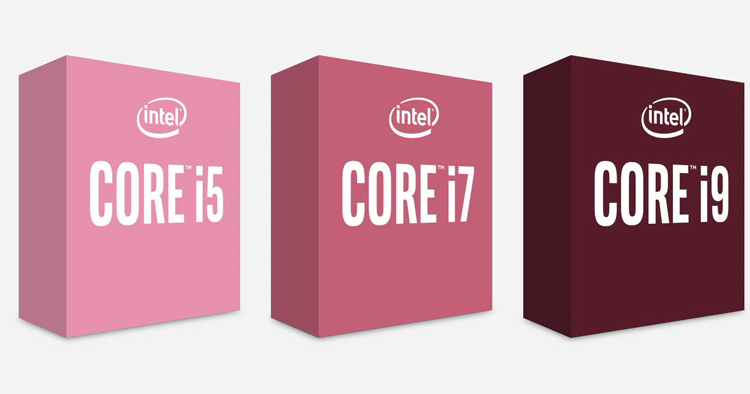
There are six models in total: the flagship Core i9-13900K and Core i9-13900KF, the average Core i7-13700K and Core i7-13700KF, as well as more affordable Core i5-13600K and Core i5-13600KF.
All of them have an unlocked multiplier and belong to the more advanced and expensive Intel solutions.
Recall that models with the suffix \"KF\" differ only in the absence of integrated graphics, but all other features they have identical to conventional processors.
Announcement of more affordable Raptor Lake processors, deprived of overclocking capabilities, is expected later.Senior Core i9-13900K has 24 cores and support 32 threads, as well as a total of 32 MB of L2 cache and 36 MB of L3 cache.
The eight cores here are high-performance Raptor Cove.
Their base frequency is 3.0 GHz, all together they can automatically overclock to 5.4 GHz, and the maximum frequency provided by the Thermal Velocity Boost technology for 1-2 cores is 5.8 GHz.
Another 16 cores of the flagship are energy-efficient Gracemont cores.
Their base frequency is 2.2 GHz, and the maximum frequency is 4.3 GHz.
The Core i7-13700K processor has eight P- and E-core each, which ultimately provides 24 threads.
The previous flagship Core i9-12900K has the same configuration.
The new Core i7 has a maximum clock speed of 5.4 GHz.
Finally, the Core i5-13600K has six P cores and eight E cores, offering 20 threads.
The clock speed of these processors can automatically go up to 5.1 GHz.
As for performance, the slide above shows Intel comparing the Core i9-13900K to its predecessor Core i9-12900K in games.
As you can see, in most projects, the newcomer is faster - in some places even by 20 percent or more.
Intel also compares the Core i9-13900K with AMD's old flagship Ryzen 9 5950X.
Intel's novelty in games delivers a higher average FPS by 6 to 58 percent, depending on the project.
In addition, Intel cites a comparison with the best gaming processor of the last generation competitor, Ryzen 7 5800X3D.
And in some games, the latter turns out to be faster or on par with the new Core i9-13900K! Intel also cites a comparison of the Core i9-13900K, Core i9-12900K and Ryzen 9 5950X in various professional applications from Adobe and Autodesk.
New Intel product outperforms old flagship AMD by 16 to 69%.Along with the new CPUs, Intel has also introduced new 700-series chipsets, and motherboard manufacturers will release new solutions based on them.
At the same Raptor Lake will be made in the same LGA 1700 chassis, as the current Alder Lake.
New products will be compatible with motherboards based on the Intel 600-series system logic.The most affordable of the currently available Raptor Lake - Core i5-13600KF - priced at $294.
By comparison, last year's Core i5-12600KF cost $264.
At the same time, the flagship Core i9-13900K costs the same as its predecessor - $589.
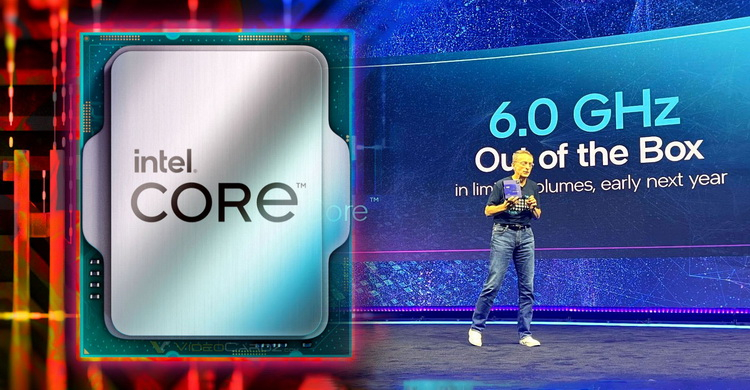
Sales of the Intel Core 13-generation processors will start on October 20.Also Intel has promised to release a limited series of processors next year, which can automatically overclock up to 6.0 GHz.
We are probably talking about the Core i9-13900KS.

Xeon E5-1660 v3 processor review from AliExpress: overclocking the Chinese way

Xeon E5-1660 v3 processor review from AliExpress: overclocking the Chinese way

Xeon E5-1660 v3 processor review from AliExpress: overclocking the Chinese way

Platforms based on obsolete Xeon processors and Chinese motherboards, which are sold in abundance on the well-known cross-border trade platform, is a truly immense topic.
We touched it twice and both times made sure that the server processors of 7-8 years ago do not look competitive at all against the background of modern CPUs.
However, as it turned out, this is far from being the end of the story.
Finally and irrevocably convince the adherents of old Xeon that the processors with microarchitectures which are four or five generations behind are not able to provide the level of performance typical of the current Core and Ryzen, we have not succeeded yet.
Every time the adherents of CPUs from the past begin to appeal to the fact that among numerous Xeon for LGA2011-3 platform we should choose some other model, so that it would be able to get on the same level with Core i5 and Ryzen 5, if not with Core i3 of Alder Lake generation by its performance.Frankly speaking, it becomes more and more difficult to believe it, because we tested quite a few different models of Xeon E5 v3 and v4 series.
Among them were both comparatively high-frequency and multicore variants, processors both on Haswell microarchitecture and on Broadwell, and all of them were notably losing in performance to modern low-cost CPUs.
However, so far we haven't tried to overclock server processors from AliExpress, and such a claim from fans of old Xeon really seems justified.
We did not want to leave anything unsaid in our tests, so we decided to return to the topic of Chinese server CPUs once again and see if overclocking can somehow help them.
At the first glance, overclocking of old Xeons does not seem to be useless: low clock frequency is really one of the factors restraining their gaming performance.
But it should be mentioned straight away that overclocking of old Xeon is not the same as overclocking of modern overclocking CPUs.
Firstly, most Xeon E5 v3 and v4 have a locked multiplier, which is logical for server processors.
Therefore, a special Xeon model will be required to increase the frequency above the default value.
Secondly, the majority of Chinese LGA2011-3 motherboards, which are currently available on the market, either do not support overclocking at all or support it rather conditionally.
So in addition to certain processor models, you also need a special board.
And only using a combination of the right equipment will it be possible to overclock Chinese Xeon.So to get an overclocking platform based on Xeon you will have to spend a bit more effort and money.
But we went all this way and are ready to tell you if the result is worth the money invested and if an overclocked Xeon from 8 years ago can be considered as the \"terror of modern CPUs\".⇡#Xeon with overclocking: what is itAlthough the statement that there were instances with an unlocked multiplier among previous generations of Xeons sounds rather strange, it is true.
Nowadays, Intel no longer allows such oversights, but in 2014, when Haswell-EP server processors appeared on the market, some of the released models did turn out to be capable of overclocking.
Apparently, this happened because Intel used the same semiconductor blanks for Xeon E5 v3, designed for single-processor configurations, and overclocking Core-X.
Obviously, the company expected that no one would think to overclock Xeon, but eventually this hidden feature became known, and now it is the source of inspiration for some fans of systems on old server CPUs.Based on the above, it is easy to conclude that overclocking may have the Xeon E5 1600 v3 series - they are maximum similar to the high-performance desktop models.
These processors are based on a simple semiconductor chip LCC (Low Core Count) and can not work in pairs (and fours), because they lack the interprocessor bus QPI.
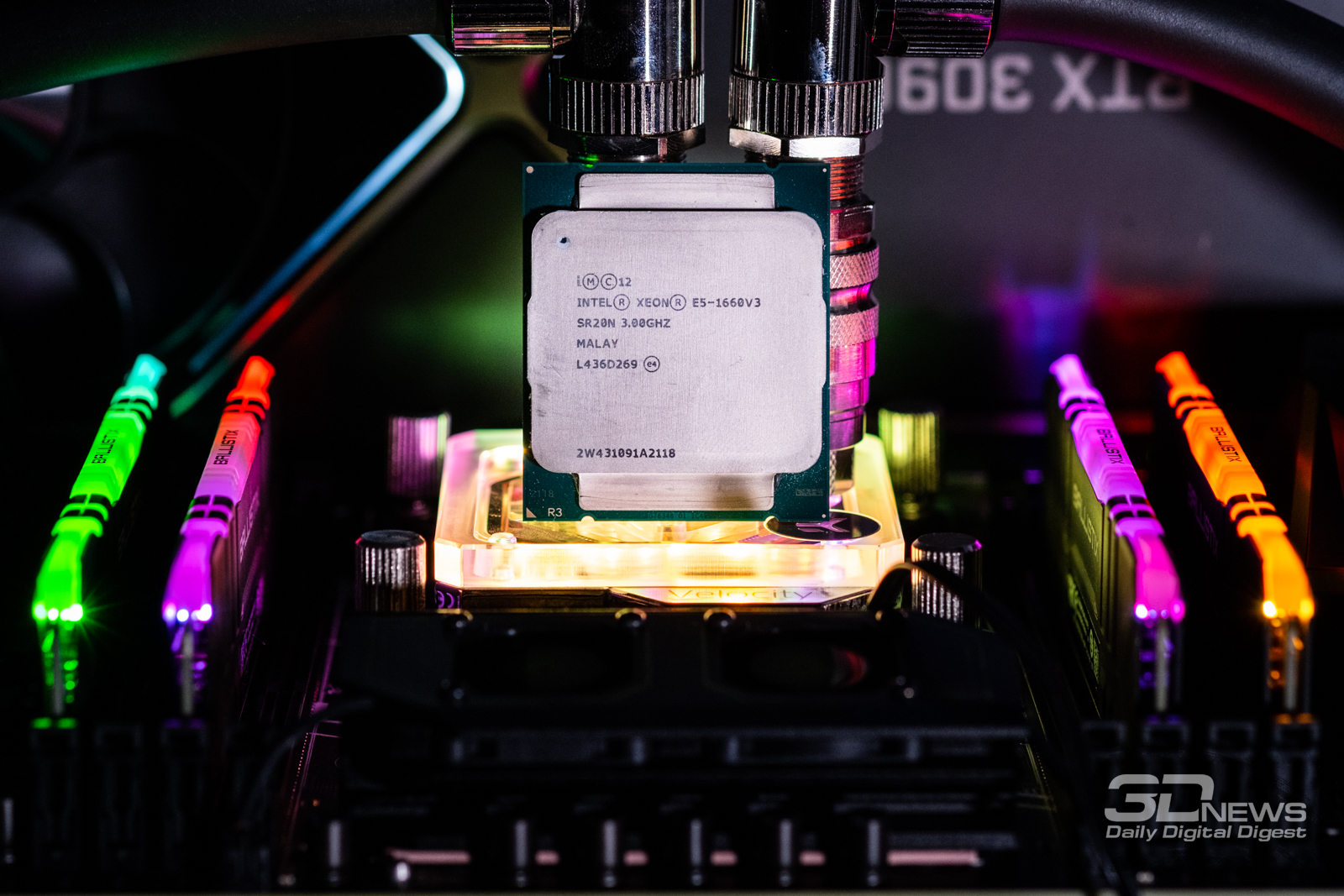
And among the Xeon E5 1600 v3, you do find a few models with an unlocked multiplier: the six-core Xeon E5-1650 v3 and the eight-core Xeon E5-1660 v3 and E5-1680 v3.
In fact, these models are similar to well-known to enthusiasts Core i7-5930K and Core i7-5960X Extreme Edition with the only difference that they have a slightly different purpose, so they were released in much larger quantities, which are now sold on the Chinese aftermarket for relatively low prices.
For example, six-core Xeon E5-1650 v3 can be found on AliExpress for 4-4, 5 thousand rubles, Eight-core Xeon E5-1660 v3 sells for 6-7 thousand rubles, and Xeon E5-1680 v3 costs about 11.5-13 thousand rubles.
The most popular solution for budget builds in this range is Xeon E5-1650 v3, but we chose more expensive for detailed study

Ryzen 7000 reviews are out: much faster than its predecessors, but unlikely to overtake Intel Raptor Lake

Ryzen 7000 reviews are out: much faster than its predecessors, but unlikely to overtake Intel Raptor Lake

Ryzen 7000 reviews are out: much faster than its predecessors, but unlikely to overtake Intel Raptor Lake

Tomorrow AMD will start selling Ryzen 7000-series processors, which not only bring the new Zen 4 architecture, but, more importantly, the new Socket AM5 platform.
And today specialized resources have published reviews of new processors and here we give only the main results of the tests.
In brief: the new products are much faster than their predecessors and can compete with Intel Alder Lake on an equal footing.
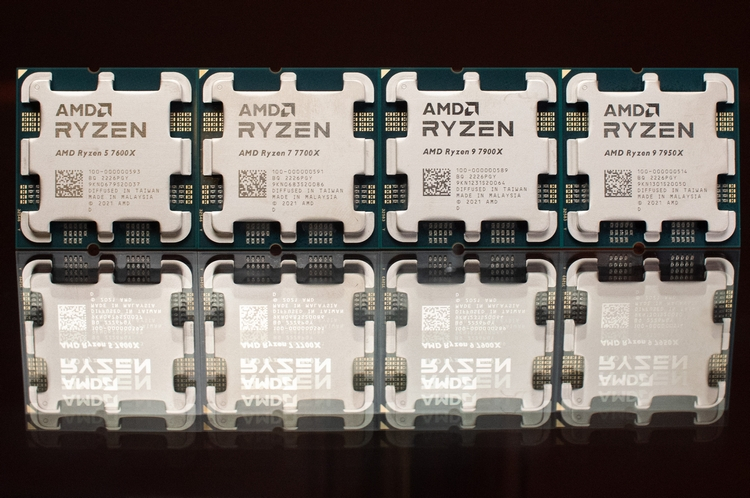
But will this be enough to compete with Raptor Lake in the future? But first, let us remind you that AMD has now introduced four new generation processors: the six-core Ryzen 5 7600X, the eight-core Ryzen 7 7700X, the 12-core Ryzen 9 7900X and the 16-core Ryzen 9 7950X flagship.
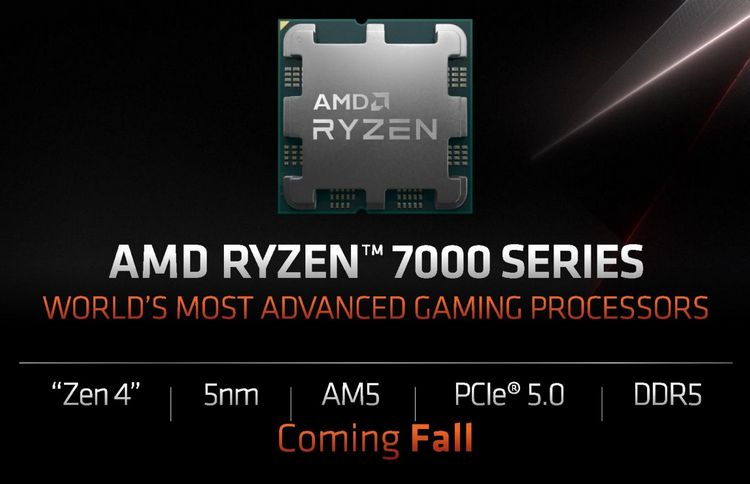
All of them use Zen 4 cores and are made according to the 5-nm process technology.
The new platform brings a LGA socket called Socket AM5, as well as support for PCI Express 5.0 and DDR5 memory.All reviewers note a significant increase in both single-core and multi-core performance compared to Ryzen 5000-series processors.
The processors in many (but not all) synthetic tests and applications Ryzen 9 7950X and Ryzen 9 7900X were faster than Core i9-12900K.
And in some places the current Intel flagship was even behind the Ryzen 7 7700X.
Synthetic test and applications 01.jpg See all pictures (12) 02.jpg 03.jpg 09.jpg 04.png 05.png 06.png 07.png 08.jpg 10.jpg 11.jpg 12.jpg See all pictures (12) On the other hand the junior Ryzen 5 7600X was ahead of Core i5-12600K without any surprises, but it did not make any bigger claims.
But, to be fair, we should note that in some applications even the flagship Ryzen 9 7950X was weaker than the Core i5-12600K.
But those were isolated cases.Games 01.jpg See all images (17) 02.jpg 03.jpg 04.jpg 05.jpg 06.jpg 07.jpg 08.jpg 09.jpg 10.jpg 11.jpg 12.jpg 13.jpg 14.jpg 15.jpg 16.jpg 17.jpg See all images (17) For gaming tests, you can see some differences between reviews.
So, according to The FPS Review, in most games Ryzen 9 7900X and Ryzen 5 7600X prove to be weaker than Alder Lake chips including Core i5-12600K, and also inferior to the \"gaming king of AMD\" of the last generation - Ryzen 7 5800X3D.
But the difference turns out to be quite insignificant.
Similar results show the novelties in the hands of TechPowerUp.
And Tom's Hardware reports that on average in games only overclocked to 5.1GHz Core i9-12900K chip is able to compete with the new AMD Ryzen 9 7950X and Ryzen 5 7600X.
With standard settings AMD novelties are faster.
Note also that not in all games the flagship is faster than other AMD novelties.
As you can see from the table below, Ryzen 7 7700X is better than flagship in many gaming tests from ComputerBase.
Even more interesting is power consumption of Ryzen 7000-series processors.
We should point out that new Ryzen 9 CPU's TDP has been increased to 170W, compared to 105W of their predecessors.
In turn, the new Ryzen 7 and 5 got TDP of just 105W.
As a result, at full load Ryzen 9 7950X consumes 247W, and Ryzen 7 7600X - only 99W.
In games, consumption is much lower on average.
In all cases, the new Ryzen consumes much less than competitors - the same Core i9-12900K is able to \"eat\" up to 285 watts.
But compared to its predecessors Ryzen 5000 series, consumption has increased.
At the same time Ryzen 7000 turned out to be quite hot.
At maximum load with a powerful air cooler Noctua NH-U14S Ryzen 5 7600X temperature was 88 °C, while Ryzen 7 7700X, Ryzen 9 7900X and Ryzen 9 7950X reached 94 °C.
At the same time in games the figures were more acceptable: 70, 71, 76 and 76 °C, respectively.
Here we should also add that automatic overclocking mechanisms, if the cooling system allows, are able to raise Ryzen 7000 frequency above standard values - for example, when cooling with a 280mm cooler I managed to achieve a peak frequency up to 5.85GHz.
But on average gaming frequencies keep around 5.5GHz, which is much higher than its predecessors.
In the end we would like to say that tomorrow Intel will unveil the Core 13th generation processors.
According to rumors and leaks, they may be much faster than the current models of the 12th generation.
So, the fact that AMD has caught up and slightly overtook (not everywhere) Intel Alder Lake processors may not be enough to successfully compete with the upcoming Raptor Lake.
Whether this is true, we will find out quite soon.

9.26.2022

All Ryzen 7000 processors were tested in Cinebench and compared with Ryzen 5000 - performance increased by 13-42 %

All Ryzen 7000 processors were tested in Cinebench and compared with Ryzen 5000 - performance increased by 13-42 %

All Ryzen 7000 processors were tested in Cinebench and compared with Ryzen 5000 - performance increased by 13-42 %

Test results of AMD Ryzen 7000-series processors in popular benchmarks Cinebench R15, R20 and R23 was published by VideoCardz resource.
Moreover all four currently presented AMD Ryzen new generation models are tested without overclocking.
Earlier this week flagship Ryzen 9 7950X showed its capabilities in the above mentioned tests, but only with overclocking.
In one case, the chip was overclocked to 5.35-5.5GHz with a liquid cooling system with 280mm radiator, and in the other, to 6.45-6.5GHz using liquid nitrogen for cooling.
In both cases, this allowed to update the specified test records for 16-core processors.Now the test results of all presented AMD new generation processors are published, viz: 16-core Ryzen 9 7950X, 12-core Ryzen 9 7900X, eight-core Ryzen 7 7700X and six-core Ryzen 5 7600X.
All of them are based on Zen 4 architecture and are made using a 5-nm process.
All mentioned processors have been tested with default settings on advanced motherboards with AMD X670E chipset and DDR5-6000 RAM.
In its turn, Ryzen 5000 were tested with DDR4-3200 memory.
As we can see, all new products increased significantly compared to their predecessors.
Single-core performance increased by 13 to 28% depending on test and processor.
As for multicore performance, the fact that Ryzen 9 7900X outperforms Ryzen 9 5950X, despite smaller number of cores, is immediately striking.
The gain depending on the chip and the test was between 26 and 42%.
Of course, these are only a few synthetic tests, and we will be able to get the full picture only in a few days, when the processors go on sale, and profile resources will publish reviews.

AMD Ryzen 9 7950X overclocked under liquid nitrogen to 6.5GHz and updated several records in Cinebench

AMD Ryzen 9 7950X overclocked under liquid nitrogen to 6.5GHz and updated several records in Cinebench

AMD Ryzen 9 7950X overclocked under liquid nitrogen to 6.5GHz and updated several records in Cinebench

AMD Ryzen 7000 series processors have not yet gone on sale but are already actively setting new records in various benchmarks, as evidenced by HWBot ratings.
Earlier this week it was reported about four records set by Ryzen 9 7950X with liquid cooling, and now Tom's Hardware writes that some of those records have been surpassed - with Ryzen 9 7950X and liquid nitrogen.For starters, let us remind you that Ryzen 9 7950X with Corsair H115i liquid cooling system with 280mm radiator enthusiasts managed to overclock all 16 cores to 5.35-5.5GHz.
This allowed them to update 16-core processor records in multi-threaded benchmarks such as Cinebench R23, Cinebench R20 and Cinebench R15 as well as in the 7-Zip archiver test.
Now AMD Ryzen 9 7950X flagship is overclocked even more, but in extreme conditions with liquid nitrogen.
In multi-threaded Cinebench R23 test AMD processor was overclocked to 6.45GHz and gained 48,235 points, 16.2% over the maximum score of Core i9-12900KS, also overclocked with liquid nitrogen.
On the other hand, Ryzen 9 7950X overclocked to 6.5GHz in Cinebench R20 test and achieved 18,605 points.
This is 15.8 % more than the previous best result achieved by liquid nitrogen cooled processors (Ryzen 9 5950X to 6 GHz).We should note that obviously more record updates are waiting for us in the near future, as it usually happens with the release of new generation processors.
Ryzen 7000 will be released on September 27.
Also in the second half of October we expect the release of Intel Core 13th generation processors (Raptor Lake), which will also compete for new HWBot ratings records.

9.20.2022

GPU performance of the Apple A16 chip has increased by more than a quarter compared to the A15

GPU performance of the Apple A16 chip has increased by more than a quarter compared to the A15

GPU performance of the Apple A16 chip has increased by more than a quarter compared to the A15

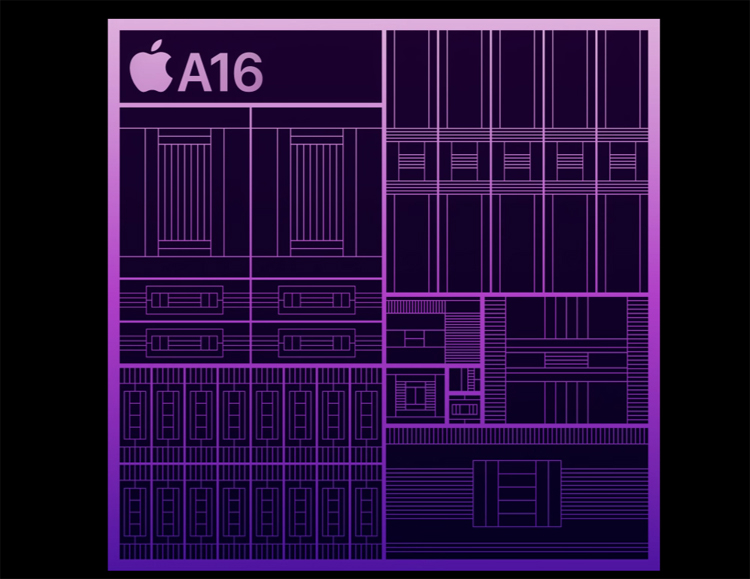
Data from the popular AnTuTu benchmark shows that the Apple A16 Bionic processor, used in the latest iPhone smartphones, significantly outperforms the previous generation A15 Bionic chip in terms of graphics unit (GPU) performance.
Image source: ArpleThe A16 Bionic is the \"heart\" of the iPhone 14 Pro and iPhone 14 Pro Max, while the iPhone 14 and iPhone 14 Plus use the A15 Bionic.
The processors have identical architecture: they are six processing cores (two performance and four energy-efficient), a five-core GPU node and a 16-core neural processor engine (Neural Engine).Image source: ApTuTuIn the AnTuTu test the iPhone 14 Pro smartphone scored a total of 978,147 points, the iPhone 14 Pro Max model - 972,936 points.
This is approximately 19% more compared to the iPhone 13 series with the A15 Bionic chip.The iPhone 14 Pro and iPhone 14 Pro Max models compared to their predecessors show a performance increase of CPU cores by 17%, memory - by 10%.
As for the graphics node, its performance rose by more than a quarter - by 28%.Image source: ApTuTuAdd that in the test AnTuTu used the iPhone 14 Pro and iPhone 14 Pro Max versions, equipped with a 1 Tbyte flash drive.
The devices carry 6 GB of RAM.

Intel accidentally showed the specifications of three flagship Raptor Lake processors

Intel accidentally showed the specifications of three flagship Raptor Lake processors

Intel accidentally showed the specifications of three flagship Raptor Lake processors

In the Canadian section of the Intel website for a short time appeared information about three Core thirteenth generation processors (Raptor Lake family).
The data was promptly removed, but they managed to spread online sources.Image source: IntelThe page on Intel's gaming PC build site listed the Core i5-13600K, Core i7-13700K and Core i9-13900K models.
According to the given description, the first of the named chips contains 14 computing cores, including six efficient and eight energy-efficient.
Up to 20 instruction threads can be executed simultaneously.
Named maximum clock speed productive unit - 5.1 GHz.Core i7-13700K processor, in turn, has 16 cores - eight performance and energy-efficient.
It is allowed to execute up to 24 instruction threads simultaneously.
Clock speed is up to 5.3 GHz.Finally, the senior model, Core i9-13900K, has 24 cores - eight efficient and 16 energy efficient.
The number of instruction threads reaches 32.
The maximum frequency of efficient core is 5.4 GHz.It should be noted that the senior chip also supports Thermal Velocity Boost (TVB), which allows two efficient cores to overclock to 5.8 GHz.The official announcement of Raptor Lake generation processors is scheduled for September 27 - it will be held at the Intel Innovation event.

The 35 watt Core i7-13700T has appeared in the Geekbench test database, and it is higher than the Ryzen 7 5800X

The 35 watt Core i7-13700T has appeared in the Geekbench test database, and it is higher than the Ryzen 7 5800X

The 35 watt Core i7-13700T has appeared in the Geekbench test database, and it is higher than the Ryzen 7 5800X

Only K-series models with unlocked multiplier are expected to be announced as part of the first wave of Intel Raptor Lake series processors.
However, a model from the future energy efficient Core T series has made its mark in the Geekbench synthetic test database.
We're talking about the 16-core and 24-thread Core i7-13700T with an estimated heat dissipation of 35 watts.Image source: VideoCardzBase frequency of the processor is 1.4 GHz.
In auto mode, it can overclock up to 4.78 MHz.
Recall that the Intel T-series processors are not designed for gaming.
It is designed for use in compact energy-efficient and embedded systems, often equipped with passive cooling systems.Image source: GeekbanenchIn single-core performance tests, Core i7-13700T showed results from 1893 to 1939 points.
In multi-core performance tests, the chip scored from 8,925 to 11,564 points.Source image: GeekbanxThe Core i7-13700T is faster than the eight-core Ryzen 7 5800X on the Zen 3 architecture.
The maximum TPD of the Raptor Lake chip is unknown, but it should be lower than that of the Ryzen model (105W nominal and 142W maximum).
Intel chip was tested with DDR4-3200 RAM, hence it did not take advantage of faster DDR5 memory support.Compared to the 10-core Core i5-12600K Alder Lake series, the Core i7-13700T showed higher single-core and almost the same multi-core performance.
Image source: VideoCardzIntel usually releases energy-efficient models of its processors after the release of the higher-end K-series models with TDP 125W and mass models without overclocking and with TDP 65W.

9.09.2022

The eight-core Ryzen 77700X was faster than the 16-core Core i9-12900K in the CPU-Z test

The eight-core Ryzen 77700X was faster than the 16-core Core i9-12900K in the CPU-Z test

The eight-core Ryzen 77700X was faster than the 16-core Core i9-12900K in the CPU-Z test

A database of the CPU-Z utility's built-in performance test revealed the performance of the eight-core AMD Ryzen 7 7700X processor on the 5nm Zen 4 architecture.
Soon the record was deleted, but vigilant users managed to take screenshots.Image source: AMDAll eight cores of AMD processor in the test worked at the same frequency of 5425 MHz.
This is 25 MHz higher than the claimed auto overclocking frequency for this model.
The TDP rating of the Ryzen 7 7700X processor is 105W.
It supports AVX512IF instructions, DDR5 memory and PCIe 5.0 interface.
AMD Ryzen 7 7700X specifications.
Image source: ValidX86 / TUM_APISAKThe processor was tested on Gigabyte X670E AORUS Master motherboard, and with DDR5-6400 memory with CL30 timings.
With this configuration, the chip scored 774 points in CPU-Z single-core performance test, and 8381 points in multi-threaded test.
Ryzen 77700X single-core performance test with CPU-Z.
Source image: ValidX86 / TUM_APISAKWith these single-core performance results, the novelty is 21% faster than the eight-core Ryzen 7 5800X and 20% faster than the 16-core Ryzen 9 5950X on Zen 3 architecture.
In addition, the Ryzen 7 7700X was 1% faster than the 10-core Core i5-12600K, but inferior to the 12-core Core i7-12700K.
Ryzen 7 7700X multicore performance test by CPU-Z.
Image source: ValidX86 / TUM_APISAKMultithreaded performance of the Ryzen 7 7700X in this test was 1 percent better than the 16-core Core i9-12900K and 8 percent better than the Core i7-12700K.
Moreover, new AMD Raphael CPU is 28% faster than Ryzen 7 5800X.
AMD new product also showed up in Geekbench synthetic test database.
However, in this case we used a different motherboard (ASUS ROG Crosshair X670E Hero) and a different RAM configuration (64 GB DDR5-6000 memory).
Source image: GeekbenchWith results of 2209 and 14,459 points in single-threaded and multi-threaded performance tests, the novelty in the first case was 16% faster than the Core i7-12700K model, and in the second - 2% faster.Ryzen 7 7700X processor along with the rest of the Ryzen 7000 series goes on sale September 27.
Reviews of the new generation chips will start to appear one day earlier.

8.31.2022

Ryzen 9 7950X results hit the Geekbench database, and they are worse than the engineering Core i9-13900K

Ryzen 9 7950X results hit the Geekbench database, and they are worse than the engineering Core i9-13900K

Ryzen 9 7950X results hit the Geekbench database, and they are worse than the engineering Core i9-13900K

Geekbench synthetic test database has posted performance test results for the flagship 16-core Ryzen 9 7950X processor.
Previously reported performance in the same benchmark of the junior six-core Ryzen 5 7600X model.Image source: AMDRyzen 9 7950X was tested on ASUS ROG Crosshair X670E Extreme motherboard paired with 32GB of DDR5-6000 RAM.
As part of the test, the processor automatically overclocked to 5759 MHz, just above the manufacturer's claimed 5.7 GHz.
Ryzen 9 7950X has 16 physical cores with support for 32 virtual threads.
The same number of cores have still current flagship processors AMD Ryzen 9 5950X and Intel Core i9-12900K.
At the same time the new AMD chip has fewer cores than the future flagship Core i9-13900K processor.
The latter will be equipped with 24 physical cores, but 16 of them are energy efficient and do not support Hyper-Threading.Ryzen 9 7950X specifications.
Source: Geekbanksh In the single-core performance test, the Ryzen 9 7950X scored 2,217 points.
This is just below the result announced by AMD itself (pictured below).
Multi-core performance index of the chip is 24,396 points.AMD declared Ryzen 7000 processor performanceMost models of future Intel Core 13th generation processors have already been tested in this benchmark (though, as engineering and qualification samples), the results of new AMD product can be compared with them.Ryzen 9 7950X performance.
Source: GeekbenchThe most recent entry in the Geekbench 5 database shows single-core performance of the Intel Core i9-13900K Raptor Lake series is 4.4 percent better.
The multi-core performance of the Intel chip is 8.8 percent higher than the Ryzen 9 7950X.
At the same time, the new AMD processor is 31 and 47.8% faster in single-threaded and multi-threaded tasks than the Ryzen 9 5950X, and 14.5% and 41.2% faster in the same tests than the Core i9-12900K.Image source: VideoCardzIt should be recalled again that only engineering and qualification samples of 13th generation Intel Core processors took part in Geekbench tests.
This means that their final performance figure may differ from the performance of the off-the-shelf consumer variants.

8.30.2022

AMD revealed plans: Ryzen 7000 with 3D cache, Threadripper on Zen 4 and all-new Zen 5

AMD revealed plans: Ryzen 7000 with 3D cache, Threadripper on Zen 4 and all-new Zen 5

AMD revealed plans: Ryzen 7000 with 3D cache, Threadripper on Zen 4 and all-new Zen 5

At last night's \"together we advance_PCs\" event, where AMD presented the Ryzen 7000 series desktop processors, some details about the company's future plans were revealed.
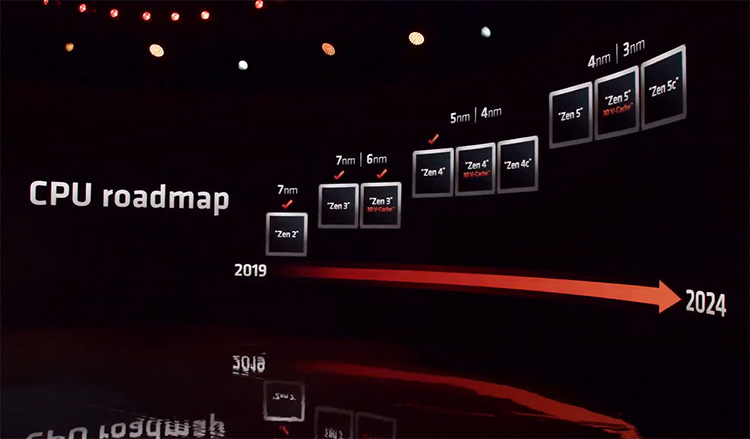
In particular, the next architecture after Zen 4, Zen 5 will come to the market in 2024.As for the near future, the next big processor announcement from AMD is scheduled for next year - the beginning of next year, the company intends to present a family of mobile Ryzen 7000 processors based on the Zen 4 microarchitecture.
Moreover, Mark Papermaster, AMD's technical director, promised during his speech that the Ryzen 7000 processors with additional 3D-cache chip (V-Cache), such as Ryzen 7 5800X3D, will be presented in the future.
On the other hand, he refused to give a definite date for Zen 4 server versions with 3D V-Cache technology, but the timing was more definite: these processors will appear in early 2023.
At the same time should go and designed for high-density servers processors EPYC Bergamo with Zen 4c-core - these chips, recall, will receive up to 128 cores, while the usual EPYC Genoa with the traditional architecture Zen 4 will be limited to 96 cores.Also AMD representatives mentioned the family of processors Ryzen Threadripper.
According to David McAfee, vice president and general manager of customer channels, AMD is looking very closely at releasing Ryzen Threadripper processors on the Zen 4 architecture.
However, due to changes in demand patterns and supply chains, we can only talk about variants \"without maximum configurations like Threadripper Pro, but with a broader lineup.
\"In addition, David McAfee promised that the Ryzen 7000 desktop processor family will not be limited to four models and will expand.
Additional processor models, covering a wider range of price categories, will be released early next year.As for the more distant prospects, the next to Zen 4 architecture Zen 5 is planned by AMD at the end of 2024, the processors based on it will be produced on the 4-nm process technology.
According to Papermaster, Zen 5 is a \"complete redesign of the core with further optimizations for AI tasks.
\"Along the way, AMD representatives have promised that the new platform Socket AM5, which comes out with the Ryzen 7000 processors, will remain relevant at least until 2025.
And this means that motherboards with socket AM5 will support not only Ryzen 7000, but also promising Ryzen processors based on Zen 5 architecture.

AMD introduced $700 Ryzen 9 7950X and other cheaper Ryzen 7000: sales start September 27

AMD introduced $700 Ryzen 9 7950X and other cheaper Ryzen 7000: sales start September 27

AMD introduced $700 Ryzen 9 7950X and other cheaper Ryzen 7000: sales start September 27

AMD has officially introduced the Ryzen 7000 family of desktop processors.
It includes four models with 6, 8, 12 and 16 cores with the new Zen 4 architecture.
Their sales will start on September 27.
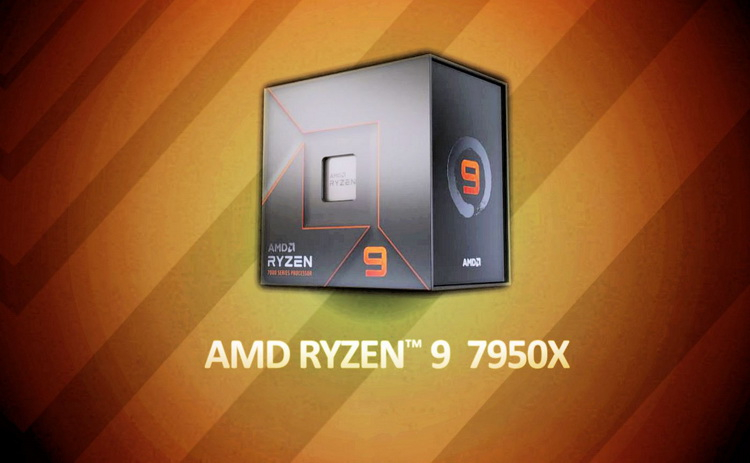
Ryzen 7000 processor family includes four models:Ryzen 9 7950X: 16 cores, 4.5-5.7 GHz, 64 Mbytes L3-cache, 170 W TDP, price - $699;Ryzen 9 7900X: 12 cores, 4.7-5.6 GHz, 64 Mbytes L3-cache, 170 W TDP, price - $549;Ryzen 77700X: 8 cores, 4.5-5.4 GHz, 32 Mbytes L3-cache, 105 W TDP, price - $399;Ryzen 5 7600X: 6 cores, 4.7-5.3 GHz, 32 Mbytes L3-cache, 105 W TDP, price - $299.
The main advantage of the new family over the Ryzen 5000 series desktop processors AMD calls increased performance.
According to the official data, the Zen 4 microarchitecture provides a 13 percent increase in IPC (specific performance per clock), plus an additional boost in performance gives the clock speed.
It has increased up to 5.7 GHz in single threaded mode, which is 800 MHz higher than the maximum frequency of the Ryzen 5000 series.
During the presentation AMD said that the older model in the family, Ryzen 9 7950X, is faster than the previous flagship processor, Ryzen 9 5950X, by an average of 40% in demanding applications for creating and processing digital content and 21% - in modern games (at 1080p resolution).Besides this AMD promises superiority in performance of its new 16-core flagship and over Core i9-12900K.
According to the company's own tests Ryzen 9 7950X beats it by about 45% in content creation applications and about 9% - in games.Separately it was mentioned that even the junior model in the family - six-core Ryzen 5 7600X - has an average of 5% better gaming performance compared to the competitor's older processor.AMD also paid attention to energy efficiency of new products.
The Ryzen 9 7950X is said to be 62% more energy efficient than the Ryzen 9 5950X for equal performance.
And when power consumption of these processors is equalized, Ryzen 9 7950X is 49% faster.
If we compare with Core i9-12900K, the claimed superiority of 16-core novelty in energy efficiency is up to 47%.Recall, the underlying Ryzen 7000 microarchitecture Zen 4 is a sequential upgrade of Zen 3.
As part of it, the main eight-core CCD chip Zen 4 moved to the TSMC N5 process, which allowed AMD to increase its silicon budget to 6.57 billion transistors (versus 4.15 billion in Zen 3).
The additional transistors were aimed at doubling the L2 cache size to 1 Mbyte per core, as well as a 1.5-fold expansion of the microoperations cache and implementation of AVX-512 instruction set support (VNNI).Also significant improvements in Zen 4 were made in the input part of the execution pipeline - the bottleneck in the Zen 3 architecture.
This, according to AMD estimates, is what provided the lion's share of the 13 percent increase in IPC.Changes have also affected the Ryzen 7000 IO-chip.
Its production is switched to TSMC N6 technology, and now it supports PCIe 5.0 bus and DDR5 memory, and has an integrated graphics core with RDNA2 architecture.
Because of these changes, as well as increased power consumption limits, Ryzen 7000 processors need new motherboards with Socket AM5 processor socket, which can provide up to 230W of power.All four Ryzen 7000 processors will go on sale September 27 with Socket AM5 motherboards based on the flagship X670 and X670E (Extreme) chipsets.
Mid-range chipsets based on B650E and B650 should be expected on the shelves in October.
Along with that, memory vendors will release DDR5 SDRAM kits up to 6400 MHz, optimized for Ryzen 7000 and with support for EXPO timings profiles.

8.29.2022

Upcoming night is AMD's presentation to unveil Ryzen 7000 on Zen 4

Upcoming night is AMD's presentation to unveil Ryzen 7000 on Zen 4

Upcoming night is AMD's presentation to unveil Ryzen 7000 on Zen 4

Less than 24 hours to go until AMD's event to unveil its next generation desktop processors, the Ryzen 7000 series chips.
The novelties will offer a new architecture, will use a completely new platform, and a lot of other advantages.
The presentation will be held this coming night, beginning at 2:00 Moscow time on August 30.
You can follow the event via official AMD YouTube channel.AMD company has already announced some details about the upcoming products in May.
It is known that Ryzen 7000 processors will be based on a new Zen 4 architecture, and their chips with cores will be made by 5-nm process technology.
Yes, new items will inherit the layout of several crystals from their predecessors.
Separate chip with I/O interfaces will be produced by 6-nm processor.From previous AMD announcements we know that architectural changes will provide IPC (instructions executed per clock) increment only by 8-10%.
But thanks to transition from 7nm to 5nm process technology was able to significantly increase clock speeds.
AMD itself promised that Ryzen 7000 will be able to automatically overclock above 5.5 GHz.
Obviously, we are talking about dynamic overclocking of individual cores, but still the level is impressive.
And the rumors were pointing at 5.7 GHz.As a result, single-core performance should increase by more than 15%, and overall performance (multi-core) will increase by more than 35%.
And AMD also promised a significant improvement in terms of power efficiency - the increase in performance per watt will be more than 25%.
At the same time, the TDP level will be up to 170 W, which is noticeably higher than the previous maximum 125 W.AMD is expected to unveil only four models.
These will be the 16-core Ryzen 9 7950X, the 12-core Ryzen 9 7900X, the eight-core Ryzen 7 7700X and the six-core Ryzen 5 7600X.
Of course, SMT (two threads per core) support will be provided in all cases.
It is also reported to support AVX-512 instructions.A notable feature of the new generation of AMD Ryzen will be the presence of integrated graphics in all desktop models - previously it was only in the desktop chips Ryzen G-series.
There will be applied graphics on RDNA 2 architecture.Another important difference Ryzen 7000 from its predecessors will be the fact that they will work with a completely new CPU socket AM5.
This is a LGA socket with 1718 pins.
New socket allows to support the latest DDR5 RAM, as well as PCIe 5.0 interface for both graphics card and M.2 SSD.AMD has introduced three chipsets for new motherboards with Socket AM5: the flagship X670E, the powerful X670 and the average B650.
AMD partner manufacturers have already introduced many different motherboards for the upcoming Ryzen 7000.
By the way, new CPU socket will be compatible with most coolers for Socket AM4.