Showing posts with label rdna 3. Show all posts

12.28.2022

The Radeon RX 7000 has been blocked from one of the most effective alternative overclocking methods

The Radeon RX 7000 has been blocked from one of the most effective alternative overclocking methods

The Radeon RX 7000 has been blocked from one of the most effective alternative overclocking methods

AMD has banned the use of Power Play Table (PPTable) in the Windows registry on its Radeon RX 7000 graphics cards.
This limits the overclocking capabilities of the graphics cards and, in particular, prevents fine-tuning GPU power and frequency curves outside of their official specifications.
This has been pointed out by well-known enthusiast Buildzoid.Image source: AMDThe Power Play tables are an alternative method of changing GPU clock frequency, power and voltage via the Windows registry instead of modifying or replacing the BIOS.
At the same time, it is the safest method of running GPUs outside of their official specifications, as it prevents any risk that may arise from BIOS re-flashing.Setting up Power Play tables or changing the BIOS has several advantages over traditional AMD overclocking methods and features offered by Radeon Software Adrenalin.
First, users can bypass GPU hardware limitations associated with the firmware and overclock the graphics card as much as possible.
Secondly, Power Play tables allow for fine-tuning of the voltage/frequency curve to improve the power efficiency of the graphics card.
In other words, this method allows you to fine tune the video card's GPU behavior in more detail, which is not possible with AMD's usual overclocking software.Last generation Radeon RX 6000 video cards do not have the ability to fine tune power via Power Play tables blocked.
Why AMD decided to prohibit access to it on Radeon RX 7000 video cards is unknown.
However, one AMD engineer on the Reddit forum in a thread discussing power consumption issues with Radeon RX 7000 graphics cards reported that \"architecturally RDNA3 has some changes in how to manipulate the power tables.\"

12.14.2022

Sapphire introduced Radeon RX 7900 XTX and RX 7900 XT graphics cards in NITRO+ and PULSE versions - all with factory overclocking

Sapphire introduced Radeon RX 7900 XTX and RX 7900 XT graphics cards in NITRO+ and PULSE versions - all with factory overclocking

Sapphire introduced Radeon RX 7900 XTX and RX 7900 XT graphics cards in NITRO+ and PULSE versions - all with factory overclocking

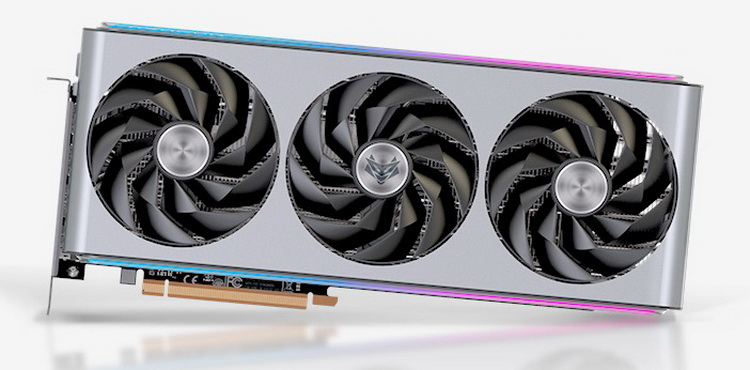
Sapphire officially introduced Radeon RX 7900 XTX and RX 7900 XT graphics cards in their signature NITRO+ and PULSE versions.
About the appearance of these new products previously reported.
Now the manufacturer has disclosed their specifications.
Radeon RX 7900 XTX NITRO+.
Image source: ShopheerGraphic processor Navi 31 with 6144 cores in the Radeon RX 7900 XTX NITRO+ in gaming mode runs at 2510 MHz, and in Boost mode - at 2680 MHz.
In both cases we are talking about factory overclocking.
Game frequency manufacturer has increased by 210 MHz, and Boost frequency - by 180 MHz.For a cut down Navi 31 GPU with 5376 cores model Radeon RX 7900 XT NITRO+ company says gaming frequency of 2220 MHz and Boost-frequency of 2560 MHz.
Thus, compared to the reference values the gain in the first case is 220 MHz, and in the second - 160 MHz.Both video cards NITRO+ series have a massive cooling system with three fans.
This is the first non-standard version of the new series of graphics cards Radeon RX 7900, in the cooling system which uses an evaporation chamber.
In this case Sapphire has applied its proprietary evaporation chamber technology Vapor-X.
In addition, new items are equipped with three cooling fans with a special shape of the blades, which can reduce the noise level by 10% compared to fans of the previous generation.
The company notes that fans can be easily removed for cleaning or replacement.Video cards are equipped with ARGB-backlit, and also have RGB-connectors on boards, allowing you to synchronize their backlight with the backlight of other system components.
Lighting can be adjusted in the proprietary Sapphire TriXX.For Radeon RX 7900 XTX Sapphire specifies power consumption of 420 watts.
This is 65 watts higher than the benchmark value.
The Radeon RX 7900 XT has a power consumption value of 368W - 53W higher than the benchmark.
Both graphics cards received three 8-pin connectors each for additional power.
For both models, the manufacturer recommends to use power supply unit with power of 800 watts and more.
Both novelties are equipped with dual BIOS system.
The dimensions of Sapphire Radeon RX 7900 XTX NITRO+ and Radeon RX 7900 XT NITRO+ graphics cards are 320 × 135.75 × 71.6 mm.
They require 3.5 free expansion slots in the PC chassis for installation.The Radeon RX 7900 XT PULSE model GPU runs at 2075 MHz in gaming mode, which is 75 MHz above the reference value.
For Boost mode the claimed value is 2450 MHz.
This is 50 MHz above the benchmark.The flagship Radeon RX 7900 XTX PULSE has gaming and Boost mode frequencies of 2330 and 2525 MHz respectively.
In the first case it is 30 MHz above the benchmark and in the second case it is 25 MHz above the benchmark.PULSE series graphics cards are equipped with a simpler but also very large cooling system.
It includes three fans with a special shape of the blades.
The manufacturer notes that the fan blades with angular velocity provides two layers of downward air pressure, which along with the air pressure on the outer ring of the fan leads to an increase in downward air pressure by 44% and increased air flow by 19% for better cooling while reducing noise compared to the previous generation of fans.PULSE series graphics cards thickness is 2.7 expansion slots.
Dimensions of video cards are 313 × 133.75 × 52.67 mm.
For the senior model, the power consumption indicator of 370 W is declared, which is 15 W higher than the reference value.
The novelty has three 8-pin connectors for additional power.
The junior model has a power consumption figure of 331W, which is 16W higher than the benchmark.
The card has two 8-pin connectors for additional power.
The manufacturer recommends to use 800W power supply in both cases.

Sales of Radeon RX 7900 XTX and RX 7900 XT graphics cards have started - they will appear in Russia by the end of December

Sales of Radeon RX 7900 XTX and RX 7900 XT graphics cards have started - they will appear in Russia by the end of December

Sales of Radeon RX 7900 XTX and RX 7900 XT graphics cards have started - they will appear in Russia by the end of December

AMD Company has started official sales of Radeon RX 7900 XTX and RX 7900 XT graphics cards on the new RDNA 3 graphics architecture.
Graphics gas pedals appeared in stores as a reference version, as well as in non-reference versions from AMD partners.Image source: VideoCardzAMD decided to start a new series of graphics cards Radeon RX 7000 with the release of only the older models.
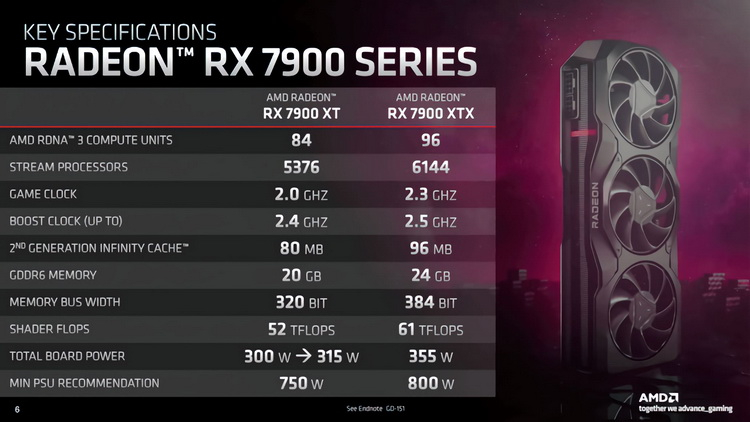
At the core of the flagship Radeon RX 7900 XTX uses full-size graphics processor Navi 31 with 6144 cores.
AMD claims a frequency range of 2.3 to 2.5 GHz for it, but independent reviews show that under load its frequency can actually be much higher - almost 3 GHz.
This GPU claims a theoretical performance of 61 Tflops.Radeon RX 7900 XTX has 24 GB of GDDR6 memory at 20 Gbit/s per pin, with 384 bit bus support and a bandwidth of 960 GB/s.
In the reference version, the gas pedal is equipped with two 8-pin power connectors.
However, partner versions are also available with three of these power connectors.
AMD recommends to use 800 watt or more power unit with the reference version of the graphics card.
Claimed TDP value of the novelty is 355 W.Image source: AMDThe Radeon RX 7900 XT uses a cut down version of Navi 31 processor with 5376 cores.
AMD declares its operating frequency range from 2.0 to 2.4 GHz.
Tests show that the chip is capable of running above 2.9 GHz under load.
The card got 20 GB of GDDR6 memory with the same 20 Gb/s per pin, 320 bit bus support and 800 Gb/s bandwidth.
For the Radeon RX 7900 XT a theoretical performance of 52 Tflops is claimed.
At the last minute AMD increased TDP value from 300 to 315W.
The card has two 8-pin power connectors.
It is recommended to use power supply unit with 750 W power rating.
Image source: Mindfactory.eThe older model AMD has priced at $999, the younger - at $899.
Novelties in reference and non-reference versions have already appeared at some US and European retailers.
Some non-reference versions of video cards are offered at recommended prices, while others are priced higher.
Source image: NeweggThe Russian electronics retail chain DNS reports that the graphics cards will appear on the shelves of Russian stores closer to the end of this month.Find out what the Western press thinks about Radeon RX 7900 XTX and RX 7900 XT here.

12.09.2022

Bloggers and media showed unboxing Radeon RX 7900 XTX and RX 7900 XT - reviews will appear on December 12

Bloggers and media showed unboxing Radeon RX 7900 XTX and RX 7900 XT - reviews will appear on December 12

Bloggers and media showed unboxing Radeon RX 7900 XTX and RX 7900 XT - reviews will appear on December 12

AMD allowed core media and tech bloggers to publish materials with unboxing of the latest graphics cards Radeon RX 7900 XTX and RX 7900 XT, reports VideoCardz.
However, reviewers can not publish information about their performance or reviews - it will have to wait until next week.Image source: VideoCardzThe majority of reviewers got their hands on a reference version of the Radeon RX 7900 XT and Radeon RX 7900 XTX.
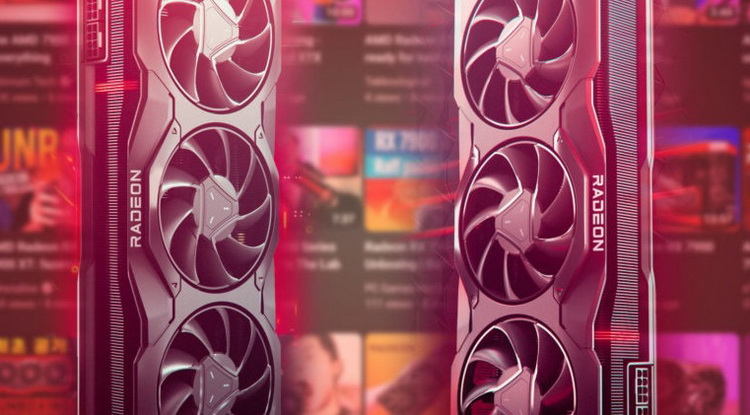
While at first glance the two cards don't seem to differ from each other, a closer look reveals that this is not the case.
The flagship Radeon RX 7900 XTX is slightly taller and longer than the Radeon RX 7900 XT.
In addition, the video cards have a different RGB backlight configuration.
However, both benchmark gas pedals have the same thickness of two expansion slots.
In addition, both video cards received two 8-pin connectors for additional power.
Image source: Overclock3DIt is also known that Radeon RX 7900 XT and Radeon RX 7900 XTX use different circuit boards.
The flagship model has a wider one.
The older version uses a board marked D704, the younger one uses a board marked D702.
It is obvious that apart from the size of the circuit boards the graphics cards also differ in their VRM power subsystems.
However, more detailed information on this will be known after the novelties will be available for disassembly.
Image source: TechPowerUpDirect comparison shows that the next-generation Radeon graphics cards are much more compact than the reference models GeForce RTX 4090 and GeForce RTX 4080, which themselves are considered compact solutions in the new series of NVIDIA gas pedals compared to non-reference versions.
Image source: ComputerBaseIt is curious that among the media only one source has received a non-reference model of AMD graphics cards on the RDNA 3 architecture.
British publication Overclock3D has shared a picture of XFX Radeon RX 7900 XTX MERC 310, images of which flashed quite recently.
Source image: Overclock3DThe German edition HardwareLUXX, full independent reviews of the Radeon RX 7900 XT and Radeon RX 7900 XTX will begin to appear on December 12, the day before the actual start of new products.Recall that in the benchmark flagship Radeon RX 7900 XTX estimated at $ 999, the junior Radeon RX 7900 XT has a price tag of $ 899.
The first uses a full-fledged GPU Navi 31 with 6144 stream processors and is equipped with 24 GB of GDDR6 memory.
The second one is based on a \"cut down\" Navi 31 GPU with 5376 stream processors and 20 GB of GDDR6 memory.

11.07.2022

AMD called Radeon RX 7900 XTX a competitor to GeForce RTX 4080, and announced FSR 3.0 compatibility with older graphics cards

AMD called Radeon RX 7900 XTX a competitor to GeForce RTX 4080, and announced FSR 3.0 compatibility with older graphics cards

AMD called Radeon RX 7900 XTX a competitor to GeForce RTX 4080, and announced FSR 3.0 compatibility with older graphics cards

PCWorld reporters managed to talk to Frank Azor, AMD chief gaming and marketing architect, and get some details about the Radeon RX 7000 graphics cards on the new RDNA 3 architecture.
AMD's representative said why at the time of the presentation of graphics cards Radeon RX 7900 XTX and RX 7900 XT novelties were not compared to models NVIDIA GeForce RTX 40-series.Image source: VideoCardzAccording to Mr.
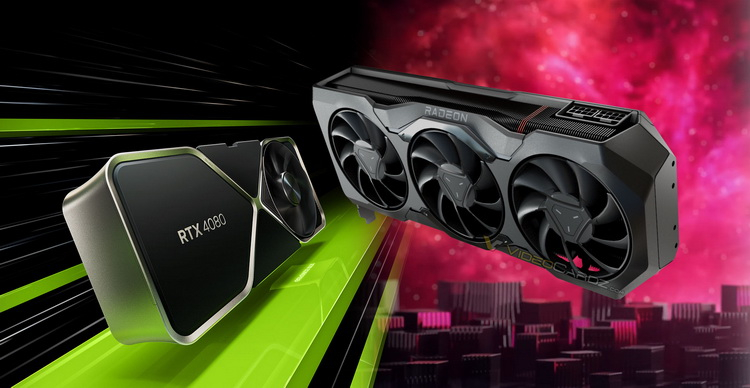
Azor, AMD is positioning flagship gas pedal Radeon RX 7900 XTX as a competitor to the GeForce RTX 4080.
Since NVIDIA has not yet released the card, AMD had no information about the performance of the gas pedal to add to its comparison charts.\"[The Radeon RX 7900 XTX] is designed to compete with the RTX 4080.
We have no information about its performance.
This is the main reason why you didn't see any comparisons with NVIDIA solutions \u003C...> the $999 card can't be a competitor to the RTX 4090, which is rated 60% more expensive.
[The Radeon RX 7900 XTX's] competitor is the RTX 4080,\" Azor said.He also commented on the announcement of FSR 3.0 image scaling technology and noted that the decision to introduce a new version of FSR was not spontaneous.
According to him, FSR 3.0 will not only be supported by RDNA 3-based graphics cards.
\"Our decision to announce FSR 3.0 is not some kind of backlash or a desire to quickly introduce a competitor to NVIDIA DLSS 3.
We have been developing this technology for some time.
Why will it be available later than many would expect? The main thing is to remember the key philosophy behind FSR technology.
After all, FSR 1.0 and FSR 2.0 do not only work on RDNA and RDNA 2 graphics cards.
They are supported by other generations of AMD graphics gas pedals.
They are also supported by our competitors' graphics cards.
This is much more difficult to implement than if we just added FSR 3.0 support only for RDNA 3 graphics cards.
We really want FSR 3.0 to work on other graphics cards as well,\" Azor commented.Hinting at DLSS 3, which is only supported by GeForce RTX 40-series gas pedals, Azor added that support for just one architecture is much easier to implement.
However, AMD has made a promise that FSR will be supported by multiple graphics architectures.
But it takes time to implement this.
The company is not yet sure it can 100% keep that promise, but it will \"try very hard.\"

11.04.2022

AMD introduced the Radeon RX 7900 XT and RX 7900 XTX graphics cards - the older one is priced at $999

AMD introduced the Radeon RX 7900 XT and RX 7900 XTX graphics cards - the older one is priced at $999

AMD introduced the Radeon RX 7900 XT and RX 7900 XTX graphics cards - the older one is priced at $999

AMD introduced its flagship gaming graphics cards Radeon RX 7900 XT and Radeon RX 7900 XTX.

New products are based on flagship graphics processor with RDNA 3 architecture, which AMD calls the world's first GPU with a chiplet design - it consists of several crystals. 

AMD's new flagship RDNA 3 architecture GPU includes 58 billion transistors, and their density has increased by 165% compared to previous-generation (RDNA 2) GPUs.

The big crystal in the center is made by 5-nm process technology and has an area of 300 mm2.It is called GCD (Graphics Compute Die) and includes all GPU computing blocks, as well as other necessary elements. Next to it are six small crystals with high speed memory Infinity Cache.

They are 6nm processors, have an area of 37mm2 each and are called MCD (Memory Cache Die).The bus bandwidth between GCD and MCD is 5.3 Tbytes/sec.

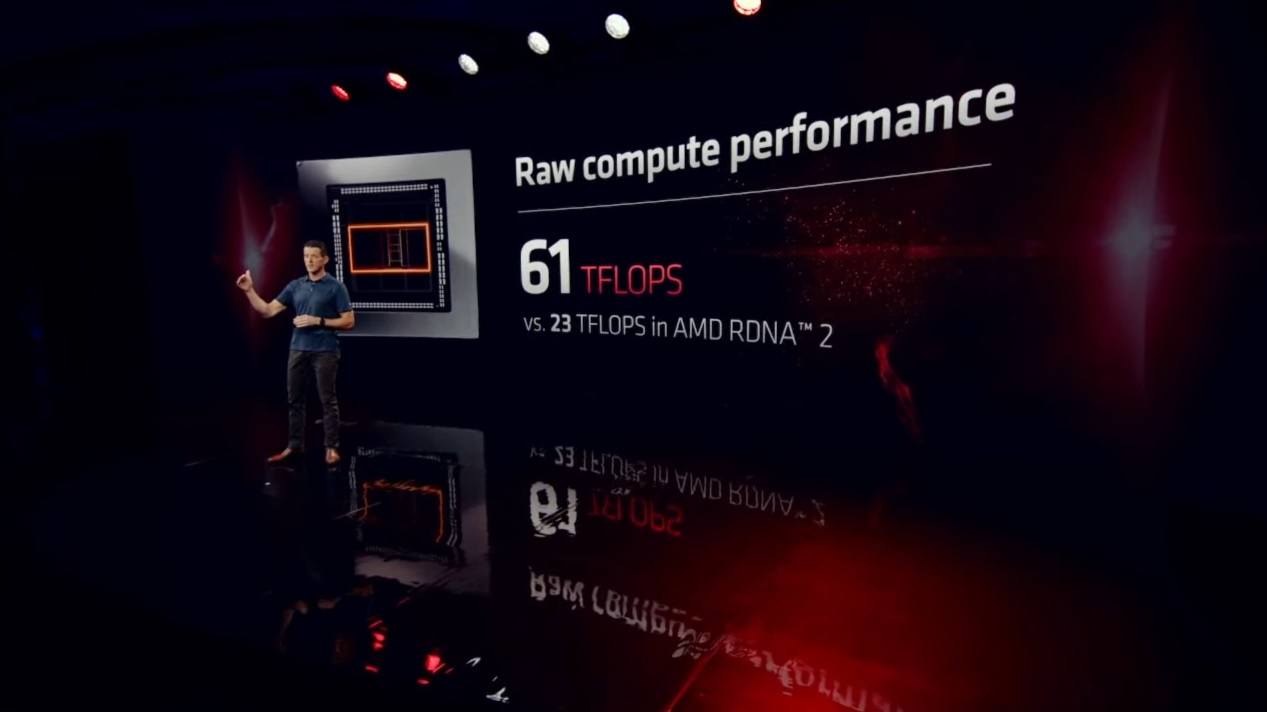
Note that Radeon RX 6000 had Infinity Cache memory on the same chip as GPU, but had 2.7 times less bandwidth. The new chips have a theoretical peak performance of 61 Tflops in single precision floating point operations (FP32), 2.7 times higher than the previous generation GPUs could offer (23 Tflops).

AMD notes that it optimized its computing block architecture for gaming, dramatically increasing performance.It also doubled the number of instructions executed per clock cycle, and increased the processing speed of ray tracing operations (by 50% for each processing unit) and artificial intelligence (by 2.7 times). 


 According to AMD, the new flagship Radeon RX 7900 XTX is 1.5-1.7 times faster in games than the Radeon RX 6950 XT.And when using ray tracing, which was not the strongest point of the last generation graphics cards, the performance increased by 1.5-1.6 times.

In general, AMD positions the new graphics card as a solution for 4K gameplay with high frame rate.And to achieve even higher frequency will help to scale FSR.Unfortunately, AMD did not compare its novelties with its competitors. Senior Radeon RX 7900 XTX has got graphics processor with 96 compute units (Compute Units, CU) with RDNA 3 architecture, which means there are 12,288 stream processors.


The chip runs at a clock speed of 2.3 GHz, which is the average frequency in games.Next to it is 96 MB of high-speed Infinity Cache memory, and the amount of GDDR6 video memory is 24 GB.It is connected via a 384-bit bus.

The graphics card power consumption is 355W. The subflagship Radeon RX 7900 XT has a graphics processor with 84 CU, which carry 10,752 stream processors.The average gaming frequency is claimed to be 2 GHz.The card has 80 MB of Infinity Cache memory, and the amount of GDDR6 video memory is 20 GB, and it is connected via a 320-bit bus.The consumption level of the card is 300 W.

The new AMD reference graphics cards have a cooling system with three fans and take up 2.5 expansion slots in height.

For additional power each has two 8-pin connectors.AMD separately pointed out that \"its new graphics cards won't need new chassis or new power supplies.\" This was obviously a kick in the teeth for NVIDIA, whose flagship GeForce RTX 4090 turned out to be huge, and also uses new 12+4 pin power connector. Also AMD emphasized on the new graphics cards support of the latest DisplayPort 2.1 interface.

It provides the ability to output images in 8K resolution at up to 165 Hz or in 4K resolution at 480 Hz.The problem so far is that there are no monitors with this interface and these characteristics on the market.Here we should also note the support of hardware acceleration when working with AV1 codec.


The recommended price of AMD Radeon RX 7900 XTX video card will be $999, while the junior Radeon RX 7900 XT is priced at $899.Both graphics cards will go on sale on December 13.

Recall that the GeForce RTX 4090 is priced at $1599, while the GeForce RTX 4080 will cost from $1199.

11.03.2022

AMD to unveil Radeon RX 7000 graphics cards tonight

AMD to unveil Radeon RX 7000 graphics cards tonight

AMD to unveil Radeon RX 7000 graphics cards tonight

AMD will unveil Radeon RX 7000 graphics cards on the latest RDNA 3 architecture graphics processors tonight.
The start of the presentation, entitled Together we advance_gaming is scheduled for 23:00 Moscow time.
The presentation will be available for all those who wish to watch it on AMD official YouTube channel.AMD itself describes the upcoming event as follows: \"AMD executives will detail AMD's new high-performance and energy-efficient AMD RDNA 3 architecture, which will deliver a new level of performance, efficiency and functionality for gamers and content creators.
\"At the moment, very little is reliably known about the upcoming new products.
AMD showed the graphics chip Navi 3X back in August and already then it was known that the RDNA 3-based GPU will consist of several chips, by analogy with AMD CPUs.
This should reduce the cost, which would have a positive effect on the price of graphics cards.
At least, that should be so in theory.
Crystals GPU, or at least some of them will be made at 5nm process on the production facilities TSMC.Also earlier head of AMD Lisa Su (Lisa Su) said that the next generation graphics will provide 50% higher performance per watt of energy compared to current solutions, meaning Radeon RX 6000 on the RDNA 2 architecture.
Also AMD representatives said recently that they will not be getting a new (and potentially problematic) power connector with 12+4 pins.The latter is confirmed by recently leaked photo which seems to depict Radeon RX 7900 XT reference graphics card - it has a pair of 8-pin connectors.
Novelty is larger than the current flagship in the face of Radeon RX 6900 XT, but still not as huge as GeForce RTX 4090 graphics cards.
Note that AMD is rumored to be preparing several graphics cards on the flagship GPU next generation: Radeon RX 7900 XT and Radeon RX 7900 XTX.
They are rumored to offer up to 24 GB of GDDR6 memory and up to 12,288 stream processors.
Whether this is true we will find out in a few hours.

10.31.2022

AMD announced the presentation of Radeon RX 7000 - RDNA 3 graphics will be presented on November 3

AMD announced the presentation of Radeon RX 7000 - RDNA 3 graphics will be presented on November 3

AMD announced the presentation of Radeon RX 7000 - RDNA 3 graphics will be presented on November 3

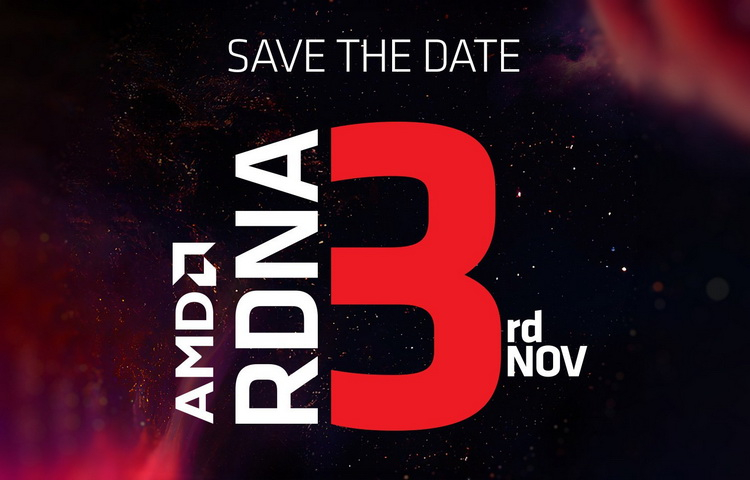
AMD has announced an online broadcast titled \"Together we advance_gaming\", which will be held on November 3 at 23:00 Moscow time.
This will be an online event dedicated to Radeon RX 7000 graphics cards based on RDNA 3 architecture, according to a press release that was published on AMD's official website.
AMD will unveil the new AMD high-performance and energy-efficient architecture RDNA 3, which will provide a new level of performance, efficiency and functionality for gamers and content creators,\" - noted in the press release.AMD graphics processors based on RDNA 3 architecture will be the first GPU company, consisting of several chips.
They will be manufactured at TSMC manufacturing facilities using 5-nm process technology.
AMD has demonstrated Navi 3x graphics processor (presumably Navi 31) back in August this year, but did not disclose any details about it.According to unofficial sources, AMD plans to introduce two Radeon RX 7000 graphics cards based on RDNA 3 this year, starting their sales in the second half of December.
AMD's graphics gas pedals are expected to get next-generation Infinity Cache buffer memory.
During a recent Ryzen 7000 processor presentation, AMD head Lisa Su said that the next-generation graphics will provide 50 percent more performance per watt of power consumption compared to current solutions, that is, compared to the Radeon RX 6000 based on the RDNA 2 architecture.

9.22.2022

Radeon RX 7000 graphics cards to be unveiled Nov.3

Radeon RX 7000 graphics cards to be unveiled Nov.3

Radeon RX 7000 graphics cards to be unveiled Nov.3

AMD corporate vice president Scott Herkelman announced via his Twitter page that the launch of the next-generation Radeon RX 7000 graphics gas pedals based on RDNA architecture will take place on Nov.
3.
Image source: Twitter / @sherkelmanIn last month's Ryzen 7000 processor announcement, AMD CEO Lisa Su (Lisa Su) pointed out that the next generation graphics will provide 50% more performance per watt of power consumption compared to current solutions (Radeon RX 6000 on RDNA 2).Radeon RX 7000 graphics cards are rumored to use a new multi-chip GPU packaging technology for the first time.
Navi 3x Series GPUs, which will find their place in the Radeon RX 7000 video cards, will be manufactured on a 5-nm process.
It is also confirmed that the cards will receive a new generation of buffer memory Infinity Cache.According to the latest rumors, in the composition of the flagship graphics chip Navi 31 will be present 12,288 stream processors.
This is twice as much than the current flagship chip Navi 21 on RDNA 2 architecture, which is used in video cards Radeon RX 6900 XT and Radeon RX 6950 XT.

8.30.2022

AMD showed next-generation Radeon RX graphics card on RDNA 3 - it will be out by the end of 2022

AMD showed next-generation Radeon RX graphics card on RDNA 3 - it will be out by the end of 2022

AMD showed next-generation Radeon RX graphics card on RDNA 3 - it will be out by the end of 2022

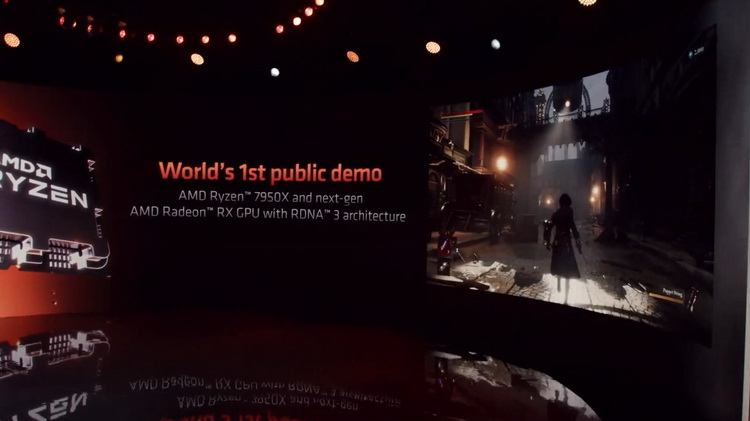
AMD also shared some details about its next generation graphics cards at today's Ryzen 7000 series processor announcement event and even showed a glimpse of one of them.
Also the company has demonstrated the RDNA 3 graphics, and announced its release date.
The head of AMD Lisa Su (Lisa Su) said that the graphics processors on the RDNA 3 architecture will consist of several crystals (chipsets), made by the 5-nm process.
Obviously, to produce them will be TSMC.
Glimpses of the shown graphics card is quite large, and by the looks, it seems that we will see the development of the design of reference graphics cards Radeon RX 6000-series - continuity is immediately visible.It was also indicated that the new generation graphics will provide 50% more performance per watt of power consumption than current AMD solutions (Radeon RX 6000 on RDNA 2).
During the presentation, Lisa Su also confirmed that the next-generation Radeon graphics is currently being tested in AMD's labs.
And its performance is \"amazing.\" The graphics capabilities were demonstrated in the game Lies Of P, which is being prepared by Neowiz Games and will be released in 2023.
AMD did not show FPS or any other data about the graphics card performance.
It was only noted that the gas pedal was paired with the new flagship - Ryzen 9 7950X.Finally, the head of AMD promised that the next generation graphics cards will be released by the end of this year.
More specific terms were not named.

6.11.2022

AMD will release 4nm mobile processors with Zen 4 and RDNA 3 next year, and Zen 5 and RDNA 3+ cores in 2024

AMD will release 4nm mobile processors with Zen 4 and RDNA 3 next year, and Zen 5 and RDNA 3+ cores in 2024

AMD will release 4nm mobile processors with Zen 4 and RDNA 3 next year, and Zen 5 and RDNA 3+ cores in 2024

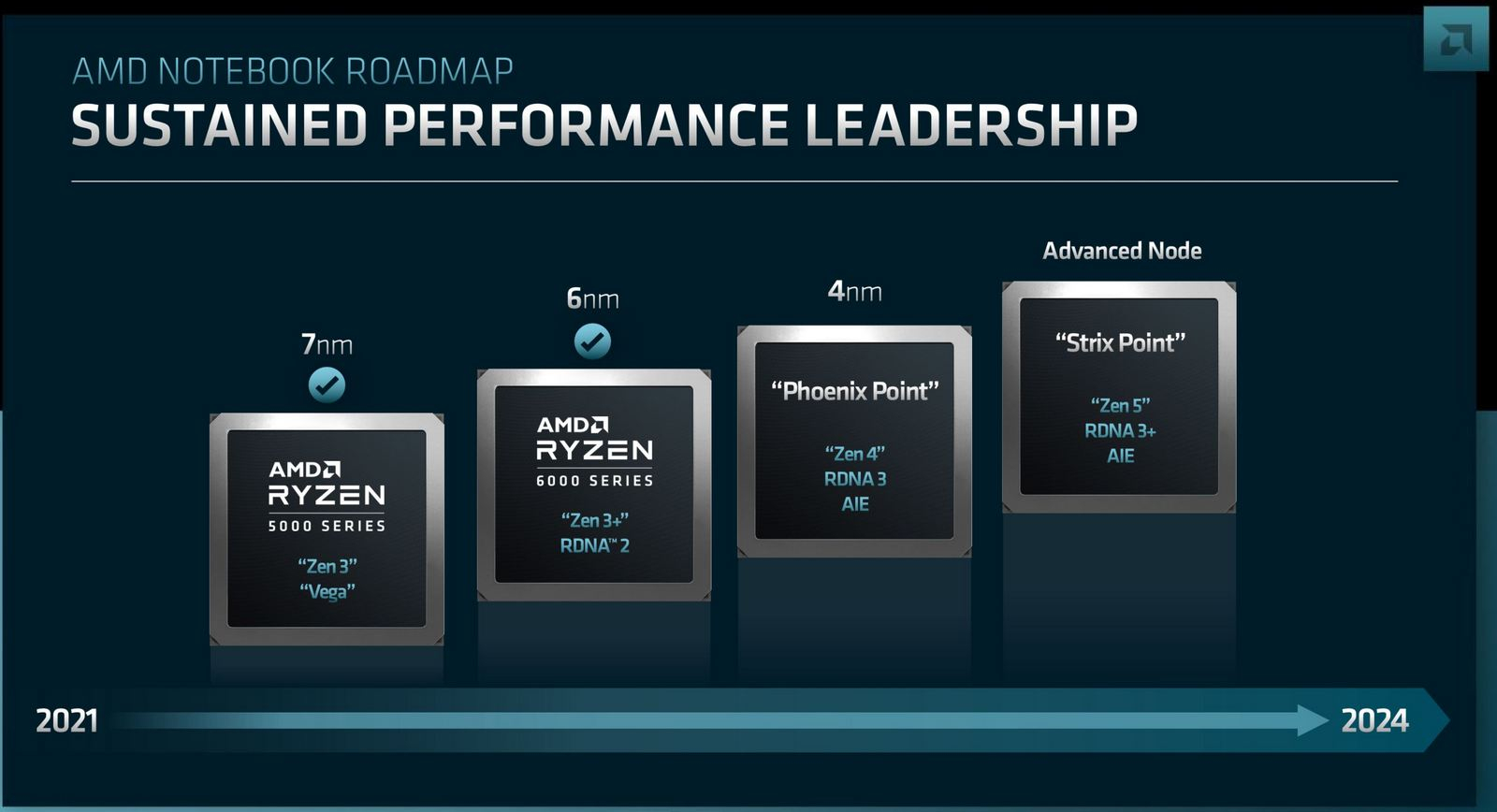
At an analyst event, AMD shared plans for various areas, including mobile processors.
The company named code names for future generations of processors, outlined their release dates, processors and architectures for both processor components and graphics.
At the moment, the most advanced AMD mobile processors are representatives of the Ryzen 6000 Rembrandt family.
They combine the processor core Zen 3 + and integrated graphics RDNA 2.
These chips are made by 6-nm process technology.Sometime next year, AMD intends to release a 4-nm mobile chips Phoenix Point, consisting of several chips, combining the new processor architecture Zen 4, as well as the new graphics RDNA 3.
In addition these chips will be equipped with the Artificial Intelligence Engine (AIE).
Details about its features and capabilities is not available now, but it is known that its creation is the responsibility of Xilinx, recently acquired by AMD.
It is noted only that AIE will get a scalable architecture with local memory, and will be able to offer high performance and efficiency in the work with AI and signal processing.
And by the end of 2024 AMD plans to release Strix Point mobile processors, which will combine the Zen 5 architecture and integrated RDNA 3+ graphics.
The latter will apparently not differ much from RDNA 3, probably offering better performance per watt.
These processors will also get a dedicated AI engine from Xilinx.
The Strix Point manufacturing process is not specified, but it is noted that it will be more advanced than the 4nm.

6.10.2022

AMD RDNA 3 graphics processors will consist of several crystals and use 5-nm process technology

AMD RDNA 3 graphics processors will consist of several crystals and use 5-nm process technology

AMD RDNA 3 graphics processors will consist of several crystals and use 5-nm process technology

For a long time AMD presentation makers hesitated to admit what exact process technology will be used to make RDNA 3 graphics processors, scheduled to debut before the end of this year.
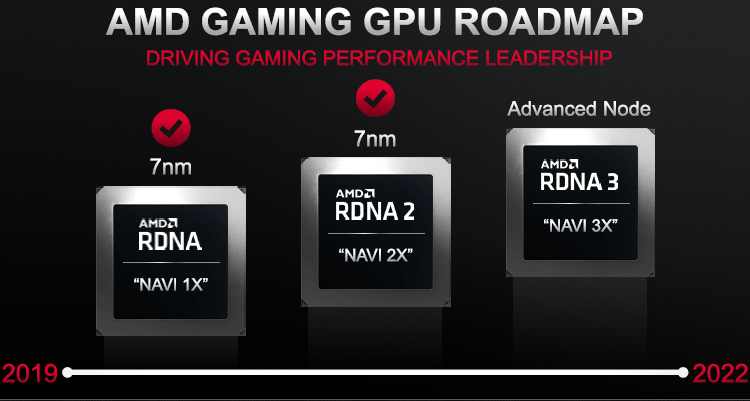
Now the time has come to partially reveal the cards: it will be a 5nm technology combined with a chip layout.Image source: AMDThe relevant revelations were made at AMD's event for financial analysts, which ended this business week with a flood of noteworthy news items for the general public.
As the target audience of this information was mainly investors, AMD also considered the near evolutionary perspective: GPUs with RDNA 4 architecture, belonging to Navi 4x family, are supposed to debut by the end of 2024.
They will be released with more advanced technology compared to 5-nm, but whether it will be a 3-nm processor, is not specified openly.Image source: AMDNo less important is the fact that graphics solutions with RDNA 3 architecture will be released by the end of this year.
How wide their range will be in 2022, it is difficult to judge, about this will probably be made relevant statements closer to the time of the announcement.
AMD promises that the Navi 3x family will provide \"industry's best performance per watt\", will use advanced packaging technologies and support advanced multimedia features.
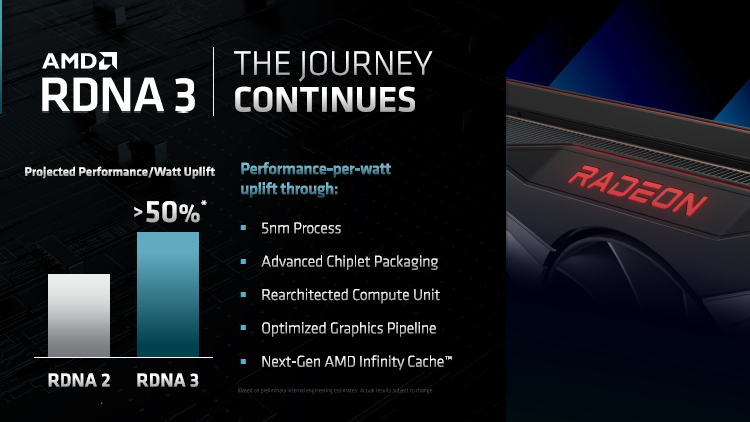
The latter includes support for DisplayPort 2.0.Picture source: AMDA separate slide in the presentation was dedicated to a 50% increase in performance per watt power consumption over RDNA 2 architectures.
It is reported about using 5nm production technology and multi-chip layout, combined with next-generation Infinity Cache memory.
It is not specified whether the latter will be somehow optimized in terms of performance or limited to an increased amount.
Navi 3x family GPUs will undergo architectural improvements to improve performance.
AMD cautions that predictions on the value of the increase in specific performance are based on preliminary engineering calculations, and therefore actual test results may differ.

7.30.2021

AMD confirmed it will release Zen 4 processors and RDNA 3 graphics next year

AMD confirmed it will release Zen 4 processors and RDNA 3 graphics next year

AMD confirmed it will release Zen 4 processors and RDNA 3 graphics next year

At a Q2 2021 investor meeting, AMD CEO Lisa Su confirmed that next-generation Ryzen consumer processors and Radeon graphics cards will be released in 2022. AMD believes that the component shortage will remain until the end of this year, but is optimistic about 2022.

Processors based on the Zen 4 architecture are expected to be released in the second half of 2022. The new generation will replace the Zen 3+ / Zen 3 3D V-Cache chips, which are due to debut at the end of this year. Zen 4 architecture will be presented in the EPYC 7004 server processors, codenamed Genoa, as well as in the consumer CPU Raphael and APU Phoenix. The latter series of chips will offer integrated RDNA 2 graphics.The transition to the new Zen 4 architecture will require a new platform. This means that the chips will receive support for DDR5 standard RAM. During a shareholder meeting, Lisa Su confirmed that the company aims to release products based on the Zen 4 architecture next year. "We still plan to release a new generation of products in 2022, including Zen 4 processors based on the 5nm process technology and graphics cards based on the RDNA 3 architecture," said Lisa Su. Unlike Intel, which is used to revealing its plans for new products long before they are actually announced, AMD has been reluctant to share details about products in the era that will follow the release of the Zen 4 architecture. The company still has not confirmed which processors except Ryzen series will get a new 3D V-Cache technology, the essence of which is to install a special SRAM memory chip directly on top of the CCD-chiplet. This technology allows to increase the L3-cache volume of the Ryzen desktop processor up to 192 MB. The company has also not officially confirmed when it is going to release graphics cards based on RDNA 3 architecture. However, according to rumors, in the gaming RDNA 3 graphics cards will be present at least four GPUs. GPUs with unofficial names Navi 31 and Navi 32 are attributed a new layout of several chips, and models Navi 33 and Navi - the usual layout of a single chip.

1.27.2021

AMD promises to introduce all graphics cards with RDNA 2 architecture by the end of the year

AMD promises to introduce all graphics cards with RDNA 2 architecture by the end of the year

AMD promises to introduce all graphics cards with RDNA 2 architecture by the end of the year

AMD management did not talk much about its results in the graphics segment at the quarterly event, but it was not without some interesting revelations. As it was announced at CES 2021, AMD will introduce more affordable RDNA 2 generation graphics solutions this semester, while work on RDNA 3 is in full swing.

Image source: AMD

On a year-on-year basis, as noted by Lisa Su, revenue from graphics products declined in the fourth quarter, but increased sequentially. Desktop GPU sales increased markedly from the previous quarter due to the arrival of the Radeon RX 6000 family of products on the market. They are in high demand, which should continue this year. New products are selling three times as active as their predecessors in price range from $549 at comparable life cycle stage, it is a record for AMD graphics solutions. As promised this month, the company will expand its RDNA 2 architecture GPU portfolio to include new mobile and desktop models by mid-year. Their range will continue to expand until the end of this year, as well as in the server segment. According to the head of AMD, this year the company will be able to increase revenue from sales of consumer graphics, as there is a pent-up demand in the market. The company will strengthen its position both in the retail segment and in the off-the-shelf computer market. As stated by Lisa Su, AMD experts are working hard on the RDNA 3 architecture. According to slides from the company's investor presentation, it will hit the market by the end of next year.

1.04.2021

Patent suggests AMD is going to apply chipsets to graphics cards, despite difficulties

Patent suggests AMD is going to apply chipsets to graphics cards, despite difficulties

Patent suggests AMD is going to apply chipsets to graphics cards, despite difficulties

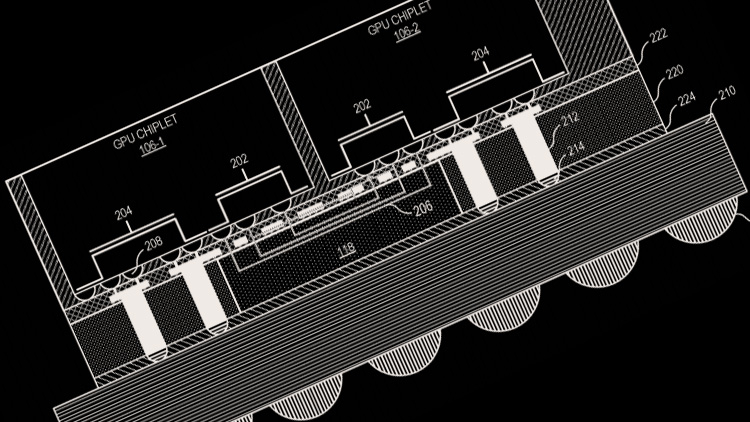
A new application filed with the US Patent and Trademark Office on the last day of last year describes AMD's approach to a potential chiplet-based graphics accelerator design. The manufacturer pointed out the problems in such a design and explained how they could be avoided in the future.

According to AMD, graphics processors are still monolithic chips for a reason: there are plenty of problems with the interaction of multiple chips. The current graphics pipeline is not particularly efficient for multiple GPUs (the same goes for configurations like Crossfire or SLI), as it is sometimes difficult to distribute tasks between multiple active chips in a system. AMD also describes synchronisation of memory content between multiple GPU chips as being complex and costly from a design perspective.

AMD believes that such problems could be avoided by introducing «high bandwidth passive crosslinks». According to AMD, the first GPU chipset should be directly connected to the CPU, while each of the graphics chipsets in the array & ; are connected to the first GPU via passive crosslinks. Such links must be placed in a silicon interposer layer, which is an intermediate wafer with conductors in one or more layers. A group of interconnected chips would work, essentially, like a system on a chip.

Conventional GPUs have a common last-level cache (LLC), but to avoid timing issues AMD believes that each of the chipsets should get their own LLC, with all of them being unified and consistent across all chipsets.

AMD has not publicly confirmed that it is working on a chiplet-based graphics accelerator design. However, there have been rumours that the RDNA 3+ design could be chiplet-based. AMD has a lot of experience with multi-chip designs, especially in its Ryzen processors and various APUs, including gaming consoles.

It is expected that both competitors, NVIDIA and Intel, could also go down this path, allowing them to produce accelerators with higher performance. Intel has already confirmed that it is working on Xe-HP graphics cards with a multi-chip design & ; they are expected to debut this year. NVIDIA is rumoured to unveil its first such accelerator along with the Hopper architecture. Back in 2019, NVIDIA's chief science advisor Bill Dally  said that the company has developed technology to build a graphics accelerator with a multi-chip layout.