Showing posts with label qualcomm. Show all posts

12.14.2022

Qualcomm announced chips for home routers with Wi-Fi 7 support and speeds up to 20 Gbps

Qualcomm announced chips for home routers with Wi-Fi 7 support and speeds up to 20 Gbps

Qualcomm announced chips for home routers with Wi-Fi 7 support and speeds up to 20 Gbps

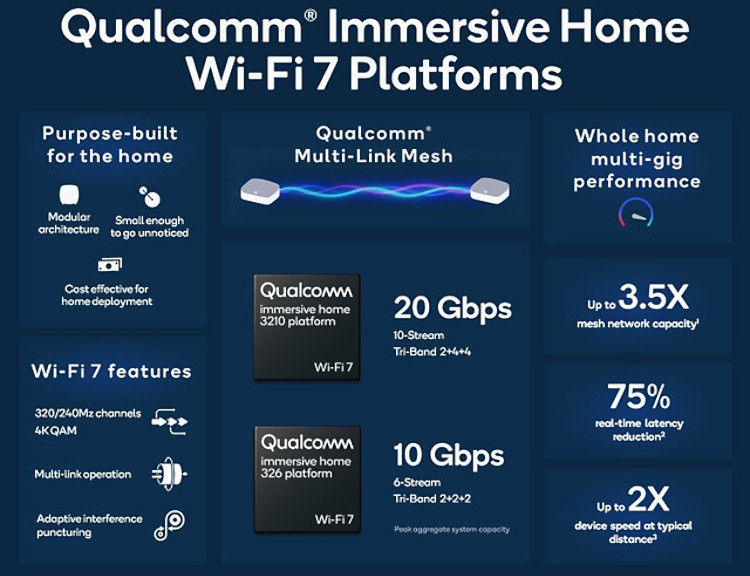
Qualcomm has revealed chipsets for its new Immersive Home Platform series of routers for home networking equipment manufacturers.
The platform is aimed at brands looking to provide support for the IEEE 802.11BE or Wi-Fi 7 ready-to-approve standard.Image source: qualcomm.comNow Qualcomm has already sent the new chipsets to its partners producing home routers and mesh kits -- equipment based on these components is expected to go on sale in the second half of 2023.
According to the developer, Immersive Home Platform shares a common architecture with enterprise-class products, but is designed for home use.Qualcomm's new components allow critical advantages of the Wi-Fi 7 standard, such as wider channels of 320 MHz (in Wi-Fi 6E only 160 MHz).
Multi-Link Operation (MLO) is supported, allowing devices to simultaneously connect in two bands, such as 5 and 6 GHz.
Finally, there is Multi-Link Mesh technology, which provides a meshed network and can reduce latency by up to 75%.
Interference avoidance algorithms are included to help avoid congestion.

11.18.2022

Qualcomm announced the development of Oryon - next-generation Arm processors for Windows laptops

Qualcomm announced the development of Oryon - next-generation Arm processors for Windows laptops

Qualcomm announced the development of Oryon - next-generation Arm processors for Windows laptops

Arm processor and Windows computers have been available for years, but the tandem is still not as popular as the combination of this OS with x86 architecture.
Nevertheless, Qualcomm is releasing more and more efficient chipsets for laptops - during the 2022 Snapdragon Summit, it was announced that it was developing new CPUs for Windows laptops.
The developer also promoted the idea that the future of Windows PCs is closely linked to Arm solutions and additional modules for processing AI algorithms.Image source: QualcommThe x86 architecture relies on two main components for computing - the CPU and GPU, so when working intensively with artificial intelligence algorithms, both types of gas pedals experience significant loads, consuming a lot of power in the process.
On the other hand, Snapdragon chipsets use the Hexagon digital signal processor (DSP), which performs AI-related tasks.
As a result, the resources of the core processors are freed up for other purposes.Image source: QualcommThe Snapdragon Summit was supported by Qualcomm's partners - Microsoft, Adobe, and Citi.
Microsoft noted that the SQ3 chipset is used in the new Surface Pro 9 5G with numerous features involving AI - from the ability to blur the background during video interviews to the camera's ability to maintain contact with the user's eyes regardless of what position the user is in relative to the lens.Adobe has previously added Snapdragon-based AI support for its Sensei machine learning tool that enhances the performance of Photoshop, Lightroom and Premiere Pro.
The company says Snapdragon's AI engines will help improve even more Creative Cloud applications in 2023.
Citi isn't using anything yet, but reportedly plans to move 70% of its staff to mobile computers based on Qualcomm products - like the Lenovo ThinkPad X13s.Most of today's Snapdragon chipsets now use CPU cores produced under the Qualcomm-owned Kryo brand.
At first, the company used the architecture of its own development, but later switched to off-the-shelf solutions of the Arm Cortex family.
Now Qualcomm has announced that in the future it will introduce notebook CPUs of the new family Oryon.Image source: QualcommThe new platform will reportedly be the first to emerge from Qualcomm's acquisition of NUVIA - it is possible that this is the basis for the next generation computer platform, the Snapdragon 8cx Gen 4.
In addition, it is known that Oryon will use a custom architecture based on the Arm command set, but is not among the latter's off-the-shelf solutions.
The company has promised to start shipping the product to the market starting in 2023.

Arm responded to Qualcomm's counterclaim: licensing scheme will not change

Arm responded to Qualcomm's counterclaim: licensing scheme will not change

Arm responded to Qualcomm's counterclaim: licensing scheme will not change

British processor developer Arm, owned by Japanese conglomerate Softbank, filed a response to Qualcomm's counterclaim, rejecting all statements and accusations by the American company.
The company has no plans to change its licensing scheme.Image source: community.arm.comIn August Arm sued Qualcomm, which was the result of a dispute over the licensing of processor architecture.
Qualcomm responded with unexpected accusations against the British partner: according to the defendant, Arm in this way is revenge for its position against the failed merger with NVIDIA, and to consolidate its position the company allegedly decided to change the processor licensing scheme to the detriment of all chip makers - payments will be charged from manufacturers of end devices.Arm denied all these allegations and in its response to the counterclaim stressed that the essence of its claims is simple: when Qualcomm bought startup Nuvia, which was a licensee of Arm, the buyer Qualcomm assures that Arm decided to take advantage of the situation and get additional royalties, and the license terms were not intended to obtain such permission.
Finally, Arm categorically rejected Qualcomm's assertion that it plans to change its licensing model - the British company said that this information is misinformation and misleading, according to The Register.
In reality, the company is not going to limit partners' access to its technology and will continue to cooperate both with processor manufacturers and OEMs.

11.04.2022

Qualcomm: smartphone sales will fall more than 10% this year, and Apple will not give up its modems in 2023

Qualcomm: smartphone sales will fall more than 10% this year, and Apple will not give up its modems in 2023

Qualcomm: smartphone sales will fall more than 10% this year, and Apple will not give up its modems in 2023

In the third quarter Qualcomm managed to increase revenues by 22% to $11.39 billion, but not the most optimistic forecast for the smartphone market caused the company's stock price to decline by 7.56% after the close of trading.
According to this provider of mobile processors, at the end of the current calendar year, the smartphone market will shrink not by 5-6%, but by 10-12%.
Since the beginning of this quarter, the company will also stop hiring new staff.Image source: Qualcomm TechnologiesIn the current quarter, as stated by representatives of Qualcomm, the company's revenue will be in the range of $9.2 to $10 billion, which is a couple of billion dollars below the most modest expectations of analysts.
Apparently, this also contributed to Qualcomm's share price decline after the release of financial statistics.
The company's representatives also noted that a sharp decline in demand and an improvement in the supply of components led to an increase in product inventories.
Qualcomm will have to spend the accumulated surplus products in the warehouses for about a couple more quarters.
The company has been running QCT, which supplies chips for smartphones and other devices that transmit data over wireless channels, and has generated $9.9 billion in revenue last quarter, up 28 percent from the same period last year.
Smartphone chip shipments brought Qualcomm $6.57 billion in revenue last quarter, increasing revenue by 40% over the same quarter last year.
The automotive business grew 58% to $427 million, while the Internet of Things added 24%, giving Qualcomm a core revenue of $1.92 billion.
Finally, radio frequency components dropped 20% to $992 million.Technology licensing and patents brought Qualcomm $1.44 billion last quarter, up 8% from a year earlier, but this revenue line still fell short of analysts' expectations.
The head of the company, Cristiano Amon, acknowledged that Qualcomm cannot stay away from the negative impact of macroeconomic conditions on the entire semiconductor industry.
Operating costs are expected to be reduced not only by suspending the expansion of the staff from October this year, but also by other measures.
Regarding the relationship with customers, it was said that the license agreement with Samsung Electronics has been extended until 2030, and in the next quarter the Korean giant will increase the share of Qualcomm chips in its mobile devices.
Almost all of the iPhones next year will use Qualcomm modems, though the company previously expressed fears that it will not get more than 20% of Apple's orders because it has time to introduce modem solutions of its own design.
In a couple of years, in the opinion of Qualcomm's management, Apple will still be able to almost completely abandon the components of the first brand.
According to the forecasts of Bloomberg, the first smartphones Apple with modem components of its own design will not appear until 2024.

Qualcomm again promised to turn the Windows PC market in two years - with Snapdragon based on Nuvia developments

Qualcomm again promised to turn the Windows PC market in two years - with Snapdragon based on Nuvia developments

Qualcomm again promised to turn the Windows PC market in two years - with Snapdragon based on Nuvia developments

Qualcomm has been optimistic about Windows PCs on Arm processors of the Snapdragon family for years.
However, with the developments of the startup Nuvia, acquired in 2021, the optimism turns into confidence - the company claims that in two years the disposition in the PC market will change.Image source: qualcomm.
comTalking to investors and analysts after announcing quarterly financial results, the company's CEO, Cristiano Amon, noted that OEMs have already expressed a desire to work with the company to release Windows PCs powered by Snapdragon processors, which will only hit the market in two years, Tom's Harware reports.
These processors use solutions from Nuvia, which specialized in server Arm processors.The release of next-generation PC chips is not easy for Qualcomm: it originally planned to start sending samples as early as August 2022 to start production and sales in 2023.
However, it was later decided to start shipping samples only in 2023, and Windows-based Snapdragon computers will begin a massive market conquest only in 2024.Mr.
Amon did not specify the number of projects in which Qualcomm chips have won competitive victories, and did not say when exactly in 2024 we should expect the next generation products, but the growing number of such projects indicates that OEMs are quite willing to start shipping Windows-based Arm-computers in two years.
And that's a good sign not only for Qualcomm, but also for other Arm chipmakers.A significant obstacle to achieving the goal could be a legal dispute between Qualcomm and Arm.
According to the British company, after the takeover, Qualcomm had to stop projects Nuvia, because under the new owner the license for Arm-architecture is no longer valid.
In addition, Arm is likely to change the licensing mechanisms of its products.

10.31.2022

Arm will prohibit the proximity of its CPU and third-party modules in one chip, as well as impose royalties on manufacturers of end devices

Arm will prohibit the proximity of its CPU and third-party modules in one chip, as well as impose royalties on manufacturers of end devices

Arm will prohibit the proximity of its CPU and third-party modules in one chip, as well as impose royalties on manufacturers of end devices

The lawsuit between Arm and Qualcomm turned unexpectedly.The British developer of processors decided to radically change its business model: first, license fees will have to be paid by manufacturers of end devices, including smartphones and tablets; second, third-party components, including GPUs, NPUs and ISPs, will be prohibited in chips with Arm processors.

In late August Arm filed a lawsuit against Qualcomm.Qualcomm absorbed server processor developer NUVIA and, according to Arm, had to update its license agreement because it deemed all previous agreements with the company invalid after it bought it.Qualcomm filed a countersuit against the British developer, and new documentation on the case contains crucial details.Qualcomm's updated lawsuit says that after 2024, Arm will stop licensing its processor architecture to semiconductor component manufacturers - payments will be charged to end-device manufacturers.

Arm, according to the U.S.company, has already told OEMs that soon the only way for them to get Arm-based chips will be through direct license fees, and they'll have to accept these rules of the game.But that's not all.The British company has also decided to tighten its policy with respect to chip developers like Qualcomm: they will not be able to use third-party components in single-chip platforms with Arm processors if Arm offers their analogs as a licensed product.

This will affect graphics and network processors, as well as image processors.In other words, Arm will prohibit the creation of duos like Samsung and AMD chips, as well as MediaTek and Imagination - both pairs of companies cooperate in the field of mobile graphics.And Qualcomm itself does not use GPUs from Arm, but its own.Such an initiative Arm shows signs of anti-competitive behavior and it is possible that these steps will accelerate the companies' efforts to develop chips based on open architecture RISC-V.However, some of the British company's partners may not be affected by the new rules.

For example, NVIDIA has a 20-year license for the development of components with Arm-architecture.Apple was at the origins of Arm, so it is unlikely that these two can be destroyed so easily.There is also a version that a mutually beneficial cooperation binds Arm with Broadcom.Thus, the dispute between Arm and Qualcomm in just over two years threatens to affect the interests of many smaller players.

Source : https://3dnews.ru/1076519/arm-s-2025-goda-oblogit-royalti-proizvoditeley-konechnih-ustroystv-i-zapretit-storonnie-podsistemi-v-chipsetah

According to Qualcomm, Arm is retaliating against the company for criticizing the deal with NVIDIA by demanding compensation for the use of Nuvia licenses

According to Qualcomm, Arm is retaliating against the company for criticizing the deal with NVIDIA by demanding compensation for the use of Nuvia licenses

According to Qualcomm, Arm is retaliating against the company for criticizing the deal with NVIDIA by demanding compensation for the use of Nuvia licenses

Early last year, Qualcomm bought the assets of processor developer Nuvia for $1.4 billion, which used the Arm architecture and held the relevant licenses.
According to Arm itself, this deal does not give Qualcomm the right to dispose of all the licenses inherited from Nuvia.
A dispute broke out between the companies, which they are trying to resolve in court.
Qualcomm believes that Arm is taking revenge for its criticism of the deal with NVIDIA.Image source: Qualcomm Recall that in the spring of this year NVIDIA was forced to abandon its intentions to buy Arm, because it opposed certain regulators, British officials and a variety of companies from among its customers.
Qualcomm was among them, and this summer it faced a lawsuit from the British developer, which accused it of misusing licenses for processor cores inherited from Nuvia.
The latter had a license for the architecture of Arm v8, which was available to Qualcomm, but Arm did not like the logic of interaction, and she demanded that the client stop using the development of Nuvia in their products.
According to Arm, after buying Nuvia, Qualcomm should have signed a new license agreement with the first of the companies.Qualcomm does not think it is right and necessary, calling Arm's claims revenge for its own position on the deal with NVIDIA, which collapsed in the spring.
Arm not only demanded extra payment for Qualcomm's right to use Nuvia's designs, but also tried to obstruct the work of that client's specialists on processors that use Nuvia's intellectual property.
Qualcomm representatives also added that Arm's original agreement with Nuvia did not provide for such control measures on the part of the British holding.
Arm believes that after Nuvia lost its independence, all the previous agreements lost their force and the new business owners represented by Qualcomm should conclude new contracts.In general, Qualcomm should pay Arm more for ready-made solutions, and in the case of using its own developments based on the Arm architecture, the royalties are reduced.
Apparently, in the precedent with Nuvia, the British developer simply does not want Qualcomm to pay him less.
The victory of Arm in this court dispute, according to Qualcomm, could untie its hands in the abuse of its own powers in relations with licensees.

9.05.2022

Meta and Qualcomm agree to jointly develop chips for virtual reality devices

Meta and Qualcomm agree to jointly develop chips for virtual reality devices

Meta and Qualcomm agree to jointly develop chips for virtual reality devices

Meta* has signed an agreement with Arm processor developer Qualcomm to create special custom chipsets designed for next-generation Quest series VR headsets.
The companies announced this at the IFA in Berlin.Image source: 3D NewsThe two companies will work together to design future chipsets based on Qualcomm's Snapdragon XR platform.
As reported by Reuters, the agreement demonstrates the dependence of Meta * of Qualcomm, even as the company began developing their own solutions for virtual, augmented and mixed reality devices.According to the head of Meta * Mark Zuckerberg (Mark Zuckerberg), \"Unlike cell phones, building VR brings new, multi-dimensional challenges in spatial computing...\" For example, there are a number of challenges to be met in optimizing the price and form factor of the devices.
According to Zuckerberg, Meta* is still in the early stages of development, and \"deep technical integration\" with a processor developer will help VR technology move toward a multi-dimensional computing platform.Meta* has been actively investing in wearable device technology like transparent AR/VR glasses.
For years, the company has relied on off-the-shelf Qualcomm chipsets to build its own VR devices, including the latest version of the Quest 2 headset, which is based on the Snapdragon XR2 chip.Image Source: 3D NewsThe chipsets being co-built will not be exclusively used by Meta*.
However, they will be optimized for Quest system specifications.
Financial terms of the deal have not yet been disclosed.
The agreement covers only VR-devices and Meta* will continue to develop its own semiconductor solutions with other functionality.According to Meta*, there may be situations in which the company prefers off-the-shelf semiconductor solutions, but it is working on customization with industry partners while developing its own solutions.
Moreover, Meta* can use both its own and partner platforms in the same products.
* Included in the list of public associations and religious organizations in respect of which there is an effective court decision to liquidate or ban their activities on the grounds provided by Federal Law № 114-FZ \"On Counteracting Extremist Activity\" dated 25.07.2002.

Arm sues Qualcomm and Nuvia over breach of license agreements

Arm sues Qualcomm and Nuvia over breach of license agreements

Arm sues Qualcomm and Nuvia over breach of license agreements

Arm has sued Qualcomm and Nuvia.
They are accused of violating license agreements signed with Arm, as well as the trademark rights of the British chip developer.Image source: QualcommThe Qualcomm company has dominated the mobile chipset market for years.
However, things are not going well in the PC segment.
To boost its potential in the PC market, Qualcomm last year acquired startup Nuvia, which was developing computer Arm processors that, in theory, could compete with Apple's solutions in the mobile and desktop segments.UK Arm works with two types of customers: companies that use its development as the basis for their own chips, and companies that license only Arm instruction sets for their own processors.
Qualcomm and Nuvia have had agreements with Arm in both areas for years.
However, the licenses are not transferable from company to company and differ in detail.Therefore, according to Arm, Qualcomm with the acquisition of Nuvia \"tried to hijack Nuvia's licenses without Arm's consent.\" From this, the British developer concluded that the licensing agreements signed between it, Qualcomm and Nuvia individually were thus violated.
In this regard, in March 2022 Arm revoked licenses from Nuvia to use its technology.
However, the latter continued to develop chips with a set of its software instructions.As a result, Arm went to court to prohibit the development of certain Nuvia chips, which can still use its technology.
In addition, the company is seeking compensation for infringement of its trademark rights.
Arm's lawsuit could set back Qualcomm and Nuvia's efforts to develop chips for laptops, desktops and servers for many months.
It could also result in hefty fines for both companies.

8.29.2022

Qualcomm will release a 4nm Snapdragon 6 Gen 1 chip with 5G and Wi-Fi 6E support

Qualcomm will release a 4nm Snapdragon 6 Gen 1 chip with 5G and Wi-Fi 6E support

Qualcomm will release a 4nm Snapdragon 6 Gen 1 chip with 5G and Wi-Fi 6E support

Network sources have obtained detailed specifications of the Snapdragon 6 Gen 1 mobile processor, which will soon be announced by Qualcomm.
The chip will find application in mid-range smartphones with 5G support.Image source: QualcommThe released data, judging by the slide below, was leaked by Qualcomm itself.
The new processor will be made with 4-nm technology.
It will get Kryo computing cores clocked up to 2.2 GHz and an Adreno graphics gas pedal with support for OpenCL 2.0 FP, Vulkan 1.1, OpenGL ES 3.2.The integrated Snapdragon X62 5G modem will provide the ability to work in the frequency range below 6 GHz and in the millimeter wave range.
Data transfer speeds towards the subscriber will theoretically be able to reach 2.9 Gbps.The Snapdragon 6 Gen 1 platform includes support for Wi-Fi 6E and Bluetooth 5.2, LPDDR5-2750 RAM with a maximum capacity of 12GB, USB 3.
Developers will be able to equip the devices with Full HD+ display with up to 120 Hz update rate, cameras with resolution of up to 48 million pixels or dual cameras with 25 + 16 million pixels configuration.
More detailed product specifications are listed below: Image source: Qualcomm / Evan Blass

8.19.2022

Qualcomm will return to the server market with a new chip

Qualcomm will return to the server market with a new chip

Qualcomm will return to the server market with a new chip

Qualcomm is about to make a new attempt to return to the server processor segment - a $28 billion market that will help the company reduce its dependence on smartphones.
The chipmaker will be helped by the assets of Nuvia, a startup it absorbed last year, and Amazon's cloud division has already agreed to review Qualcomm's proposal, Bloomberg has learned.Image source: Bethany Drouin / pixabay.comCompany CEO Cristiano Amon is trying to make Qualcomm a big supplier of broad-based semiconductor products - its role as only a leading smartphone chip manufacturer is not satisfactory anymore.
Four years ago Amon's predecessor abandoned the idea of conquering the server market, and at the time it was an understandable decision: the company was cutting costs and calming investors after it managed to fend off an unfriendly takeover by Broadcom.
Now Qualcomm has Nuvia and its specialists, including people from Apple.
When buying Nuvia for $1.4 billion, Mr.
Amon said it would help Qualcomm strengthen its position in the smartphone and PC segments, but Nuvia was created as a developer of server solutions.To return to the server market Qualcomm will need to reconnect with potential customers that the company tried to win last time, although the industry has changed a lot in recent years.
Amazon has started making its own server processors, and startup Ampere Computing has become a major player and gained support from Microsoft.
Nevertheless, the trend remains promising: smartphone chips are worth tens of dollars, while a server processor can cost $10,000.
According to IDC analysts, total spending on cloud infrastructure in the past year grew by 8.8% and reached $73.9 billion.
And the market for data center processors alone is valued at $28 billion for the year, Bloomberg Intelligence analyst Mandeep Singh estimated.Image source: Elias / pixabay.comOblackband providers today use not only chips from Intel and AMD, but increasingly solutions on the Arm architecture.
In the mobile segment, Arm processors are valued for their low power consumption, but as cloud infrastructure expands and the \"green\" agenda intensifies, the issue of power consumption becomes relevant for data centers as well.
Amazon, as the largest cloud provider, has solved this problem with Arm chips of its own design, Graviton, although it continues to work in parallel with the products of Intel, AMD and NVIDIA - and Qualcomm expects to take its niche among other suppliers.The last attempt to gain a foothold in the server market Qualcomm made in 2017, presenting the Centriq 2400 chip - it was produced by Samsung Electronics and in some respects surpassed Intel Xeon processors.
Potential buyers of the solution, including Microsoft, also participated in the announcement.
But less than a year later, the company's management began to wind down the project, and the former top manager of Intel, Anand Chandrasekher, left Qualcomm.
The company's return to the server segment and increased competition here will hit the hardest on Intel, which once dominated this market and is now reducing its share due to AMD and its own cloud provider solutions.

6.27.2022

Qualcomm to unveil flagship Snapdragon 8 Gen2 processor in mid-November

Qualcomm to unveil flagship Snapdragon 8 Gen2 processor in mid-November

Qualcomm to unveil flagship Snapdragon 8 Gen2 processor in mid-November

Qualcomm has announced that the annual Snapdragon Tech Summit 2022 event will be held from November 14 to 17.
One of the main announcements is expected to be the presentation of the flagship Snapdragon 8 Gen2 mobile processor.Image source: QualcommNow, the current Snapdragon 8 Gen1 chip was introduced last November 30 at the Snapdragon Tech Summit.
This product contains eight processing cores, including a powerful Kryo Prime core clocked at up to 3.0 GHz, three 2.5 GHz Kryo Performance cores and four 1.8 GHz Kryo Efficiency cores.The Snapdragon 8 Gen2 processor is rumored to get an architecture with four clusters in a 1 + 2 + 2 + 3 configuration.
Allegedly will be combined one powerful core Cortex X3 (Makalu-Elp), two-core Cortex A720 (Makalu), two-core Cortex A710 (Matterhorn) and three-core Cortex A510 (Klein-R1).In equipment news will also include a graphics gas pedal Adreno 740 and modem 5G.
Production of the product will take the company TSMC using 4-nm technology.
One of the first smartphones based on Snapdragon 8 Gen2 may become Xiaomi 13 and Xiaomi 13 Pro.

6.10.2022

Rumor: Snapdragon 8 Gen 2 processor will consist of four clusters

Rumor: Snapdragon 8 Gen 2 processor will consist of four clusters

Rumor: Snapdragon 8 Gen 2 processor will consist of four clusters

Internet sources have released information on the characteristics of Qualcomm's next-generation flagship mobile processor: the chip is expected to enter the commercial market as Snapdragon 8 Gen 2.
Image source: QualcommThe current Snapdragon 8+ Gen 1 product combines a single Kryo Prime core (Arm Cortex X2) clocked at up to 3.2 GHz, three Kryo Performance cores (Arm Cortex A710) at up to 2.8 GHz and four Kryo Efficiency cores (Arm Cortex A510) at up to 2.0 GHz.
The Snapdragon 8 Gen 2 processor is said to get an unusual four-cluster architecture in a 1 + 2 + 2 + 3 configuration.
This is one powerful core Cortex X3 (Makalu-Elp), two-core Cortex A720 (Makalu), two-core Cortex A710 (Matterhorn) and three-core Cortex A510 (Klein-R1).Image source: GMArenaThe Snapdragon 8 Gen 2 (SM8550) will be manufactured using the same 4-nanometer process technology as the Snapdragon 8+ Gen 1.
It is said that the new processor will include a powerful Adreno 740 graphics gas pedal and advanced 5G modem.
Announcement of the product is expected closer to the end of the year.

6.01.2022

Qualcomm is ready to become a shareholder of Arm, if there are companions

Qualcomm is ready to become a shareholder of Arm, if there are companions

Qualcomm is ready to become a shareholder of Arm, if there are companions

Last quarter SoftBank's attempt to sell British processor architecture developer Arm to NVIDIA failed, after which the assets decided to return to the stock market, but not British, but American.
The head of Qualcomm Cristiano Amon (Cristiano Amon) spoke in favor of the idea to buy out Arm by a consortium of strategic investors, and in this respect, an ally of Qualcomm could become Intel.Image source: CTIA Everything Works Recall that the CEO of the latter, Patrick Gelsinger (Patrick Gelsinger), previously expressed a willingness to invest in Arm assets.
So far Qualcomm does not expect to form an alliance with Intel, but in general Cristiano Amon believes that the buyout of Arm assets by a group of investors would better serve the interests of the industry.
At the very least, it would preserve the balance of interests that would have been broken if the deal with NVIDIA had been consummated.
As you know, Qualcomm opposed the Arm and NVIDIA deal.
According to Amon, \"several companies should be involved in the deal, so that Arm could eventually maintain independence.
\"Until 2016, Arm shares were traded on the London and New York stock exchanges, but now SoftBank aims to return them only to the U.S.
stock exchange.
This causes discontent of some British politicians, who consider Arm a part of the national technological patrimony.
However, so far the attempts of the British authorities to influence the situation have not brought any results, but only contributed to the disruption of the deal with NVIDIA.As the leadership of Qualcomm, Arm managed to achieve success at the expense of collective investment in the ecosystem of the same name.
Arm's independence, according to Amon, was critical to the success of its namesake architecture.
Now everything is moving towards Arm platforms, as the head of Qualcomm thinks, so investments in the company's assets should justify themselves and contribute to its further development.
So far Cristiano Amon did not discuss with SoftBank the possibility of buying the Arm assets, because the management of the Japanese corporation was focused on solving problems with the rebellious head of the Chinese Arm division.
Whether such a conversation will take place in the near future is not specified.

5.26.2022

Qualcomm CEO predicts growth in premium smartphone sales even in global recession

Qualcomm CEO predicts growth in premium smartphone sales even in global recession

Qualcomm CEO predicts growth in premium smartphone sales even in global recession

Qualcomm CEO Cristiano Amon predicts the company will continue to grow as users increasingly want to buy \"better smartphones.\" He said this on Wednesday, speaking at the International Economic Forum - even as the event is dominated by discussions about the economic downturn.Image source: QualcommAmon said Qualcomm has revised its mobile strategy to focus on premium solutions and gained additional market share.
For example, if before the share of Qualcomm solutions in Samsung Galaxy smartphones was 40%, now it has grown to at least 75%.The head of Qualcomm called the smartphone market \"mature\", which limits growth.
At the same time, politicians, business representatives and market experts talk about the threat of a global recession.
Nevertheless, during the COVID-19 pandemic, the demand and usefulness of smartphones continued to grow thanks to strong demand for virtual work meetings in services like Zoom and distance learning, as well as active contact by family members and loved ones separated by health restrictions.
\"People are looking for better phones with more features.
These things can keep the mobile market stable even in the face of inflation and recession risk,\" Amon said.
In April, his company predicted third-quarter revenue would be higher than analysts had expected.Today, Qualcomm's technology powers not only smartphones, but also virtual/ augmented reality devices, including developments by the recognized Russian extremist company Meta*.
According to Amon, its relationship with Qualcomm is expanding.
\"Augmented reality can be as big as smartphones,\" he explained.Qualcomm already has partnerships with Microsoft and TikTok developing virtual and augmented reality devices.
In addition, there are projects that have not yet been announced.
* Included in the list of public associations and religious organizations in respect of which there is a court decision which has entered into legal force to liquidate or ban activities on the grounds provided by Federal Law No.
114-FZ of July 25, 2002 \"On Counteracting Extremist Activity\".

5.21.2022

Qualcomm introduced the Snapdragon 7 Gen 1 processor for advanced mid-range smartphones

Qualcomm introduced the Snapdragon 7 Gen 1 processor for advanced mid-range smartphones

Qualcomm introduced the Snapdragon 7 Gen 1 processor for advanced mid-range smartphones

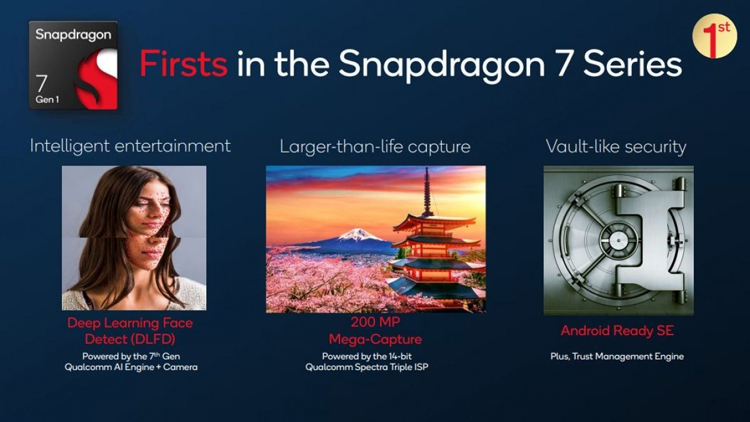
Qualcomm introduced the Snapdragon 7 Gen 1 mobile processor, which will be produced at Samsung's facility using 4-nanometer technology.
The chip is designed for use in very advanced mid-range smartphones.Image source: QualcommThe product combines eight computing cores.
This is one core Cortex-A710 Prime with a clock frequency of 2.4 GHz, three cores Cortex-A710 Performance with a frequency of up to 2.36 GHz and four cores Cortex-A510 Efficiency with a frequency of 1.8 GHz.The equipment includes a graphics gas pedal Adreno 662 and modem Snapdragon X62 5G, which provides data download speeds up to 4.4 Gbit/s.
The processor allows up to 16 GB of memory LPDDR5-3200 and QHD+ displays with a refresh rate of 60 Hz.
It supports photography with a resolution of up to 200 million pixels.Among other things mentioned controllers Wi-Fi 6E and Bluetooth 5.3, support for HDR10 and HDR10 +, as well as aptX Voice, aptX Lossless, aptX Adaptive and LE audio.
Smartphones on the new platform will be able to be equipped with Qualcomm Quick Charge 4+ technology.

Qualcomm introduced an improved flagship processor Snapdragon 8+ Gen 1 for powerful smartphones

Qualcomm introduced an improved flagship processor Snapdragon 8+ Gen 1 for powerful smartphones

Qualcomm introduced an improved flagship processor Snapdragon 8+ Gen 1 for powerful smartphones

Qualcomm announced the Snapdragon 8+ Gen 1 processor, designed for use in flagship smartphones.
The novelty is an improved version of the chip Snapdragon 8 Gen 1.Image source: QualcommThe Snapdragon 8 Gen 1 product combines eight computing cores, including a powerful Kryo Prime core clocked at up to 3.0 GHz, three Kryo Performance cores at 2.5 GHz and four Kryo Efficiency cores at 1.8 GHz.
The new Snapdragon 8+ Gen 1 platform got one Kryo Prime core clocked at up to 3.2 GHz, three Kryo Performance cores at up to 2.8 GHz and four Kryo Efficiency cores at up to 2.0 GHz.The other major components remained the same.
The novelty has a seventh-generation Qualcomm AI Engine, a next-generation Adreno graphics gas pedal with higher clock speeds and a Snapdragon X65 5G modem.
The Snapdragon 8+ Gen 1 processor claims a 10 percent increase in CPU and GPU performance over its predecessor, and a 30 percent improvement in CPU power efficiency.
Also noted a 30% reduction in GPU power consumption.Support for 4K displays with refresh rates up to 60 Hz and QHD+ with refresh rates up to 144 Hz, LPDDR5-3200 RAM, Wi-Fi 6E and Bluetooth 5.3.Devices on the new platform are preparing such companies as ASUS, Black Shark, Honor, iQOO, Lenovo, Motorola, Nubia, OnePlus, OPPO, Realme, RedMagic, Redmi, Vivo, Xiaomi and ZTE.

5.18.2022

Qualcomm has made it into Samsung's top five clients by virtue of its chip contract

Qualcomm has made it into Samsung's top five clients by virtue of its chip contract

Qualcomm has made it into Samsung's top five clients by virtue of its chip contract

In the first quarter of this year, Qualcomm managed to make it into Samsung Electronics' top client list for the first time, according to Korea's Yonhap News agency.
This was helped by an increase in revenue the Korean contractor receives from contract manufacturing services for mobile processors for the U.S.
developer.
Together, the top five customers account for about 14% of Samsung's revenue.Image source: Samsung ElectricsIn the last quarter, Qualcomm swapped places with Verizon on this list, although German telecom operator Deutsche Telekom retained its position among Samsung's largest customers.
Traditionally, competing with the Korean giant Apple is also among its largest partners, because it depends on Samsung in the supply of components for smartphones - the same displays, for example.
Best Buy and Supreme Electronics round out Samsung's top five sources of revenue.In December, Qualcomm executives confirmed that Samsung's 4nm technology will be used to produce the Snapdragon 8 Gen 1 mobile processor.
Now rumors attribute Qualcomm's rejection of the Korean contractor's services in the release of the Qualcomm Snapdragon 8 Gen 1 Plus processor, which will be released this Friday.
It is believed that it will be produced by rival TSMC.
Qualcomm's history of tossing from TSMC to Samsung and back is quite extensive in its content, but in terms of business strategy is intended to diversify the risks of dependence on a single processor supplier.According to TrendForce data for the fourth quarter of last year, TSMC controlled 52.1% of the global market for semiconductor contract manufacturing services, while Samsung Electronics was content with 18.3% of the market.
Last month, representatives of the Korean giant said that there is a high demand for the core services of the company, as well as the reduction of defect rates in the use of advanced technological processes.
Rumors about Samsung's intentions to raise prices for its services by up to 20% have not yet officially commented, but the Korean company's management in recent months is not tired to repeat that the pricing policy should be realistic and take into account the need to invest in expanding and modernizing production.

5.16.2022

Qualcomm to unveil new Snapdragon processors at May 20 presentation

Qualcomm to unveil new Snapdragon processors at May 20 presentation

Qualcomm to unveil new Snapdragon processors at May 20 presentation

Qualcomm has published a teaser announcing that the new Snapdragon processors for smartphones will be unveiled on May 20.
Chips are expected to be announced for mid-range and flagship devices.Image source: QualcommIn particular, according to network sources, the Snapdragon 8 Gen 1+ processor will be presented.
This will be an improved version of the product Snapdragon 8 Gen 1, which combines eight processing cores, including a powerful core Kryo Prime clocked at up to 3.0 GHz, Qualcomm AI Engine seventh generation artificial intelligence, graphics gas pedal Adreno next generation and modem Snapdragon X65 5G.It is expected that one of the first smartphones based on Snapdragon 8 Gen 1 + will unit Motorola Edge X30.
It is also noted that the chip will be produced at TSMC enterprise on 4-nanometer technology.At the upcoming presentation may also be announced processor Snapdragon 7 Gen 1.
It is reportedly configured with four Cortex-A710 cores up to 2.36 GHz and four Cortex-A510 cores up to 1.8 GHz.
Processing of graphics will take Adreno 662 controller.

5.10.2022

Rumor: Snapdragon 8 Gen 2 flagship chip will get a new 5G modem and will be produced by TSMC

Rumor: Snapdragon 8 Gen 2 flagship chip will get a new 5G modem and will be produced by TSMC

Rumor: Snapdragon 8 Gen 2 flagship chip will get a new 5G modem and will be produced by TSMC

By May a number of new season Android flagship smartphones have already appeared on global sales, most of them using the Qualcomm Snapdragon 8 Gen 1 chip.
According to rumors, an improved version of this chip - Snapdragon 8 Gen 1 Plus - will be released soon.
And meanwhile, information about the next generation model - Snapdragon 8 Gen 2 appeared in the Network.Image source: QualcommAccording to the known accurate forecasts informer Digital Chat Station, work on Snapdragon 8 Gen 2 is already actively underway.
The CPU cores of the new chip will be distributed in three clusters according to the scheme \"1+3+4\".
The main core will be a Cortex X-family supercore, it will have three high-performance cores and four energy-efficient.It is expected that the model will get a new 5G-modem X70 with peak download speeds of up to 10 Gbps and an updated neuroprocessor (NPU) for more effective operations related to the AI and machine learning.
The Snapdragon 8 Gen 2 is codenamed SM8550.
According to a source, the production of the mobile platform has been entrusted to Taiwanese manufacturer TSMC.
It is likely to be produced in accordance with the 4-nm process.In addition, it is reported that the release of Snapdragon 8 Gen 1 Plus, not yet on the market, is postponed.
Earlier Qualcomm had planned to introduce the chipset in May, but now it is likely that the final decision will be made in the second half of this year.
Galaxy Z Flip 4 and Fold 4 are expected to be built on the new platform, which will go on sale in August or early September - by that time the product should be ready for industrial use.According to rumors, the postponement is related to the outbreak of COVID-19 infection in China - the closure of factories has disrupted the plans of many companies.